Hold down the T key for 3 seconds to activate the audio accessibility mode, at which point you can click the K key to pause and resume audio. Useful for the Check Your Understanding and See Answers.
 The previous section of Lesson 3 elaborated upon the dependence of current upon the electric potential difference and the resistance. The current in an electrical device is directly proportional to the electric potential difference impressed across the device and inversely proportional to the resistance of the device. If this is the case, then the rate at which that device transforms electrical energy to other forms is also dependent upon the current, the electric potential difference and the resistance. In this section of Lesson 3, we will revisit the concept of power and develop new equations that express power in terms of current, electric potential difference and resistance.
New Equations for Power
In Lesson 2, the concept of electrical power was introduced. Electrical power was defined as the rate at which electrical energy is supplied to a circuit or consumed by a load. The equation for calculating the power delivered to the circuit or consumed by a load was derived to be
P = ΔV • I
(Equation 1)
The two quantities that power depends upon are both related to the resistance of the load by Ohm's law. The electric potential difference (ΔV) and the current (I) can be expressed in terms of their dependence upon resistance as shown in the following equations.
If the expressions for electric potential difference and current are substituted into the power equation, two new equations can be derived that relate the power to the current and the resistance and to the electric potential difference and the resistance. These derivations are shown below.
|
Equation 2:
P = ΔV • I
P = (I • R) • I
P = I2 • R
|
Equation 3:
P = ΔV • I
P = ΔV • (ΔV / R)
P = ΔV2 / R
|
We now have three equations for electrical power, with two derived from the first using the Ohm's law equation. These equations are often used in problems involving the computation of power from known values of electric potential difference (ΔV), current (I), and resistance (R). Equation 2 relates the rate at which an electrical device consumes energy to the current at the device and the resistance of the device. Note the double importance of the current in the equation as denoted by the square of current. Equation 2 can be used to calculate the power provided that the resistance and the current are known. If either one is not known, then it will be necessary to either use one of the other two equations to calculate power or to use the Ohm's law equation to calculate the quantity needed in order to use Equation 2.
Equation 3 relates the rate at which an electrical device consumes energy to the voltage drop across the device and to the resistance of the device. Note the double importance of the voltage drop as denoted by the square of ΔV. Equation 3 can be used to calculate the power provided that the resistance and the voltage drop are known. If either one is not known, then it will be important to either use one of the other two equations to calculate power or to use the Ohm's law equation to calculate the quantity needed in order to use Equation 3.
Concepts Come First
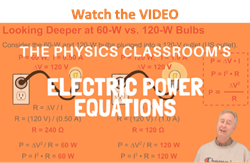
While these three equations provide one with convenient formulas for calculating unknown quantities in physics problems, one must be careful to not misuse them by ignoring conceptual  principles regarding circuits. To illustrate, suppose that you were asked this question: If a 60-watt bulb in a household lamp was replaced with a 120-watt bulb, then how many times greater would the current be in that lamp circuit? Using equation 2, one might reason (incorrectly), that the doubling of the power means that the I2 quantity must be doubled. Thus, current would have to increase by a factor of 1.41 (the square root of 2). This is an example of incorrect reasoning because it removes the mathematical formula from the context of electric circuits. The fundamental difference between a 60-Watt bulb and a 120-Watt bulb is not the current that is in the bulb, but rather the resistance of the bulb. It is the resistances that are different for these two bulbs; the difference in current is merely the consequence of this difference in resistance. If the bulbs are in a lamp socket that is plugged into a United States wall outlet, then one can be certain that the electric potential difference is around 120 Volts. The ΔV would be the same for each bulb. The 120-Watt bulb has the lower resistance; and using Ohm's law, one would expect it also has the higher current. In fact, the 120-Watt bulb would have a current of 1 Amp and a resistance of 120 Ω; the 60-Watt bulb would have a current of 0.5 Amp and a resistance of 240 Ω.
|
Calculations for 120-Watt Bulb
P = ΔV • I
I = P / ΔV
I = (120 W) / (120 V)
I = 1 Amp
ΔV = I • R
R = ΔV / I
R = (120 V) / (1 Amp)
R = 120 Ω
|
Calculations for 60-Watt Bulb
P = ΔV • I
I = P / ΔV
I = (60 W) / (120 V)
I = 0.5 Amp
ΔV = I • R
R = ΔV / I
R = (120 V) / (0.5 Amp)
R = 240 Ω
|
Now using equation 2 properly, one can see why twice the power means that there would be twice the current since the resistance also changes with a bulb change. The calculation of current below yields the same result as shown above.
|
Calculations for 120-Watt Bulb
P = I2 • R
I2 = P / R
I2 = (120 W) / (120 Ω)
I2 = 1 W / Ω
I = SQRT ( 1 W / Ω )
I = 1 Amp
|
Calculations for 60-Watt Bulb
P = I2 • R
I2 = P / R
I2 = (60 W) / (240 Ω)
I2 = 0.25 W / Ω
I = SQRT ( 0.25 W / Ω )
I = 0.5 Amp
|
Check Your Understanding
1. Which would be thicker (wider) - the filament of a 60-Watt light bulb or the filament of a 100-W light bulb? Explain.
See Answer

The resistance of a light bulb filament is effected by both length and cross-sectional area. Thicker wires have less resistance. A 120-Watt bulb has a greater current and a smaller resistance. Thus, a 120-Watt bulb must have a thicker filament than a 60-Watt bulb (assuming the lengths of the filaments are identical).
2. Calculate the resistance and the current of a 7.5-Watt night light bulb plugged into a US household outlet (120 V).
See Answer
Answers: I = 0.0625 Amp and R = 1920 Ω
Given:
 V = 120 V (true for US household outlets)
P = 7.5 W
Find: I and R
Use the P = V • I equation to calculate the current:
I = P / V = (7.5 W) / (120 V)
I = 0.0625 Amp
Now since current is known, use the Ohm's law equation (V = I • R) to calculate the resistance:
R = V / I= (120 V) / (0.0625 Amp)
R = 1920 Ω
3. Calculate the resistance and the current of a 1500-Watt electric hair dryer plugged into a US household outlet (120 V).
See Answer
Answers: I = 12.5 Amp and R = 9.6 Ω
Given:
ΔV = 120 V (true for US household outlets)
P = 1500 W
Find: I and R
Use the P = ΔV • I equation to calculate the current:
I = P / ΔV = (1500 W) / (120 V)
I = 12.5 Amp
Now since current is known, use the Ohm's law equation (ΔV = I • R) to calculate the resistance:
R = ΔV / I = (120 V) / (12.5 Amp)
R = 9.6 Ω
4. The box on a table saw indicates that the amperage at startup is 15 Amps. Determine the resistance and the power of the motor during this time.
See Answer
Answers: R = 8 Ω and P = 1800 W
Given:
ΔV = 120 V (true for US household outlets)
I = 15 A
Find: R and P
Use the Ohm's law equation (ΔV = I • R) to calculate the resistance:
R = ΔV / I= (120 V) / (15 Amp)
R = 8 Ω
Now calculate power using any one of the three equations:
P = I • ΔV = (15 A) • (120 V)
P = 1800 W
5. The sticker on a compact disc player says that it draws 288 mA of current when powered by a 9 Volt battery. What is the power (in Watts) of the CD player?
See Answer
Answer: P = 2.59 W
Given:
ΔV = 9 V
I = 288 mA = 0.288 Amp
Find: P
P = I • ΔV = (0.288 A) • (9 V)
P = 2.59 W
6. A 541-Watt toaster is connected to a 120-V household outlet. What is the resistance (in ohms) of the toaster?
See Answer
A 541-Watt toaster is connected to a 120-V household outlet. What is the resistance (in ohms) of the toaster?
Answer: R = 26.6 Ω
Given:
ΔV = 120 V (true for US household outlets)
P = 541 W
Find: R
Use the P = ΔV2 / R equation to calculate the resistance:
R = ΔV2 / P = (120 V)2 / (541 W)
R = 26.6 Ω
7. A color TV has a current of 1.99 Amps when connected to a 120-Volt household circuit. What is the resistance (in ohms) of the TV set? And what is the power (in Watts) of the TV set?
See Answer
Answers: R = 60.3 Ω and P = 239 W
Given:
ΔV = 120 V (true for US household outlets)
I = 1.99 A
Find: R and P
First use the Ohm's law equation (ΔV = I • R) to calculate the resistance:
R = ΔV / I= (120 V) / (1.99 Amp)
R = 60.3 Ω
Now any one of the three power equations can be used to determine the power. The P = I2 • R equation will be used here:
P = I2 • R = (1.99 A)2 • (60.3  )
)
P = 239 W