Hold down the T key for 3 seconds to activate the audio accessibility mode, at which point you can click the K key to pause and resume audio. Useful for the Check Your Understanding and See Answers.
So what's the
big deal? Many people have known
Newton's first law since eighth grade (or earlier). And if prompted with the first few words, most people could probably recite the law word for word. And what is so terribly difficult about remembering that
F = ma? It seems to be a simple algebraic statement for solving story problems. The
big deal however is not the ability to recite the first law nor to use the second law to solve problems; but rather the ability to understand their meaning and to
believe their implications. While most people know what Newton's laws say, many people do not know what they mean (or simply do not
believe what they mean).
Learning ≠ Storing
 Cognitive scientists (scientists who study how people learn) have shown that physics students come into physics class with a set of beliefs that they are unwilling (or not easily willing) to discard despite evidence to the contrary. These beliefs about motion (known as misconceptions) hinder further learning. The task of overcoming misconceptions involves becoming aware of the misconceptions, considering alternative conceptions or explanations, making a personal evaluation of the two competing ideas and adopting a new conception that is more reasonable than the previously held-misconception. This process involves self-reflection (to ponder your own belief systems), critical thinking (to analyze the reasonableness of two competing ideas), and evaluation (to select the most reasonable and harmonious model that explains the world of motion). Self-reflection, critical thinking, and evaluation. While this process may seem terribly complicated, it is simply a matter of using your noodle (that's your brain).
 The most common misconception is one that dates back for ages; it is the idea that sustaining motion requires a continued force. The misconception has already been discussed in a previous lesson, but will now be discussed in more detail. This misconception sticks out its ugly head in a number of different ways and at a number of different times. As you read through the following discussion, give careful attention to your own belief systems. View physics as a system of thinking about the world rather than information that can be dumped into your brain without evaluating its consistency with your own belief systems.
Newton's laws declare loudly that a net force (an unbalanced force) causes an acceleration; the acceleration is in the same direction as the net force. To test your own belief system, consider the following question and its answer as seen by clicking the button.
Are You Infected with the Misconception?
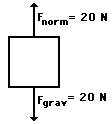 Two students are discussing their physics homework prior to class. They are discussing an object that is being acted upon by two individual forces (both in a vertical direction); the free-body diagram for the particular object is shown at the right. During the discussion, Anna Litical suggests to Noah Formula that the object under discussion could be moving. In fact, Anna suggests that if friction and air resistance could be ignored (because of their negligible size), the object could be moving in a horizontal direction. According to Anna, an object experiencing forces as described at the right could be experiencing a horizontal motion as described below.

Noah Formula objects, arguing that the object could not have any horizontal motion if there are only vertical forces acting upon it. Noah claims that the object must be at rest, perhaps on a table or floor. After all, says Noah, an object experiencing a balance of forces will be at rest. Who do you agree with?
See Answer

Anna is correct.
Noah Formula may know his formulas but he does not know (or does not believe) Newton's laws. If the forces acting on an object are balanced and the object is in motion, then it will continue in motion with the same velocity. Remember: forces do not cause motion. Forces cause accelerations.
Remember last winter when you went sledding down the hill and across the level surface at the local park? (Apologies are extended to those who live in warmer winter climates.)
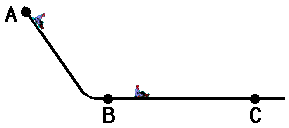
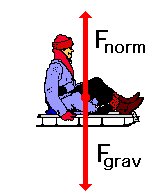 Imagine a the moment that there was no friction along the level surface from point B to point C and that there was no air resistance to impede your motion. How far would your sled travel? And what would its motion be like? Most students I've talked to quickly answer: the sled would travel forever at constant speed. Without friction or air resistance to slow it down, the sled would continue in motion with the same speed and in the same direction. The forces acting upon the sled from point B to point C would be the normal force (the snow pushes up on the sled) and the gravity force (see diagram at right). These forces are balanced and since the sled is already in motion at point B it will continue in motion with the same speed and direction. So, as in the case of the sled and as in the case of the object that Noah and Anna are discussing, an object can be moving to the right even if the only forces acting upon the object are vertical forces. Forces do not cause motion; forces cause accelerations.
Newton's First Law - Revisited
Newton's first law of motion declares that a force is not needed to keep an object in motion. Slide a book across a table and watch it slide to a rest position. The book in motion on the table top does not come to a rest position because of the absence of a force; rather it is the presence of a force - that force being the force of friction - that brings the book to a rest position. In the absence of a force of friction, the book would continue in motion with the same speed and direction - forever (or at least to the end of the table top)! A force is not required to keep a moving book in motion; and a force is not required to keep a moving sled in motion; and a force is not required to keep any object horizontally moving object in motion. To read more about this misconception, return to an earlier lesson.

We Would Like to Suggest ...

Sometimes it isn't enough to just read about it. You have to interact with it! And that's exactly what you do when you use one of The Physics Classroom's Interactives. We would like to suggest that you combine the reading of this page with the use of our
Rocket Sledder Interactive. You can find it in the Physics Interactives section of our website. The
Rocket Sledder allows a learner to explore the effect of balanced and unbalanced forces upon the acceleration of a rocket-propelled sledder.