Ray Optics: Refraction and Lenses
Refraction and Lenses: Audio Guided Solution
Problem 17:
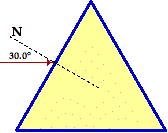 Strontium titanate (SrTiO3) is a rare oxide mineral found naturally in tausonite crystals in Siberia. Because it has an index of refraction (n = 2.41) value similar to that of diamond, it is often used as a diamond substitute. Were it not for its greater physical density and its greater softness (it shows abrasions and scratches much more commonly under a microscope), a jeweler would have difficulty distinguishing between diamond and strontium titanate.
The triangular prism at the right is made of strontium titanate. A ray of light in air approaches the boundary at an angle of incidence of 30.0°. The ray strikes at the midpoint of one of the faces of the triangle.
a. Determine the angle of refraction upon entering into the prism.
b. Use geometric principles to determine the angle of incidence at the opposite side of the triangle.
c. Will the light ray refract out of the prism at this opposite face or will it undergo total internal reflection? Do the calculation and explain the answer.
Audio Guided Solution
Habits of an Effective Problem Solver
-
Read the problem carefully and develop a mental picture of the physical situation. If necessary, sketch a simple diagram of the physical situation to help you visualize it.
-
Identify the known and unknown quantities and record them in an organized manner. Equate given values to the symbols used to represent the corresponding quantity - e.g., do = 24,8 cm; di = 16.7 cm; f = ???.
-
Use physics formulas and conceptual reasoning to plot a strategy for solving for the unknown quantity.
-
Identify the appropriate formula(s) to use.
-
Perform substitutions and algebraic manipulations in order to solve for the unknown quantity.
Read About It!
Get more information on the topic of Refraction and Lenses at The Physics Classroom Tutorial.
Return to Problem Set
Return to Overview
View Audio Guided Solution for Problem:
1 |
2 |
3 |
4 |
5 |
6 |
7 |
8 |
9 |
10 |
11 |
12 |
13 |
14 |
15 |
16 |
17 |
18 |
19 |
20 |
21 |
22 |
23 |
24 |
25 |
26 |
27 |
28 |
29 |
30 |
31 |
32