Suppose that you were given a small light bulb, an electrochemical cell and a bare copper wire and were asked to find the four different arrangements of the three items that would result in the formation of an electric circuit that would light the bulb. What four arrangements would result in the successful lighting of the bulb? And more importantly, what does each of the four arrangements have in common that would lead us into an understanding of the two requirements of an electric circuit?
The activity itself is a worthwhile activity and if not performed before, one ought to try it before reading further. Like many lab activities, there is power in the actual engagement in the activity that cannot be replaced by simply reading about it. When this activity is performed in the physics classroom, there are numerous observations that can be made by watching a class full of students eager to find the four arrangements. The following arrangements are often tried and do not result in the lighting of the bulb.
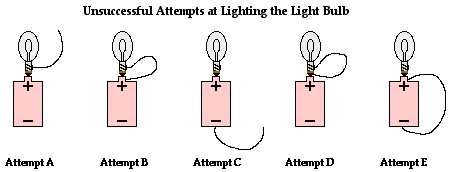
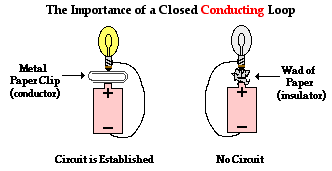
After a few minutes of trying, several healthy chuckles, and an occasional exclamation of how hot the wire is getting, a couple of students become successful at lighting the bulb. Unlike the above attempts, the first successful attempt is 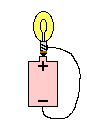 characterized by the production of a complete conducting loop from the positive terminal to the negative terminal, with both the battery and the light bulb being part of the loop. As shown in the diagram at the right, the base of the light bulb connects to the positive terminal of the cell and the wire extends from the ribbed sides of the light bulb down to the negative terminal of the cell. A complete conducting loop is made with the light bulb being part of the loop. A circuit exists and charge flows along the complete conducting path, lighting the bulb in the process. Compare the arrangement of the cell, bulb and wire at the right to the unsuccessful arrangements shown above. In attempt A, the wire does not loop back to the negative terminal of the cell. In attempt B, the wire does form a loop but not back to the negative terminal of the cell. In attempt C, there is no complete loop at all. Attempt D resembles attempt B in that there is a loop but not from the positive terminal to the negative terminal. And in attempt E, there is a loop and it does go from positive terminal to negative terminal; this is a circuit but the light bulb is not included as part of it. CAUTION: Attempt E will cause your fingers to get hot as you hold the bare wire and charge begins to flow at a high rate between the positive and negative terminals.
Light Bulb Anatomy
 Once one group of students successfully lights the bulb, many other lab groups quickly follow suit. But then the question emerges as to what other ways that the cell, bulb and bare wire can be arranged in such a manner as to light the bulb. Often a short light bulb anatomy lesson prompts the lab groups into a quick discovery of one or more of the remaining arrangements.
A light bulb is a relatively simple device consisting of a filament resting upon or somehow attached to two wires. The wires and the filament are conducting materials that allow charge to flow through them. One wire is connected to the ribbed sides of the light bulbs. The other wire is connected to the bottom base of the light bulb. The ribbed edge and the bottom base are separated by an insulating material that prevents the direct flow of charge between the bottom base and the ribbed edge. The only pathway by which charge can make it from the ribbed edge to the bottom base or vice versa is the pathway that includes the wires and the filament. Charge can either enter the ribbed edge, make the pathway through the filament and exit out the bottom base; or it can enter the bottom base, make the pathway through the filament and exit out the ribbed edge. As such, there are two possible entry points and two corresponding exit points.
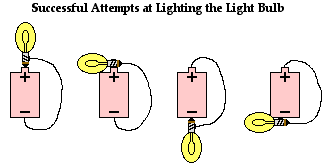
The successful means of lighting the bulb as shown above involved placing the bottom base of the bulb on the positive terminal and connecting the ribbed edge to the negative terminal using a wire. Any charge that enters the light bulb at the bottom base exits the bulb at the location where the wire makes contact with the ribbed edge. Yet the bottom base does not have to be the part of the bulb that touches the positive terminal. The bulb will light just as easily if the ribbed edge is placed on top of the positive terminal and the bottom base is connected to the negative terminal using a wire. The final two arrangements that lead to a lit light bulb involve placing the bulb at the negative terminal of the cell, either by making contact to it with the ribbed edge or with the bottom base. A wire must then connect the other part of the bulb to the positive terminal of the cell.
The Requirement of a Closed Conducting Path
There are two requirements that must be met to establish an electric circuit. The first is clearly demonstrated by the above activity. There must be a closed conducting path that extends from the positive terminal to the negative terminal. It is not enough that there is simply a closed conducting loop; the loop itself must extend from the positive terminal to the negative terminal of the electrochemical cell. An electric circuit is like a water circuit at a water park. The flow of charge through wires is similar to the flow of water through the pipes and along the slides at a water park. If a pipe gets plugged or broken such that water cannot make the complete path through the circuit, then the flow of water will soon cease. In an electric circuit, all connections must be made and made by conducting materials capable of carrying charge. As the cell, bulb and wire experiment continues, some students explore the capability of various materials to carry a charge by inserting them in their circuit. Metallic materials are conductors and can be inserted into the circuit to successfully light the bulb. On the other hand, paper and plastic materials are typically insulators and their insertion within the circuit will hinder the flow of charge to such a degree that the current ceases and the bulb no longer lights. There must be a closed conducting loop from the positive to the negative terminal in order to establish a circuit and to have a current.
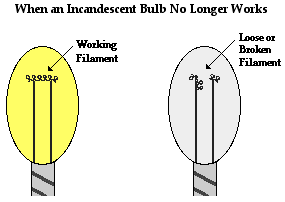
With an understanding of this first requirement of an electric circuit, it becomes clear what is happening when an incandescent light bulb in a table lamp or floor lamp no longer works. Over time, a light bulb filament becomes weak and brittle can often break or simply become loose. When this occurs, the circuit is opened and a closed conducting loop no longer exists. Without a closed conducting loop, there can be no circuit, no charge flow and no lit bulb. Next time you find a broken bulb in a lamp, safely remove it and inspect the filament. Often times, shaking the removed bulb will cause a rattle; the filament has likely fallen off the supporting posts that it normally rests upon to the bottom of the glass globe. When shook, you will hear the rattle of the filament hitting the glass globe.
The Requirement of an Energy Supply
The second requirement of an electric circuit that is common in each of the successful attempts demonstrated above is that there must be an electric potential difference across the two ends of the circuit. This is most commonly established by the use of an electrochemical cell, a pack of cells (i.e., a battery) or some other energy source. It is essential that there is some source of energy capable of increasing the electric potential energy of a charge as it moves from the low energy terminal to the high energy terminal. 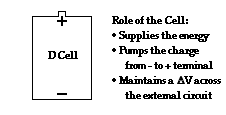 As discussed in Lesson 1, it takes energy to move a positive test charge against the electric field. As applied to electric circuits, the movement of a positive test charge through the cell from the low energy terminal to the high energy terminal is a movement against the electric field. This movement of charge demands that work be done on it in order to lift it up to the higher energy terminal. An electrochemical cell serves the useful role of supplying the energy to do work on the charge in order to pump it or move it through the cell from the negative to the positive terminal. By doing so, the cell establishes an electric potential difference across the two ends of the electric circuit. (The concept of an electric potential difference and its application to electric circuits was discussed in detail in Lesson 1.)
In household circuits, the energy is supplied by a local utility company that is responsible for making sure that the hot and the neutral plates within the circuit panel box of your home always have an electric potential difference of about 110 Volts to 120 Volts (in the United States). In typical lab activities, an electrochemical cell or group of cells (i.e., a battery) is used to establish an electric potential difference across the two ends of the external circuit of about 1.5 Volts (a single cell) or 4.5 Volts (three cells in a pack). Analogies are often made between an electric circuit and the water circuit at a water park or a roller coaster ride at an amusement park. In all three cases, there is something that is moving through a complete loop - that is, through a circuit. 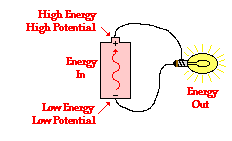 And in all three cases, it is essential that the circuit include a section where energy is put into the water, the coaster car or the charge in order to move it uphill against its natural direction of motion from a low potential energy to a high potential energy. A water park ride has a water pump that pumps the water from ground level to the top of the slide. A roller coaster ride has a motor-driven chain that carries the train of coaster cars from ground level to the top of the first drop. And an electric circuit has an electrochemical cell, battery (group of cells) or some other energy supply that moves the charge from ground level (the negative terminal) to the positive terminal. By constantly supplying the energy to move the charge from the low energy, low potential terminal to the high energy, high potential terminal, and a continuous flow of charge can be maintained.
By establishing this difference in electric potential, charge is able to flow downhill through the external circuit. This motion of the charge is natural and does not require energy. Like the movement of water at a water park or a roller coaster car at an amusement park, the downhill motion is natural and occurs without the need for energy from an external source. It is the difference in potential - whether gravitational potential or electric potential - that causes the water, the coaster car and the charge to move. This potential difference requires the input of energy from an external source. In the case of an electric circuit, one of the two requirements to establish an electric circuit is an energy source.
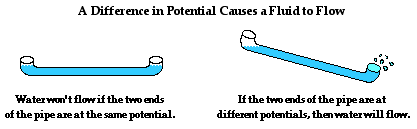
In conclusion, there are two requirements that must be met in order to establish an electric circuit. The requirements are
- There must be an energy supply capable doing work on charge to move it from a low energy location to a high energy location and thus establish an electric potential difference across the two ends of the external circuit.
- There must be a closed conducting loop in the external circuit that stretches from the high potential, positive terminal to the low potential, negative terminal.
Check Your Understanding
1. If an electric circuit could be compared to a water circuit at a water park, then the ...
... battery would be analogous to the ____.
... positive terminal of the battery would be analogous to the ____.
... current would be analogous to the ____.
... charge would be analogous to the ____.
... electric potential difference would be analogous to the ____.
Choices:
|
A. water pressure
|
B. gallons of water flowing down slide per minute
|
|
C. water
|
D. bottom of the slide
|
|
E. water pump
|
F. top of the slide
|
See Answer

If an electric circuit could be compared to a water circuit at a water park, then the ...
... battery would be analogous to the water pump (E).
... positive terminal of the battery would be analogous to the top of the slide (F).
... current would be analogous to the gallons of water flowing down the slide per minute (B).
... charge would be analogous to the water (C).
... electric potential difference would be analogous to the water pressure (A).
{^cosymantecnisbfw^}
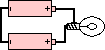
2. Utilize your understanding of the requirements of an electric circuit to state whether charge would flow through the following arrangements of cells, bulbs, wires and switches. If there is no charge flow, then explain why not.
|
a.

|
b.

|
|
Charge Flow: Yes or No?
Explanation:
|
Charge Flow: Yes or No?
Explanation:
|
|
c.

|
d.
|
|
Charge Flow: Yes or No?
Explanation:
|
Charge Flow: Yes or No?
Explanation:
|
See Answer
|
a.

|
b.

|
|
Charge Flow: No
Explanation:
The switch is in the open position, so there is no closed conducting loop.
|
Charge Flow: No
Explanation:
There is no closed conducting loop from + to - terminal.
|
|
c.

|
d.

|
|
Charge Flow: Yes
Explanation:
In this case, there is a closed conducting loop stretching from the + to the - terminal. Thus, there is a charge flow. However, the flow does not pass through the light bulb and so the bulb will not light.
|
Charge Flow: Maybe
Explanation:
If two cells are pumping charge in opposite directions as indicated by the fact that there + terminals are connected to each other. If they have different voltage ratings (e.g., 1.5 V and 9 V), then there will be a charge flow. However, if their voltage ratings are identical, then there will be no charge flow.
|
3. The diagram at the right shows a light bulb connected to a 12-V car battery. The + and - terminals are shown.
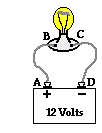 a. As a + charge moves through the battery from D to A, it ________ (gains, loses) potential energy and ________ (gains, loses) electric potential. The point of highest energy within a battery is the ______ (+, -) terminal.
b. As a + charge moves through the external circuit from A to D, it ________ (gains, loses) potential energy and ________ (gains, loses) electric potential. The point of highest energy within the external circuit is closest to the ______ (+, -) terminal.
c. Use >, <, and = signs to compare the electric potential (V) at the four points of the circuit.
VA  VB VC VD
See Answer
a. As a positive charge moves through the battery from D to A, it gains potential energy and gains electric potential. The point of highest energy within a battery is the positive terminal.
b. As a positive charge moves through the external circuit from A to D, it loses potential energy and loses electric potential. The point of highest energy within the external circuit is closest to the positive terminal.
c. 
4. In the movie Tango and Cash, Kurt Russell and Sylvester Stallone escape from a prison by jumping off the top of a tall wall through the air and onto a high-voltage power line. Before the jump, Stallone objects to the idea, telling Russell "We're going to fry." Russell responds with "You didn't take high school Physics did you. As long as you're only touching one wire and you're feet aren't touching the ground, you don't get electrocuted." Is this a correct statement?
See Answer
Answer: Yes!
In order for there to be a sustained flow of charge from one location to another, there must be a difference in electric potential. In this case, there would be a momentary flow of charge between the wire and the actor until they reach the same electric potential. Once at the same potential, charge flow would cease and there would be no electrocution. However, if the actor's feet touched the ground (an electric potential of 0) or another wire of a different potential, then there would be a sustained charge flow which likely would lead to electrocution.