Static Electricity Audio Guided Solution SE10Q4
 Problem Set SE10, Question 4:
Two 1.47 gram balloons are suspended by strings that are 166 cm long. The two balloons establish equilibrium with an angle between the two strings of 13.1 degrees. Determine the charge (in Coulombs) on each balloon. Assume the same amount of charge is on each balloon.
Audio Guided Solution
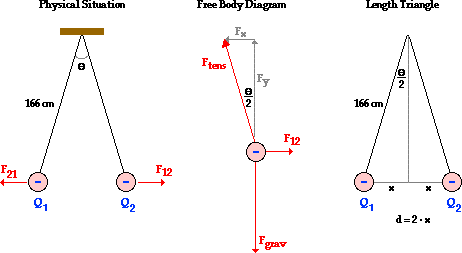
Problem 19 is a relatively complex analysis involving the hanging of two balloons of no mass by strings from the same point on the ceiling. The two balloons establish equilibrium and the angle between the strings is 13.1 degrees. I have called this theta in the diagram that I have drawn. We are to determine the charge on each balloon. Given that the length of the string is 166 centimeters. When you get a problem such as this you always have to begin to think about what is the charge related to. It is related to one of two things either the electric field or the electric force. What in this problem can be related to the electric force? That is where the free body diagram comes in. There is a balloon hanging at rest and it encounters three forces. Let's consider the balloon I have labeled as balloon number 2 or Q2. There is the tension force in the string directed upwards at an angle with respect to the vertical that is one half of 13.1 degrees. Then there is F grab downwards which is the mass of the balloon in kilograms multiplied by G. And then there is the electrical force of object 1 pushing on object 2 which I have labeled as F12. If at equilibrium these three forces must balance each other the problem has to do with the tension. We need to take that tension force and break it up into an X and a Y component. Once done we can forget about tension and think of that tension as being substituted for by two forces FY and FX. Once done you can think of F12 the electrical force balancing FX and FY balancing F grab. If you know the mass of the balloon you know F grab and you can calculate that. It is .00147 kilograms times 9.8. Once found that gives you FY. Now you will notice the force triangle in the free body diagram with FY being the side adjacent to the theta half angle where theta half is 13.1 divided by 2. And FX is the side that we would really like to find because it is related to electrical force. So we say the tangent of this 6.55 half of 13.1 degrees is equal to FX over FY where FY is known as the gravity force. So I can rearrange that to say FX is equal to the tangent of 6.55 times the value of FY. That gives me FX and that is equal to electrical force. Now I have the task of determining from electrical force the quantity of charge on each balloon. We are told it is the same amount of charge so when you use Coulomb's law expression the Q1 times Q2 can be substituted for by just the Q squared. So we have this electrical force the FX component equal to K which we know multiplied by Q squared our unknown divided by D squared the distance between the centers of the balloons which we don't know. However if you make a right triangle with distances a length triangle the 166 centimeters is the length of the string will be the hypotenuse of that right triangle one of whose sides is 6.55 degrees half of the original distance between the angle between the strings. Now I can say the tangent of that 6.55 degrees is X divided by 166 centimeters and solve that for X and when I do I can double it and get the distance between the centers of the balloons. That can get squared and placed in the denominator of the Coulomb's law expression and so now you can say F electrical is equal to K which is known as 9 times 9 times Q squared divided by that distance that you just calculated squared. Now you can solve for Q squared and take the square root of it to get Q in Coulomb's and that would be your final answer. Good luck.
Solution
1.62 x 10⁻⁷ C
(rounded from 1.623562... x 10-7 C)
Habits of an Effective Problem Solver
An effective problem solver by habit approaches a physics problem in a manner that reflects a collection of disciplined habits. An effective problem-solver...
- ... reads the problem carefully and develops a mental picture of the physical situation. If necessary, sketches a simple diagram of the physical situation to help visualize it.
- ... identifies the known and unknown quantities; records them in an organized manner. A diagram is a great place to record such information. Equates given values to the symbols used to represent the corresponding quantity - e.g., Q1 = 2.4 μC; Q2 = 3.8 μC; d = 1.8 m; Felect = ???.
- ... uses physics formulas and conceptual reasoning to plot a strategy to solve for the unknown quantity.
- ... identifies the appropriate formula(s) to use.
- ... performs substitutions and algebraic manipulations in order to solve for the unknown quantity.
Read About It!
Get more information on the topic of Static Electricity at The Physics Classroom Tutorial.
Watch It!
Try our YouTube video on the topic of ...