Static Electricity Audio Guided Solution SE11Q2
Problem Set SE11, Question 2:
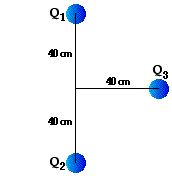 Three charges are arranged as shown. It is known that
Q1 = -7.0 nC;
Q2 = -4.0 nC;
Q3 = -5.0 nC.
(1 nC = 1 nanoCoulomb = 1x10⁻⁹ C)
a. Calculate the magnitude of the net electrostatic force on Q3.
b. Calculate the direction of the net electrostatic force on Q3. Express as a counterclockwise angle (in degrees) of rotation from due East.
Audio Guided Solution
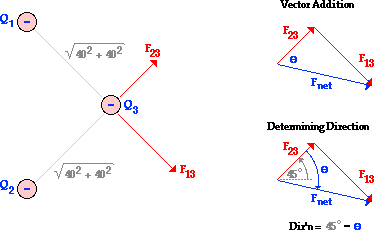
Problems 4 and 5 go together, so we'll use the same audio help file for each of these. These two problems are just excellent problems that bring together some vector principles with principles having to do with Coulomb's law in electric force. There's a configuration of three charges, and you have to perform a complex analysis to determine the net electric force on charge Q3. Approaching this problem demands that you have a really good understanding of what's going on visually. That means you need to construct a diagram. This is not a one-step problem. There's no simple shortcuts. You have to have a good diagram and a good understanding of strategy as to how to get from known information to unknown information. You have the values of the quantities of charge on your three objects, and you have some distance information. You wish to find the net electric force on Q3. Now Q1 will repel Q3, since they have like charges, and Q2 will repel Q3, since they have like charge. So what you will do is calculate these two forces of repulsion. You've seen I've drawn that on the diagram, and that's the way you should approach it as well, using the diagram and adding to it. Now I can calculate these values. F13 is calculable because I know Q1 and Q3 and the distance between them. And F23 can be calculated because I know the values of the charges and the distance between them. Now I'll talk a little bit about the distance first. You'll notice that it's an isosceles triangle, and that we can find the hypotenuse of the right triangle formed by Q1, Q3, and the midpoint of the Q1, Q2 line segment. Using Pythagorean theorem, it would just be the square root of 40 squared plus 40 squared, since 40 and 40 are the sides of the right triangle. I can do the same thing for the distance from 2 to 3, and I now know the distance in centimeters. I should convert that to meters though, or I'm going to have a wrong answer. So do that conversion to meters. Now once you get that distance, you need to know the charges, Q1 and Q3, in order to find F1 on 3. The charges are given in nanocoulombs, and a nanocoulomb is simply 1 times 10 to the negative 9th coulombs. So when you go to use Coulomb's Law to calculate the force of 1 on 3, then you go K, 9 times 10 to the 9th, times Q1, 7 times 10 to the negative 9th, times Q3, 5 times 10 to the negative 9th, divided by the distance in meters squared. That gets you the force of 1 on 3, and you can repeat the process for the force of 2 on 3, also repulsive force, as shown on the diagram. To say that 2 repels 3 or 1 repels 3 means it pushes it away. So I've drawn the forces on the diagram, I've now calculated the two individual forces, I should write them down and not round them. Now what I wish to find is the net electric force by means of vector addition, and you'll notice I've drawn a vector addition diagram, adding F2,3 and F1,3 in head-to-tail fashion, and drawing the resultant from the tail of the first and the head of the last. That's just sound vector principles. Now to determine the net electric force, I simply use the Pythagorean Theorem. This is fortunate because F2,3 and F1,3 are at right angles to each other, as you can tell from the geometry of the situation, and Q1, Q3 and Q2 form a right isosceles triangle, and so F2,3 and F1,3 are at right angles to one another. So finding F-net for problem 4 is simply the use of Pythagorean Theorem as a third step after you've found F2,3 and F1,3. Now problem 4 asks you for the direction of this net force, using it counterclockwise from East Convention. So you'll notice that I have redrawn F2,3 and F1,3 in the diagram, and what I happen to know about F2,3 is it makes a 45 degree angle north of east. I know that from the fact that it's a right isosceles triangle, and so F2,3 is along the 45 degree angle there. Now I can find theta using tangent function. Theta is the inverse tangent of the side opposite F1,3 over the side adjacent F2,3, and because I can use tangent to find theta, I can use 45 degrees and theta to determine the direction. Now depending on your numbers, theta may be less than 45 degrees. So if theta is less than 45 degrees, what you can do with theta is subtract it from 45 and get your direction, it will be a very small angle. If theta is greater than 45 degrees as shown in the diagram, then that means that your F-net is in the fourth quadrant, and you can find F-net by first going 45 minus theta. That will give you a negative value if theta is greater than 45. That means that value that you found for theta is the number of degrees south of east. So to find the counterclockwise from east direction, you simply subtract that from 360, and that gives you your counterclockwise from east direction. That's a complex problem. Good luck.
Solution
a. 1.1 x 10⁻⁶ N (rounded from 1.1337549... x 10-6 N)
b. 350.54° CCW (rounded from 350.5376778...° CCW)
Habits of an Effective Problem Solver
An effective problem solver by habit approaches a physics problem in a manner that reflects a collection of disciplined habits. An effective problem-solver...
- ... reads the problem carefully and develops a mental picture of the physical situation. If necessary, sketches a simple diagram of the physical situation to help visualize it.
- ... identifies the known and unknown quantities; records them in an organized manner. A diagram is a great place to record such information. Equates given values to the symbols used to represent the corresponding quantity - e.g., Q1 = 2.4 μC; Q2 = 3.8 μC; d = 1.8 m; Felect = ???.
- ... uses physics formulas and conceptual reasoning to plot a strategy to solve for the unknown quantity.
- ... identifies the appropriate formula(s) to use.
- ... performs substitutions and algebraic manipulations in order to solve for the unknown quantity.
Read About It!
Get more information on the topic of Static Electricity at The Physics Classroom Tutorial.