Momentum, Collisions and Explosions Audio Guided Solution MC4Q7
Problem Set MC4, Question 7:
A baseball batter was able to impart to a 6.21 N-s impulse to a 0.143-kg baseball thrown at 60 mph, before receiving instruction. After improving his follow-through, the batter has been able to increase the impulse by 10.7%. What will be the new speed of the ball leaving the bat (in m/s) with this greater impulse? (Use 1.0 m/s = 2.24 mi/hr)
Audio Guided Solution
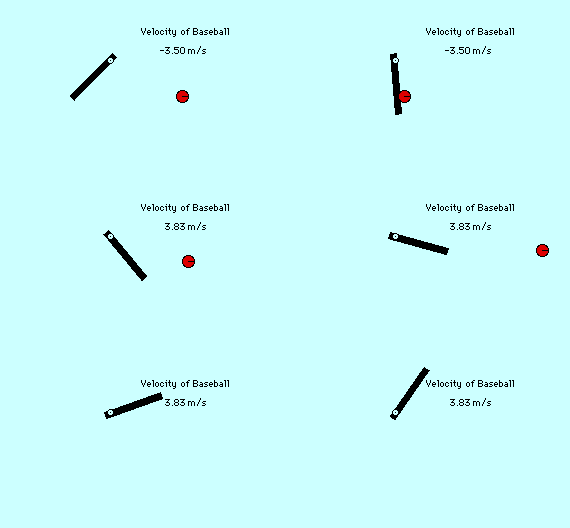
This problem is one of those what's going on here problems where you read the problem and you have no idea what they're asking for. So as I read through it, listen carefully and think about what's going on. And we'll get through this pretty easily because the mathematics is not that difficult. A baseball batter was at one time able to impart a 6.21 newton per time second impulse to a .143 kilogram baseball that was thrown at 60 miles per hour. This is our former baseball player. That's what he was able to do. He was able to swing a bat at a ball that was coming towards him at 60 miles per hour and he was able to give that type of impulse to cause some sort of m-delta-v or momentum change in the baseball. But things have now changed because this student, this baseball batter, has received instruction. And after improving his follow through, the batter's been able to increase the impulse from the 6.21 newtons per time second by 10.7%. It's going to be more than 6.21 newtons per time second now. In fact, 10.7% more. The question will be, what will be the post-collision speed of the ball after it leaves the bat, after the batter's received this instruction? You'll need to use some converting factors on that 60 miles per hour to convert it to meters per second. Use the fact that one meter per second equals 2.24 miles per hour. Okay, now, the first thing we need to do is we need to find the new impulse that the batter's able to impart to a ball. So take the 6.21 and make it 10.7% greater. Think about how you're going to do that. The best way is to multiply by 1.107. That would make it 10.7% greater. Another way to do it is to take 6.21 and multiply it by 0.107 to get 10.7% of it and add it on to 6.21. Anyway, get that new impulse. Now, that new impulse, label it Ft, it's going to give an m-delta-v. Now, if you could only get the delta-v, you could probably figure out the post-collision velocity of this ball. It's not going to be too hard to get the delta-v, because Ft equals m-delta-v. You've got your new Ft, and there's the m.143. Get the delta-v. That delta-v represents the change in velocity of the baseball. Now, the velocity is a vector and it has a direction, so you have to imagine the baseball coming at you at 60 miles per hour, slowing down to zero and heading back the other way. Now, we need to convert that 60 miles per hour to meters per second, so divide it by 2.24 and get a meter per second value. Write that down as v-initial. Now, delta-v equals v-final minus v-initial. Now, what you can do is plug in your v-initial and calculate a v-final. It should be negative if you're plugging in a positive v-initial. All that negative means is it turned around and went back the other way. That's a good thing if you're a batter. And so, take the absolute value of it, because that will make it a speed, enter it as your answer, and be happy. Good luck.
Solution
21.3 m/s
(rounded from 21.28750 ... m/s)
Habits of an Effective Problem Solver
An effective problem solver by habit approaches a physics problem in a manner that reflects a collection of disciplined habits. An effective problem-solver...
- ...reads the problem carefully and develops a mental picture of the physical situation. If needed, they sketch a simple diagram of the physical situation to help visualize it.
- ...identifies the known and unknown quantities in an organized manner, often times recording them on the diagram itself. Then equate given values to the symbols used to represent the corresponding quantity (e.g., vo = 0 m/s; a = 4.2 m/s/s; vf = 22.9 m/s; d = ???.).
- ...plots a strategy for solving for the unknown quantity; the strategy will typically center around the use of physics equations be heavily dependent upon an understanding of physics principles.
- ...identifies the appropriate formula(s) to use, often times writing them down. Where needed, they perform the needed conversion of quantities into the proper unit.
- ...performs substitutions and algebraic manipulations in order to solve for the unknown quantity.
Read About It!
Get more information on the topic of Momentum and Collisions at The Physics Classroom Tutorial.
Watch It!
Try our YouTube video on the topic of ...