Sounds Waves Audio Guided Solution SW22Q1
Problem Set SW22, Question1:
A closed organ pipe is 3.37 m long. There are several frequencies between 20 Hz and 20,000 Hz at which this pipe will resonate? Determine the 5th highest frequency (in Hertz) within this range. (Assume a speed of sound in air of 343 m/s.)
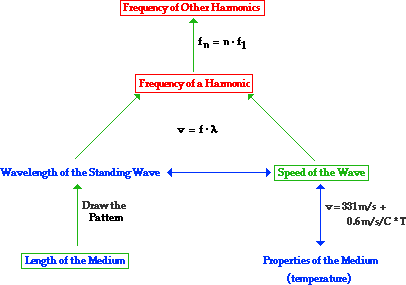
Audio Guided Solution
Problem 5 pertains to a closed-in air column and the various frequencies that it is capable of producing. So, before we begin discussing the strategy here, let's make sure we understand something about closed-in air columns. One thing discussed in class and discussed on the Set C overview page, textbook, and the physics classroom, everything that you rely upon, is that closed-in air columns can only produce odd-numbered harmonics. That is, they can produce a 1st, a 3rd, a 5th, a 7th, a 9th, etc. Where each one of these harmonics is some multiple of the fundamental frequency or 1st harmonic. In fact, the multiplier is simply the harmonic number. For instance, the 9th harmonic is 9 times the frequency of the 1st harmonic. Now here what we have to do is we have to find, at least in this problem, the 5th highest frequency within the range of 20,000 to 20,000 Hz for a closed-in air column. And what we know is the length of the air column and the speed of sound within the air column. So, strategy-wise, the way you would proceed is to kind of look at the graphic at the bottom of the page and notice where you're at. You have length, you have speed. You want to get a frequency value. Now the frequency value that you get will be found only when you get the wavelength. So use the length of 3.37 meters long and find the wavelength. I do it for the 1st harmonic for the fundamental frequency. So look for the diagram for a standing wave pattern for the 1st harmonic in a closed-in air column and relate the length of the wavelength from the diagram. Once related, calculate the wavelength for the 1st harmonic. And then use it with the speed to calculate the frequency of the 1st harmonic. Now if it's within the range of 20 Hz and 20,000 Hz, it might be below 20, I'm not sure, but if it's within that range of 20 to 20,000 Hz, then you have the 1st frequency in that range. And you want to find the 5th. So the way you would do it if the 1st falls within the range is you multiply by 3 to get the 2nd highest, or by 5 to get the 3rd highest, or by 7 to get the 4th highest, and by 9 to get the 5th highest. Now on the other hand, if the frequency you calculate for the fundamental is not in the range of 20 to 20,000 Hz, then you need to calculate the 3rd harmonic frequency, and that probably would be in the range. And then you need to do the same thing, the 2nd highest would be the 5th, the 3rd highest the 7th, the 4th highest the 9th, and the 5th highest therefore would be the 11th. So you multiply your fundamental value by 11 to get the 5th highest frequency within the range. Good luck!
Solution
229 Hz
Habits of an Effective Problem Solver
- Read the problem carefully and develop a mental picture of the physical situation. If necessary, sketch a simple diagram of the physical situation to help you visualize it.
- Identify the known and unknown quantities and record in an organized manner, often times they can be recorded on the diagram itself. Equate given values to the symbols used to represent the corresponding quantity (e.g., v = 12.8 m/s, λ = 4.52 m, f = ???).
- Use physics formulas and conceptual reasoning to plot a strategy for solving for the unknown quantity.
- Identify the appropriate formula(s) to use.
- Perform substitutions and algebraic manipulations in order to solve for the unknown quantity.
Read About It!
Get more information on the topic of Sound and Music at The Physics Classroom Tutorial.