Forces in 2D Audio Guided Solution F2D12Q6
Problem Set F2D12, Question 6:
Janesh exerts a force at a 19.5° angle relative to an inclined plane in order to pull a 117-N sled up the incline at a constant speed. The angle of the incline is 35.0°. The coefficient of friction between the incline and the sled is 0.269. Determine the force with which Janesh must pull to move the sled at a constant speed.
Audio Guided Solution
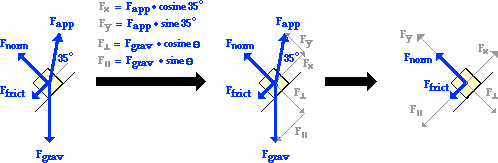
Now this is a humdinger of a problem. There's trigonometry, a good deal of it, very complex algebra, lots of physics, and a need to be very, very careful, particularly in reading and interpreting the problem statement. A boy is dragging a sled up a hill. You know the incline angle of the hill, and you know the weight of the sled is 117 newtons, and the incline angle is 19.55. You know the coefficient of friction between the two surfaces are sliding across each other, mu equal .269. And you know the angle at which the boy pulls on the sled, there's an applied force, and it's 35 degrees with respect to the hill. It's not parallel to the hill, it's 35 degrees with respect to the hill, which makes this a rather complicated problem. Now fortunately, there's no acceleration, it's a constant velocity, so all your force is balanced. Like any one of these problems, what you would want to do is begin with an FBD. And you're welcome, I actually drew it for you. And you'll notice in my FBD, I have drawn the four forces, F normal as always, and F grab as always. And then the F applied in an unusual direction at an angle to the hill, that angle being 35 degrees, and F friction in the usual direction opposing the motion of the object. Now, because there are two forces that are neither parallel nor perpendicular to the direction of the movement, what I've done is taken both of them and resolved them into individual components. That's always what we do with gravity on these types of problems. We resolve it into F perpendicular and F parallel. Once done, we forget about gravity. But now I have to do it for F applied as well. So to get the Fx component, I go F applied, which is our unknown, times the cosine of 35. And to get the Fy component, I go F applied times the sine of 35. Not knowing F applied, I just have to leave it in there as a variable. And now I'm prepared to think in terms of forces that are going parallel and forces that are going perpendicular to the incline. I can write two equations that show balance of forces. First, looking at the three parallel forces, the three being Fx and F parallel and F friction, what I can say is Fx equals F parallel plus F friction. Those that go up the hill are balanced by those that go down in parallel to the hill. Now, I could sort of expand that a little bit and instead of writing Fx equals F parallel plus F friction, I could write it as F app times cosine 35 equals mg sine theta, where theta is 19.55 degrees, plus mu times F norm. Now I can analyze forces that are going perpendicular to the hill. And what I would say is that the two forces that are going, the one force that is going down, is balancing the two forces that are going up perpendicularly out of the hill. That is to say that F perpendicular is equal to F normal plus Fy, which I could rewrite. Instead of saying F perpendicular, I'll say mg cosine of theta, where theta is 19.55 degrees, is equal to Fy, but I'm going to call it F app times cosine of 35 degrees, plus F norm. Now if you look at the two equations you have, the one for the parallel analysis and the one for the perpendicular analysis, what you could state is that you have two equations and two unknowns. You know everything except for F applied and F normal. Everything else is no-no. So it's an algebra problem. No more physics involved. Not an easy algebra problem with two simultaneous equations for which you have to solve for. And the way I typically do it is I would have taken, if it were me, I would take the perpendicular equation and rearrange it to the form of F norm equal mg cosine theta minus F app cosine 35 degrees. And then I would take that expression for F norm and plug it into the other equation in place of F norm, and then I would have in that top equation, I would have F app in there in two terms, and I would solve for F app. I'm being very careful with my algebra. With some care, you can do it. Good luck.
Solution
70.7 N
(rounded from 70.6873 ... N)
Habits of an Effective Problem Solver
An effective problem solver by habit approaches a physics problem in a manner that reflects a collection of disciplined habits. An effective problem-solver...
- ... read the problem carefully and develop a mental picture of the physical situation. If necessary, sketch a simple diagram of the physical situation to help you visualize it.
- ... identifies the known and unknown quantities in an organized manner, equating given values to the symbols used to represent the corresponding quantity - e.g., m = 1.25 kg, µ = 0.459, vo = 0.0 m/s, Ø = 41.6º, vf = ???.
- ... uses physics formulas and conceptual reasoning to plot a strategy for solving for the unknown quantity.
- ... identifies the appropriate formula(s) to use.
- ... performs substitutions and algebraic manipulations in order to solve for the unknown quantity.
Read About It!
Get more information on the topic of Vectors and Forces in Two-Dimensions at The Physics Classroom Tutorial.
Watch It!
Try our YouTube video on the topic of ...