Forces in 2D Audio Guided Solution F2D13Q3
Problem Set F2D13, Question 3:
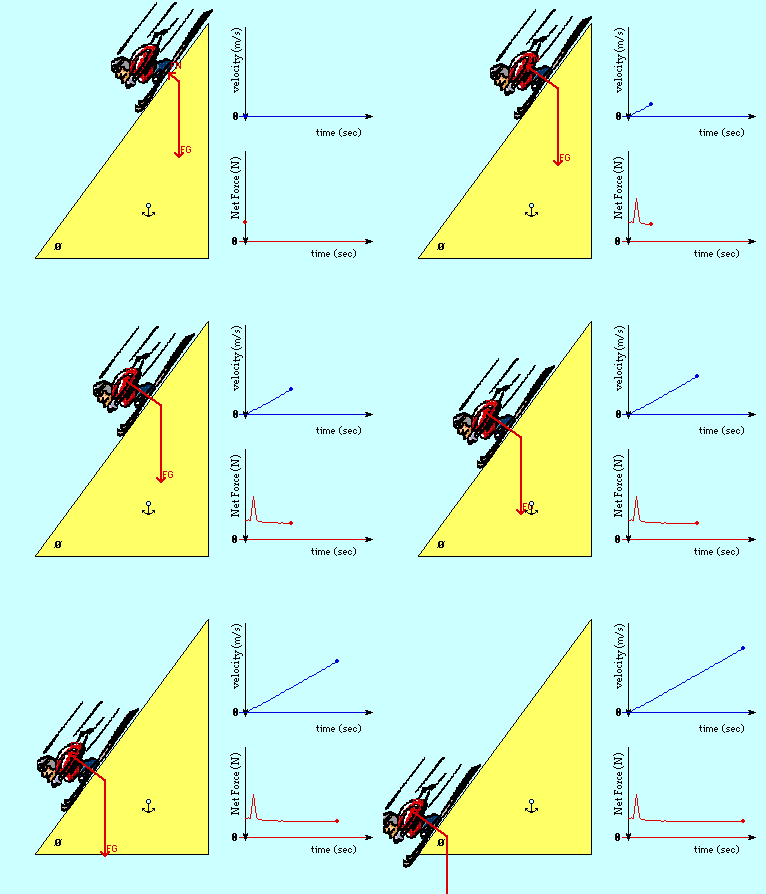
A 68.8-kg skiier heads down a frictionless slope from rest on an incline of 32.8-degrees. If the hill is 50.4 meters high on the vertical, what is the skiier's final velocity (in m/s) at the bottom? Ignore air resistance.
Audio Guided Solution
This problem represents a good illustration of how we can combine a Newton's Laws analysis with a kinematic analysis in order to determine a final answer. When I read the problem I notice that there's distance information, there's speed information that is mentioned in the problem, that's kinematic stuff, and then there's mass, force, and acceleration information, that's epinetical MA stuff. So, like any problem, read it carefully, identify that which you know, and draw a free body diagram, analyze the forces, and write an epinetical MA equation. Now, what we know is that it's an inclined plane problem, inclined with a theta of 32.8, we know m equals 68.8 kilograms, and we know on the kinematic side of the problem v original equals zero, and we also know, and this is a very important statement, that the hill is so high, 50.4 meters high. Now the motion, that's a vertical distance, the motion does not occur along the vertical, it occurs along the incline, and so you'll need to say d equals 50.4 meters divided by the sine of 32.8 degrees, that takes the height and changes it to a distance along the inclined plane, d is 50.4 divided by the sine of 32.8. Now, that's kinematic information, so kinematics wise we know v original, and we know d, and we're looking for v final, so the strategy will involve using epinetical MA to get an A, and then plugging into a kinematic equation to get a v final. So as we approach the epinetical MA part, that begins with a free body diagram, draw the forces on the skier, there is F grab down, F norm perpendicular to the inclined surface, the F grab down gets broken up into an F perpendicular, that balances F norm, into an F parallel that is unbalanced by any other force. So your F net is the F parallel part of gravity, it's mg sine theta, or 68.8 times 9.8 times the sine of 32.8 degrees. If you take that F net as mg sine theta and divide it by the m, you will get an acceleration value, and then once you get that, pick up kinematic equation that has within it the following four variables, vF, the unknown, and then the three knowns, A, v original, and d. Be careful with your algebra, and solve for vF, you can do it.
Solution
31.4 m/s
Habits of an Effective Problem Solver
An effective problem solver by habit approaches a physics problem in a manner that reflects a collection of disciplined habits. An effective problem-solver...
- ... read the problem carefully and develop a mental picture of the physical situation. If necessary, sketch a simple diagram of the physical situation to help you visualize it.
- ... identifies the known and unknown quantities in an organized manner, equating given values to the symbols used to represent the corresponding quantity - e.g., m = 1.25 kg, µ = 0.459, vo = 0.0 m/s, Ø = 41.6º, vf = ???.
- ... uses physics formulas and conceptual reasoning to plot a strategy for solving for the unknown quantity.
- ... identifies the appropriate formula(s) to use.
- ... performs substitutions and algebraic manipulations in order to solve for the unknown quantity.
Read About It!
Get more information on the topic of Vectors and Motion in Two Dimensions at The Physics Classroom Tutorial.
Watch It!
Try our YouTube video on the topic of ...