Forces in 2D Audio Guided Solution F2D14Q6
Problem Set F2D14, Question 6:
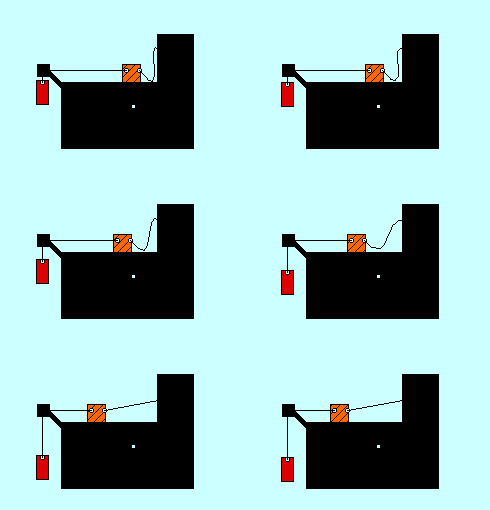 A hanging 2.0-kg block begins to accelerate a 4.1-kg block on a horizontal surface. But a rope connected to the wall at 35.8 degrees brings the block to an equilibrium position. What is the tension (in Newtons) in the angled rope that is required to keep the block from accelerating? The coefficient of friction between the surface and the 4.1-kg block is 0.23.
Audio Guided Solution
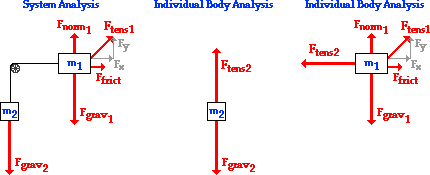
Well, the bad news is this is a very, very hard problem and the good news is there's probably not a whole lot of problems this year that won't be any harder than this one. That's good news. So it's a two-body problem and you'll notice I've drawn free-body diagrams for the system for each of the two individual objects in the system and in my diagrams I've used notation that object 2 is the hanging mass, object 1 is the mass on the table. So in any two-body problem what you typically do is you relate the forces acting upon the system to the acceleration of the object and in this case we're asked what's the tension in the angled rope, which I've called rope 1, that is required to keep the block from accelerating. So since it says to keep the block from accelerating we're talking about in an equilibrium position, which means A is zero. So as I go to analyze the system, looking at our free-body diagram, we would say F-grab 2 equals F-frict plus F-x since all of the forces must balance in the direction of the would-be acceleration. F-grab 2 is M2g and M2 is known to be as 2 kilograms and F-friction we don't know and F-x we don't know. So that's one equation with two unknowns and so if you wish to find F-x you're going to have to generate a second equation with a second unknown. So looking at the vertical forces on object M1, the object on the table, I could say that F-grab 1 is equal to F-norm 1 plus F-y. Now that F-grab 1 is calculable as M1g or 4.1 times 9.8. F-norm is not calculated and F-y we can't calculate it, both unknowns. So I need to do a little bit more work on my two equations but I hope you've written them down. If you haven't you can rewind and pause and write these things down as we go because this will get very complicated. So going back to the first equation M2g is equal to F-frict plus F-x, I'm going to rewrite that right side as instead of F-frict I'm going to write it as mu F-norm or 0.23 times F-norm and instead of writing F-x as F-x I'm going to write F-x as F-tension 1 times cosine of 35.8. So my unknowns in this equation are F-norm and F-tension 1. Now what I'm going to do is go back up to the vertical analysis and I had an equation that said M1g equal F-norm 1 plus F-y and I'm going to rewrite the right side of that one instead of saying F-y I'm going to say F-tension 1 times the sine of 35.8. Now I have 2 equations and 2 unknowns and the unknowns are F-tension 1 and F-norm 1 and so I have to solve this with very careful algebra for my F-tension 1, the force of tension in the angled row. Now when you're done you're done and that's the answer. I'll talk about the individual body analysis because that's another way to approach this. It's really no easier though and it's still a hard problem with 2 equations and 2 unknowns but thinking about the hanging mass we could say M2g equal F-tension 2. That's tension in the rope that connects 2 objects which would mean since we know M2 and g is always 9.8 we could easily calculate F-tension 2. It's 2 times 9.8 or 19.6. That's F-tension 2. Now we can go over the other object, the other individual body analysis and I know one of the forces already on that which helps me with the horizontal analysis and I could say that F-tension 2 which was calculated as 19.6 equal F-rect plus F-x. I'm going to rewrite the right side there instead of saying F-rect I'm going to say mu F-norm or .23 times F-norm and for F-x I'm going to express that as F-tension 1 times cosine of 35.8. So I have an equation that goes 19.6 equal mu equal .23 times F-norm plus F-tension 1 times cosine of 35.8. Now that's one equation with 2 unknowns so now I have to analyze the vertical on object M1 and it would be just as we had done before with the system analysis M1g down equal F-norm up plus F-y. It could be rewritten as 4.1 times 9.8 equal F-norm 1 up plus F-tension 1 times the sine of 35.8 and there's your second equation with the same 2 unknowns F-tension 1 and F-norm 1. You have to solve for F-tension 1. Like I said, either way you do it it's very difficult but be careful on your algebra and I know you can do it. Good luck.
Solution
15 N
(rounded from 15.31151... N)
Habits of an Effective Problem Solver
An effective problem solver by habit approaches a physics problem in a manner that reflects a collection of disciplined habits. An effective problem-solver...
- ... read the problem carefully and develop a mental picture of the physical situation. If necessary, sketch a simple diagram of the physical situation to help you visualize it.
- ... identifies the known and unknown quantities in an organized manner, equating given values to the symbols used to represent the corresponding quantity - e.g., m = 1.25 kg, µ = 0.459, vo = 0.0 m/s, Ø = 41.6º, vf = ???.
- ... uses physics formulas and conceptual reasoning to plot a strategy for solving for the unknown quantity.
- ... identifies the appropriate formula(s) to use.
- ... performs substitutions and algebraic manipulations in order to solve for the unknown quantity.
Read About It!
Get more information on the topic of Vectors and Motion in Two Dimensions at The Physics Classroom Tutorial.
- Mass and Weight
- Drawing Free Body Diagrams
- Friction Force
- Kinematic Equations
- Two Body Problems Revisited
Watch It!
Try our YouTube video on the topic of ...