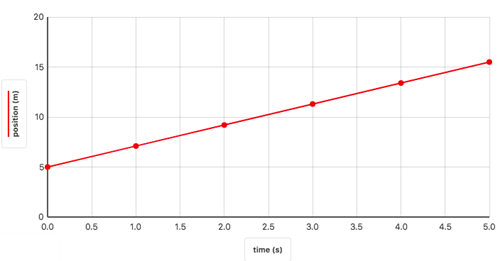
Calculating the slope of a line does not have to be difficult. There are four simple steps that must be taken to do it. Here are the steps:
- Find the x, y coordinates of two points that lie on the line. In this Concept Builder, you can find these coordinate values by tapping on any of the six data points. The coordinates are displayed above the graph. Take the time to write these coordinates down in X, Y format. It might look something like this:
(X1, Y1) = (3.0 s, 5.0 m) and (X2, Y2) = (6.0 s, 14.0 m)
- Using the two sets of coordinates, calculate the change in the Y-coordinate value. We sometimes refer to this as the ∆Y or as the rise. It is an indicator of how high the line rises vertically between the two points. For the coordinates given in step 1, the ∆Y calculation would look like this:
∆Y = Y2 - Y1 = (14.0 m - 5.0 m) = 9.0 m
- Using the same two sets of coordinates, calculate the change in the X-coordinate value. We sometimes refer to this as the ∆X or as the run. It is an indicator of how far the line runs horizontally between the two chosen points. For the coordinates given in Step 1, the ∆X calculation would look like this:
∆X = X2 - X1 = (6.0 s - 3.0 s) = 3.0 s
- Determine the ratio of the change in Y to the change in X by dividing ∆Y value (from step 2) by the ∆X value (from step 3). For the set of two points provided as the example in Step 1, the calculation would go like this:
Slope = ∆Y/∆X = (9.0 m) / (3.0 s) = 3.0 m/s
One word of caution: the most common error students make when calculating the slope is to do it as the Y/X ratio instead of the ∆Y/∆X ratio. You need to know two X-Y coordinate values so that you can perform the change calculations of Steps 2 and 3. Check to see if you did that.
If you did the
Apprentice Difficulty Level, you might remember that one of the points on the line was the origin. In cases like that, one of the coordinates is (0.0 s, 0.0 m) ... and you are always advised to use it as one of your two sets of coordinates when applicable. In this unique instance, the Y
2 value is equal to the ∆Y and the X
2 value is equal to the ∆X. So in effect, you might have learned a bad habit in the
Apprentice Level ... calculating the slope as Y
2/X
2. Now is the time to
unlearn it. Calculate the slope as the ∆Y/∆X.