The amount of torque experienced by an object depends upon the amount of force applied to the object, the direction of the force, and the distance that the line of force is from the axis of rotation.
Getting your Trinity Audio player ready...
Hold down the T key for 3 seconds to activate the audio accessibility mode, at which point you can click the K key to pause and resume audio. Useful for the Check Your Understanding and See Answers.
Rotational Inertia - help2
There are two similar versions of this question. Here is one of the versions:
Version 1:
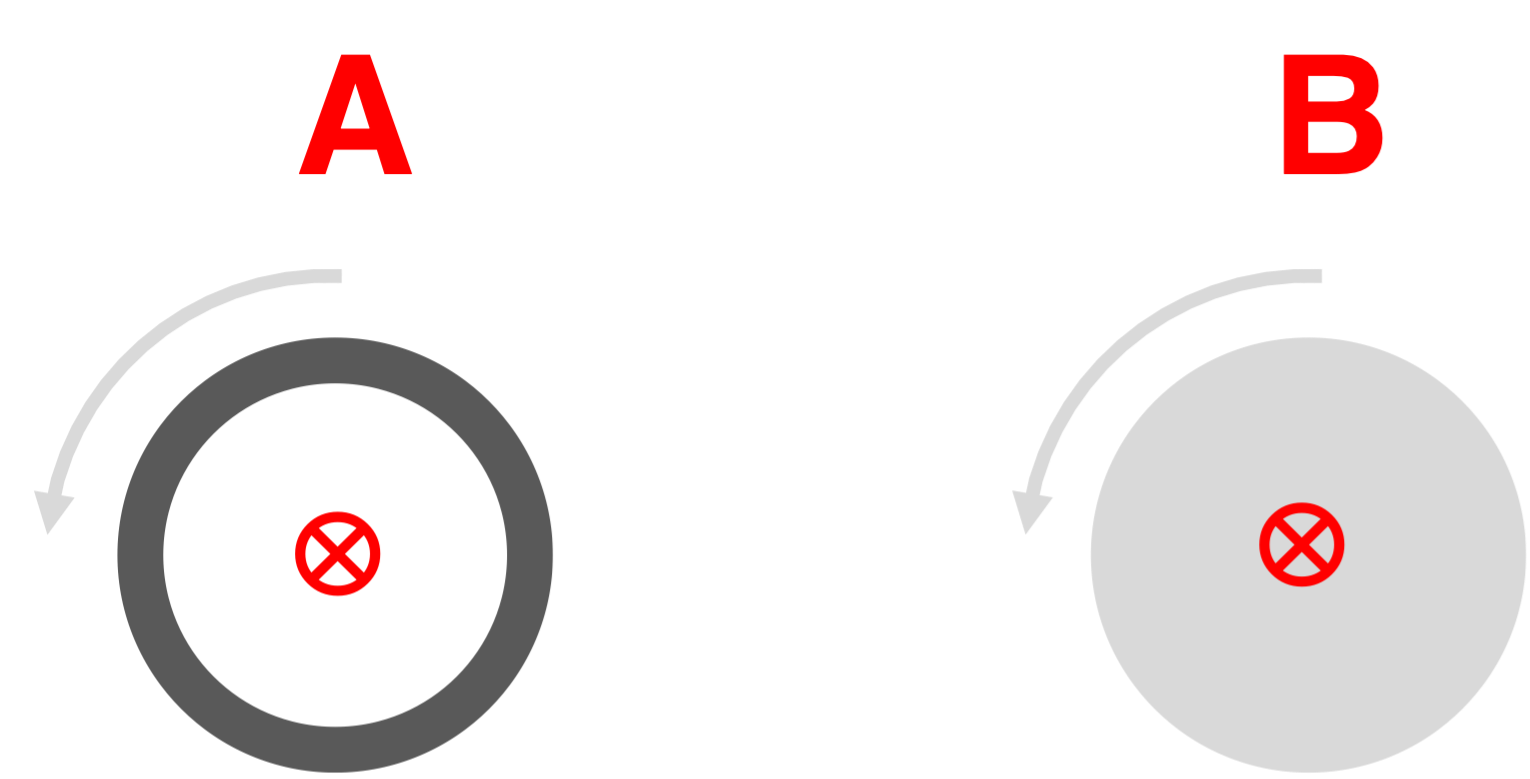
A ring (A) and a solid disk (B) have the same mass. That mass is concentrated along the rim of the ring and distributed uniformly about the disk. For which object – A or B – is the rotational inertia (I) about the axis the greatest?

Try these links to The Physics Classroom Tutorial for more help with understanding the concept of rotational inertia:
Sorry. We hope to add resources in the future.