When discussing waves, it is often useful to distinguish between the variety of types of waves. While all waves share a set of similar traits, waves that are of a different category possess characteristics that are unique and set it apart from waves of other categories. The unique features of the various categories are discussed in the How to Think About This Situation below.
Getting your Trinity Audio player ready...
Hold down the T key for 3 seconds to activate the audio accessibility mode, at which point you can click the K key to pause and resume audio. Useful for the Check Your Understanding and See Answers.
Wave Basics - helpMaster
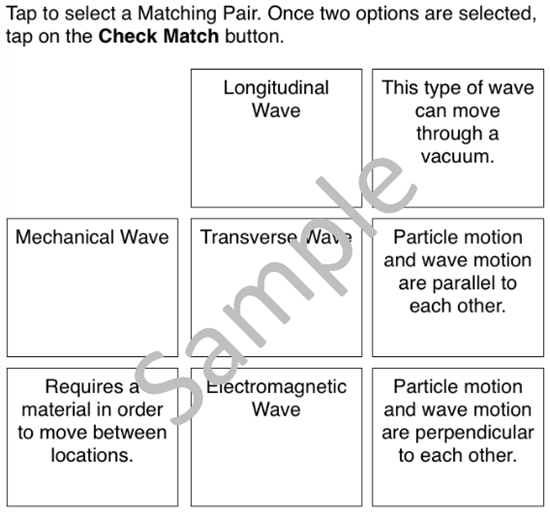
This activity presents learners with 8 different terms that must be matched by meaning. Learners tap on the terms to select them and then tap on the Check Match button. The order of the terms is randomized. A ms-matched pair restarts the gameand re-randomizes the order of the terms. The terms are ...
- Mechanical Wave
- Transverse Wave
- Particle motion and wave motion are parallel to each other.
- Requires a material in order to move between locations.
- This type of wave can move through a vacuum.
- Longitudinal Wave
- Particle motion and wave motion are perpendicular to each other.
- Electromagnetic Wave
Here is a sample screen layout:
Try this link to The Physics Classroom Tutorial for more help with the different categories of waves:
Categories of Waves