1D Kinematics Audio Guided Solution K17Q1
Problem Set K17, Question1:
A biker speeds up to 32.4 m/s from rest in 6.48 seconds. The biker maintains this speed for 7.01 seconds before coasting to a stop in 6.00 seconds. What was the biker's average speed (in m/s) for the trip?
Audio Guided Solution
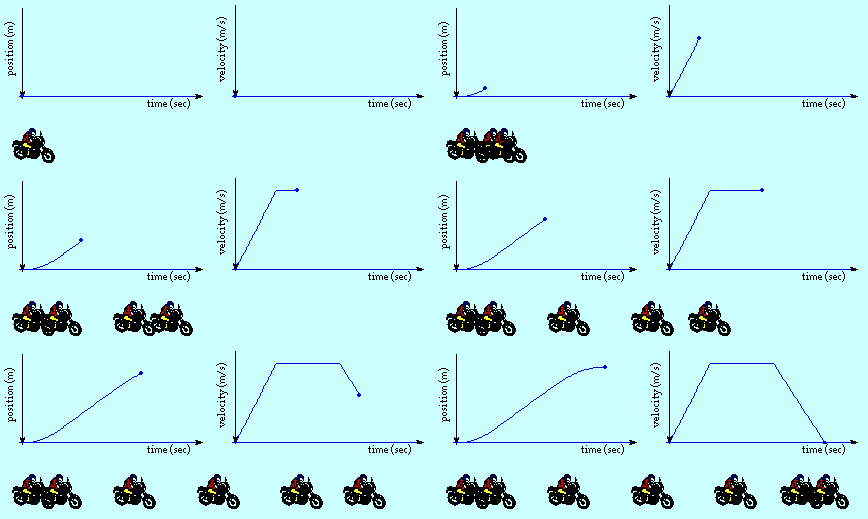
This is a very difficult problem, and like any difficult problem, you're going to have to commit yourself to the habits of a good problem solver. Take your time on this problem. Don't rush it. You might find that by taking your time, you're actually going to save a little time and a lot of frustration. Think about it and strategize before you ever begin using your calculator. Here we're told a biker speeds up from rest to a speed of 32.4 meters per second. This takes 6.48 seconds. Then the biker maintains his speed for 7.01 seconds before finally doing the third stage of the motion where the biker goes to a stop in six seconds. The question here is, what was the biker's average speed for the trip? Now if you click the view animation button, you'll see an animation of the biker. Probably most important, you'll see a velocity time graph on the right side of that animation. And in the velocity time graph, you see that the acceleration phase, then the constant speed phase where the velocity graph levels out, and then the deceleration phase where the biker comes to a rest. Now we know the time for each of those three phases. We know the total time of the motion then by just simply summing the 6.48, the 7.01, and the six seconds together. What we're looking for is the average speed for the trip. We want to find the average speed. That is a distance per time ratio. Now the time is just what you get when you add all those times together. And the distance is simply the area beneath the graph on the velocity time graph. So you've got a triangle, a rectangle, and another triangle. The triangle for the first 6.48 seconds has a base of 6.48 and a height of 32.4. So using the triangle area equation, you can calculate the distance for the first 6.48 seconds. The next 7.01 seconds is quite easy because it's a rectangle and the width is 7.01 and the height is 32.4. So again, using a rectangle area equation, you can find the distance for the middle 7.01 seconds. And then for the last 6 seconds, you have another triangle, the base of which is 6 seconds, and the height of which is 32.4 meters per second. That will give you a third distance. You can sum all three distances together and you'll have the total distance. And if you divide by the total time, you'll have your average speed. And that was probably a lot easier than it looked. But note how I first strategized and thought about how do I get average speed. There's other ways to do this problem. That might be the easiest one, the one I just explained. Good luck to you.
Solution
23.2 m/s

Habits of an Effective Problem Solver
An effective problem solver by habit approaches a physics problem in a manner that reflects a collection of disciplined habits. An effective problem-solver...
- ...reads the problem carefully and develops a mental picture of the physical situation. If needed, they sketch a simple diagram of the physical situation to help visualize it.
- ...identifies the known and unknown quantities in an organized manner, often times recording them on the diagram itself. They equate given values to the symbols used to represent the corresponding quantites (e.g., vo = 0 m/s; a = 4.2 m/s/s; vf = 22.9 m/s; d = ???.).
- ...plots a strategy for solving for the unknown quantity; the strategy will typically center around the use of physics equations and be heavily dependent upon an understanding of physics principles.
- ...identifies the appropriate formula(s) to use, often times writing them down. Where needed, they perform the needed conversion of quantities into the proper unit.
- ...performs substitutions and algebraic manipulations in order to solve for the unknown quantity.
Read About It!
Get more information on the topic of Kinematics at The Physics Classroom Tutorial.
Watch It!
Try our YouTube videos on the topic of ...