1D Kinematics Audio Guided Solution K17Q2
Problem Set K17, Question 2:
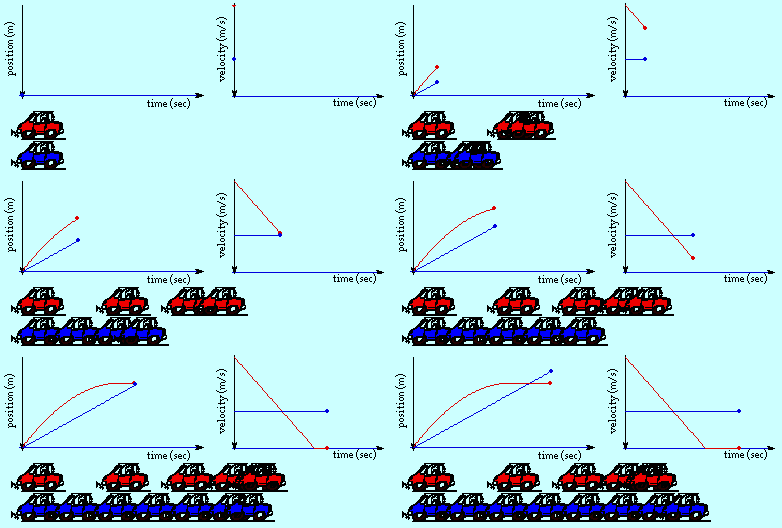
A red car moving at 61.9 mph passes a blue car moving at 37.3 mph. (Use 1609 meters = 1 mile when converting to meters/second.) Seeing a stopped car in his lane up ahead, the driver of the red car applies the brakes just as he passes the blue car which causes the red car to slow down to a stop by losing 4.67 m/s every second. How much time (in seconds) passes before the two cars are side-by-side once again?
Audio Guided Solution
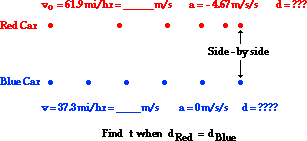
A red car moving at 61.9 miles per hour passes a blue car moving at 37.3 miles per hour. Note that these are unconventional units of speed, and so we'll need to convert it to meters per second. We should use the information that's given that 1609 meters equal one mile, in addition to the fact that there's 3600 seconds per hour. Now seeing a stopped car in his lane up ahead, the driver of the red car applies his brakes. Notice as he passes the blue car, which causes the red car to slow down to a stop by losing 4.67 meters per second every second. How much time does it take before the two cars are side by side once again? Enter your answer in the third decimal place. So the red car is naturally side by side with the blue car when he applies the brakes, but because he's going faster, he passes the blue car. Because he's slowing down, the blue car eventually catches back up. So there's a point in time when they're side by side, and what we wish to know is how much time does it take for them to become side by side once again? Find the t when the d of the red car equals the d of the blue car. That's what this problem's about, time and distance. Now we know two pieces of kinematic information about each car. We know the original speed, which we'll convert to meters per second, and we know the acceleration of both cars, with the blue car being 0 meters per second squared. So we could write an expression for the displacement of each car in terms of v, a, and t. If we were to do that, we would write d equal v original times t plus 1 half a t squared. Now for the red car, when you write that, there's two terms, and both terms remain within the equation. And for the blue car, there's only one term, because the a term cancels out, since a is 0. So v of the red car times t plus 1 half a of the red car times t squared equals v blue car times t. And you have to solve for t. Now when you do, you'll notice that there's two solutions, t equals 0, and t equals some other answer. Be careful with your algebra, but I know you can do it, and when you do do it, you're going to get the t in seconds, and that would be your answer. Good luck to you.
Solution
4.71 seconds
(rounded from 4.70870 ... m/s)

Habits of an Effective Problem Solver
An effective problem solver by habit approaches a physics problem in a manner that reflects a collection of disciplined habits. An effective problem-solver...
- ...reads the problem carefully and develops a mental picture of the physical situation. If needed, they sketch a simple diagram of the physical situation to help visualize it.
- ...identifies the known and unknown quantities in an organized manner, often times recording them on the diagram itself. They equate given values to the symbols used to represent the corresponding quantites (e.g., vo = 0 m/s; a = 4.2 m/s/s; vf = 22.9 m/s; d = ???.).
- ...plots a strategy for solving for the unknown quantity; the strategy will typically center around the use of physics equations and be heavily dependent upon an understanding of physics principles.
- ...identifies the appropriate formula(s) to use, often times writing them down. Where needed, they perform the needed conversion of quantities into the proper unit.
- ...performs substitutions and algebraic manipulations in order to solve for the unknown quantity.
Read About It!
Get more information on the topic of Kinematics at The Physics Classroom Tutorial.
Watch It!
Try our YouTube videos on the topic of ...