1D Kinematics Audio Guided Solution K17Q3
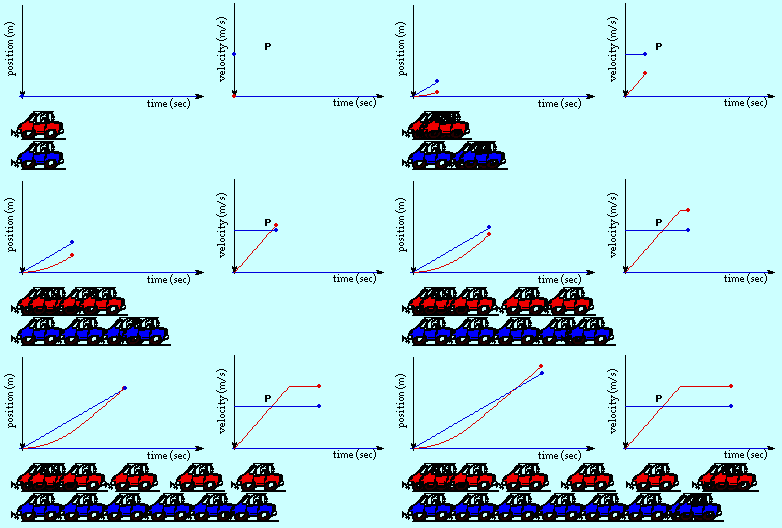 Problem Set K17, Question 3:
A red car is sitting at a stop light at rest. When the light turns green two things happen simultaneously; (1) the red car accelerates to a speed of 32.7 m/s in 8.48 seconds and then maintains that 32.7 m/s speed and (2) a blue car passes by the red car at a constant speed of 21.4 m/s. How much time (in seconds) will have elapsed from when the light turned green until the two cars are side-by-side?
Audio Guided Solution
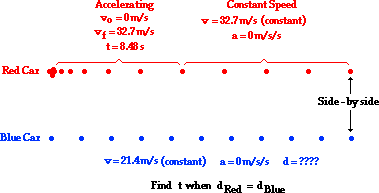
A red car is sitting at a stoplight at rest, and when the light turns green, there are two things that happen simultaneously. First of all, the red car begins to accelerate, and the rate of acceleration is not given, but you know it accelerates up to a final speed of 32.7 meters per second, and it takes 8.48 seconds to reach that final speed. Once that's done, this red car maintains that speed of 32.7 meters per second. Now, the second thing that happens is a blue car passes by the red car already in motion at 21.4 meters per second, and being in motion, it's going to pass the red car and be out ahead of the red car, but because the red car is accelerating and accelerating up to a faster speed, that red car will eventually catch up and finally be side-by-side with the blue car. The question here is how much time will have elapsed from when the light turns green until the two cars are side-by-side. Another way to couch this question is, find the time when the distance of the red car equals the distance of the blue car. And so what we need to do is generate a couple of equations, one for the distance of the red car, expressed in terms of the parameters we know, and the other for the distance of the blue car. And then we wish to find the time at which the d on the red car equals the d on the blue car. We'll talk about the blue car first, it's easiest. The distance that the blue car travels is going to be equal to its speed multiplied by its time of travel, that is the original of 21.4 meters per second, by some time t, the t of the blue car. Now the distance that the red car travels is a little bit more complicated, because it has an accelerating phase and then it has a constant speed phase. We know the time for the accelerating phase, we don't know the time for the constant speed phase. So what we'll do is we'll say that the time for the constant speed phase is going to be t, that's what we'll call it, t. And let's call it x, x is the time for the constant speed phase. So the distance it travels is the distance during the first 8.48 seconds and the distance during the second 8.48 seconds, or during the time x. Now for the first 8.48 seconds, the distance it travels can be found using the equation d equal v original plus v final over 2, all multiplied by the t. And you should calculate that, all the units are standard, straightforward calculation. And then add on to that the distance it travels at constant speed, which would be 32.7 times x plus 1 half a t squared, where a is zero, and that term cancels out. So you have the two terms for the distance the red car travels. And in that term, x is the time after 8.48 seconds. Now back to the blue car, we've already said that the distance it travels is 21.4 seconds times t, where t is the total time since the light turned green. Now instead of writing it as t, let's write it as 8.48 seconds plus x seconds. So you have 21.4 meters per second times the quantity 8.48 plus x. Now you have an expression for the distance the red car travels and the distance the blue car travels. We're trying to find the t when the distance the red car equals the distance the blue car. So set these two expressions for distance equal to one another and solve for x. It's going to take a good deal of algebra, so be careful with that. Once you get your x, that's not the answer. What x is, is the time after 8.48 seconds. What we're looking for is the total amount of time. So add the x on to the 8.48 seconds, and you get the total time. You'll have your answer. Good luck to you.
Solution
12.27 seconds

Habits of an Effective Problem Solver
An effective problem solver by habit approaches a physics problem in a manner that reflects a collection of disciplined habits. An effective problem-solver...
- ...reads the problem carefully and develops a mental picture of the physical situation. If needed, they sketch a simple diagram of the physical situation to help visualize it.
- ...identifies the known and unknown quantities in an organized manner, often times recording them on the diagram itself. They equate given values to the symbols used to represent the corresponding quantites (e.g., vo = 0 m/s; a = 4.2 m/s/s; vf = 22.9 m/s; d = ???.).
- ...plots a strategy for solving for the unknown quantity; the strategy will typically center around the use of physics equations and be heavily dependent upon an understanding of physics principles.
- ...identifies the appropriate formula(s) to use, often times writing them down. Where needed, they perform the needed conversion of quantities into the proper unit.
- ...performs substitutions and algebraic manipulations in order to solve for the unknown quantity.
Read About It!
Get more information on the topic of Kinematics at The Physics Classroom Tutorial.
Watch It!
Try our YouTube videos on the topic of ...