1D Kinematics Audio Guided Solution K18Q5
Problem Set K18, Question 5:
Try Entopass is attempting to pass a physical education class at school. To pass, Try must complete the 1-mile run in 12.0 minutes. Try runs the first 10.0 minutes at a constant pace but still has 581 yds to go. Assuming that Try accelerates uniformly over the remainder of the run, what acceleration (in m/s/s) would he need to pass the test? (GIVEN: 1 mi = 1609 m; 3.28 ft = 1.00 m).
Audio Guided Solution
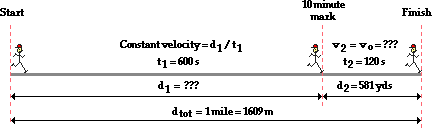
In physics, there are problems which are mathematical exercises in which you use the equations we've introduced in Plug and Chug, and then there are problems which are problems, and this problem is a true problem. There's a collection of information that seems to not immediately jump out at you as to what you're supposed to do with it. There is a mess of units involved, and the strategy for getting from the given information to the final answer is not immediately obvious, and in problems that are true problems, what you really need to focus on is good habits, diagramming the situation, strategizing how you will get from givens to unknowns, and then making an effort to pick proper equations in order to do it. So let's begin with the first habit, and that is read the problem carefully. In order to pass a physical education class at a university, a student must run one mile in 12 minutes. So there's a distance, and there's a time. Not what we would call classic units, but still, a total distance run and a time. Now after running the first 10 minutes at a constant pace, she still has 581 yards to go. So there's a statement that sort of breaks up this 12 minutes into two sections of time, and then two minutes, and it also takes the one mile and breaks it up into two sections of distances, one being a constant velocity distance, that not known, and the other being 581 yards. Now assuming that she accelerates uniformly over the last part of the race, that remaining two minutes, that is, the question is, what acceleration would she need to have during that last part in order to pass the test? The question is, what's the acceleration during the last section of the race? It says, enter your answer in the fourth decimal place and be cautious of rounding errors. Indeed, that's the case. Now there's a mess of units here. You'll notice yards, and meters, and miles. You'll notice minutes and seconds, and this is something that we have to treat. So I'm going to pick, as the unit of choice, the meter and the second, and I'm going to diagram a runner, and you'll notice, you can see it right here below the audio file, a runner going from the starting line to the finishing line, and the distance between those two points is 1609 meters, or one mile, and the person has to do it in 12 minutes, or 720 seconds. Now the last two minutes is equivalent to a distance of 581 yards. Now we need to convert that to meters, so go from yards to feet, because you know there's three feet in the yard, and then go from feet to meters, because you see the converting information there. And you get that D2 distance, as I call it, in meters. And then we know the T2 time for that last part of the race is 120 seconds, or two minutes. We don't know the V2, what we wish to find is the A2 during that section. Now even though we don't know the V2, the V at the beginning of that last section, what we can find is the average V for the first section, because the runner is running at, it says, a constant pace for the first 600 seconds, or 10 minutes, and then accelerates over the last two minutes. We want to find that acceleration. Now the speed at the start of that two-minute interval is just going to be the average speed during the first 10 minutes. So V2 is essential, because it's going to help us use the equation D equal V2T plus one-half AT squared in order to solve for A. So we need to find V2. Finding V2 focuses on finding the V during the first 10 minutes, and we can find the distance there, and we already know the time of 600 seconds for T1. We just need to find D1, and then we can go V equal D1 over T1. That will give us the V2 that we use in the equation D equal V original times T2 plus one-half AT squared. So how do you get D1? Well, D1 is going to be whatever is left after you subtract the 581 yards from the 1609 meters. So you've already taken the 581 yards and converted it to meters. Subtract it from the 1609, and that gives you the D1. Subtract 600 into it, and that gives you the constant velocity pace during the first 10 minutes. And then say, at that 10-minute mark for the next 120 seconds, there's acceleration, and calculate it. That's not too bad. Well, be careful of rounding and careful of units, and you can do it. Good luck.
Solution
0.0521 m/s/s
(rounded from 0.0521388 ... m/s/s)

Habits of an Effective Problem Solver
An effective problem solver by habit approaches a physics problem in a manner that reflects a collection of disciplined habits. An effective problem-solver...
- ...reads the problem carefully and develops a mental picture of the physical situation. If needed, they sketch a simple diagram of the physical situation to help visualize it.
- ...identifies the known and unknown quantities in an organized manner, often times recording them on the diagram itself. They equate given values to the symbols used to represent the corresponding quantites (e.g., vo = 0 m/s; a = 4.2 m/s/s; vf = 22.9 m/s; d = ???.).
- ...plots a strategy for solving for the unknown quantity; the strategy will typically center around the use of physics equations and be heavily dependent upon an understanding of physics principles.
- ...identifies the appropriate formula(s) to use, often times writing them down. Where needed, they perform the needed conversion of quantities into the proper unit.
- ...performs substitutions and algebraic manipulations in order to solve for the unknown quantity.
Read About It!
Get more information on the topic of Kinematics at The Physics Classroom Tutorial.
Watch It!
Try our YouTube videos on the topic of ...