1D Kinematics Audio Guided Solution K8Q5
Problem Set K8, Question 5:
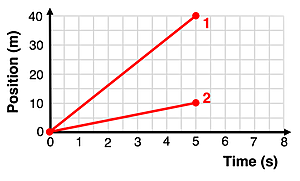 Consider the position-time graphs of Objects 1 and 2. How much faster is Object 1 moving than Object 2 at a time of 3.7 seconds?
Audio Guided Solution
This is a most excellent problem, which asks us to analyze the motion of two objects whose position is represented with respect to time on a position-time graph. We're told that the red line represents object A, and you'll note that object A is moving at a constant velocity in the positive direction. We could calculate the slope of that line, and we would get the velocity of that object, that is, the speed, with a plus-minus sign on it. And then the blue line represents object B's motion, and you'll note that for the first second of motion, object B is just remaining at the same position at 12 meters, object B is at rest. And then from one second to four seconds, object B then moves with a constant velocity, and again, we could calculate the slope of that line between one and four seconds, and we would have the velocity of object B. It would be a speed with a plus-minus sign. Now the question here is, how much faster in meters per second is the faster of the two objects moving compared to the slower of the two objects moving at a time of 3.7 seconds in our positive number? Now the fact that they give you the time of 3.7 seconds is really rather unimportant. All that really matters is that they give you a time greater than one second, because by giving you a time greater than one second, they're asking us to compare the slope of the blue line where it's sloping downwards to that of the red line where it's sloping upwards, because everywhere from one to four seconds, the slopes of those lines are the same. So our answer will be the same, regardless of the time we get, as long as it's greater than 1.0 seconds. So what I need to do is calculate the slope of the blue line, and then I need to calculate the slope of the red line. We've done a lot of that on this collection of problems already. You just need to do a rise over run calculation, write your results down. Now you're going to get a plus and a minus when you do that. Now this one question is, how much faster is the faster of the two objects moving? So when you get the plus and minus sign, you've got a plus or minus indicating some directional information. But the number, the value, the magnitude of the slope, well that's just the speed, and that tells you how fast the objects are going. So if after doing your calculations you get say 6 meters per second and negative 2 meters per second, you don't by the way, but just for an example, suppose you get those two numbers, well what you have is one object moving with a speed of 6 and the other with a speed of 2. And the faster object is moving 4 meters per second greater than the slower object. So that's exactly what you have to do here with this problem, is do your two slope calculations, and then take the difference of their absolute values, and that would be your answer. Good luck to you.
Solution
Blue is faster by 1.5 m/s.
Habits of an Effective Problem Solver
An effective problem solver by habit approaches a physics problem in a manner that reflects a collection of disciplined habits. An effective problem-solver...
- ...reads the problem carefully and develops a mental picture of the physical situation. If needed, they sketch a simple diagram of the physical situation to help visualize it.
- ...identifies the known and unknown quantities in an organized manner, often times recording them on the diagram itself. They equate given values to the symbols used to represent the corresponding quantites (e.g., vo = 0 m/s; a = 4.2 m/s/s; vf = 22.9 m/s; d = ???.).
- ...plots a strategy for solving for the unknown quantity; the strategy will typically center around the use of physics equations and be heavily dependent upon an understanding of physics principles.
- ...identifies the appropriate formula(s) to use, often times writing them down. Where needed, they perform the needed conversion of quantities into the proper unit.
- ...performs substitutions and algebraic manipulations in order to solve for the unknown quantity.
Read About It!
Get more information on the topic of 1-Dimensional Kinematics at The Physics Classroom Tutorial.
Watch It!
Try our YouTube video on the topic of ...