Light Waves and Colors Audio Guided Solution LW7Q5
Problem Set LW7, Question 5:
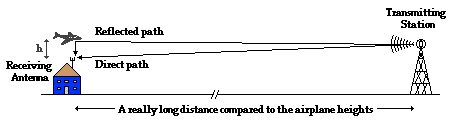
Interference of radio waves can occur when a wave from a broadcasting station reflects off an airplane or a mountain and meets up with a wave that makes a direct route from the broadcast station to the receiver. Suppose that a 635.9 kiloHertz signal reflects off an airplane located 354 meters above the receiver of a home and interferes destructively with a signal traveling directly to the receiver from the distant station. What would be the next highest plane location that would result in destructive interference? (Neglect any possibility of phase change upon reflection off the plane.)
Audio Guided Solution
Before I discuss this problem, I want to call your attention to a section on this particular help page. It's near the bottom. It's called the Read About section. And in there, you'll find three links, each to the physics classroom. And the third link listed there, Other Two-Point Source Interference Applications, is really worthy of reading. If you're having difficulty with this problem, you might want to take some time to read that because what it's going to talk about is the main principle behind a two-point source interference pattern applied to situations like this one, which is a little bit of a unique situation. So know that that link is there and use it. Also note on this page, we have the Habits of a Good Problem Solver listed, and I'm going to employ those habits as I approach this problem, beginning with the reading of the problem. It's known that signals from radio stations and television stations can reflect off airplanes, mountains, et cetera, and interfere with a signal traveling directly from the station to a home. Suppose that there's a radio station transmitting signals at 6355.9 kilohertz. That's a frequency. I recognize it to be a frequency by its unit, so I'm going to list f equal 6355.9 kilohertz. These signals are reflecting off an airplane located 354 meters above the receiver at home, and they destructively interfere with a signal sent directly from the radio station to the home. Now, you'll notice I've diagrammed the situation. I've drawn the home because it speaks of a home. I put an antenna on the home. I've drawn the transmitting station that transmits the radio signal. I put the airplane above the home. It says directly above the home, so I put it directly above the antenna of the home, and I've drawn two paths, one from the transmitting station, bouncing off the airplane and going to the home, and the other one directly from the home. What I did is I represented all this verbal information in the form of a diagram. What I'm going to get is destructively interference at this antenna location, and that happens because a crest from one of the waves meets up with a trough from the other, and it doesn't matter which is the crest, which is the trough, but what matters is that the path difference is equal to m lambda, where m is some half number of wavelengths. Well, I know m is either a half, three halves, five halves, seven halves, etc., and I know that the difference in distance traveled is going to be 354 meters. I know that because that's the height, and that's the difference in distance taken by the reflected path compared to the direct path. After all, if this radio station is really, really far away, then what you would know is that the horizontal distance for the direct path is going to be about the same as the horizontal distance for the reflected path. So the only difference in distance traveled is that for the reflected path, there's an extra vertical distance equal to 354 meters. So pd equals 354 meters. Now I know a frequency, and I know a pd, so what would be really useful is if I knew a wavelength, and I do because these waves are light signal waves, and v of a light signal is 3.0 times 10 to the 8th meters per second. So I can go v equals f lambda, where f and v are known, and I can calculate lambda, and that's important. Take the time to do that now. Now pay attention to the units, because if you have the f in kilohertz, you're not in the v in meters per second. You're not going to get the lambda in meters. So what you need to do is take the kilohertz and convert it to hertz. Hertz is a big unit. Hertz is a smaller unit. So there's 10 to the 3rd hertz per 1 kilohertz. Use that as your converting factor, and then divide it into the speed in meters per second. You'll get the wavelength in meters. Now what can you do with all that? You got pd. You got wavelength. Ah, you can figure out what the m number is, and it should come out to be a half number. So go pd equals m lambda, substitute pd and lambda values in, and you'll get an m number. It might come out to be 1.49576321 or something like that. We'll round it to a half number, like to 1.5. What they wish you to find is what's the next highest plane elevation which would result in destructive interference? That's what's the next highest path difference. Path differences are associated with half numbers here for destructive interference. So if you found m to be 1.5, well, now make the next highest elevation equal to an m value of 2.5. Just add 1 to your m value, and then calculate pd by going 2.5 times lambda, or the next highest m number times the same lambda, and that would be your answer, the next highest elevation. Boy, that's a complicated problem. Again, you might want to read the background information at the physics classroom. Good luck to you.
Solution
401 m
Habits of an Effective Problem Solver
An effective problem solver by habit approaches a physics problem in a manner that reflects a collection of disciplined habits. To be an effective problem-solver...
- ... read the problem carefully and develop a mental picture of the physical situation. If necessary, sketch a simple diagram of the physical situation to help you visualize it.
- ... identify the known and unknown quantities and record them in an organized manne; often times, they can be recorded on the diagram itself. Equate given values to the symbols used to represent the corresponding quantity (e.g., v = 3.00x10⁸ m/s, λ = 554 nm, f = ???).
- ... use physics formulas and conceptual reasoning to plot a strategy for solving for the unknown quantity.
- ... identify the appropriate formula(s) to use.
- ... perform substitutions and algebraic manipulations in order to solve for the unknown quantity.
Read About It!
Get more information on the topic of Light Waves at The Physics Classroom Tutorial.