Newton's Laws Audio Guided Solution NL14Q6
Problem Set NL14, Question 6:
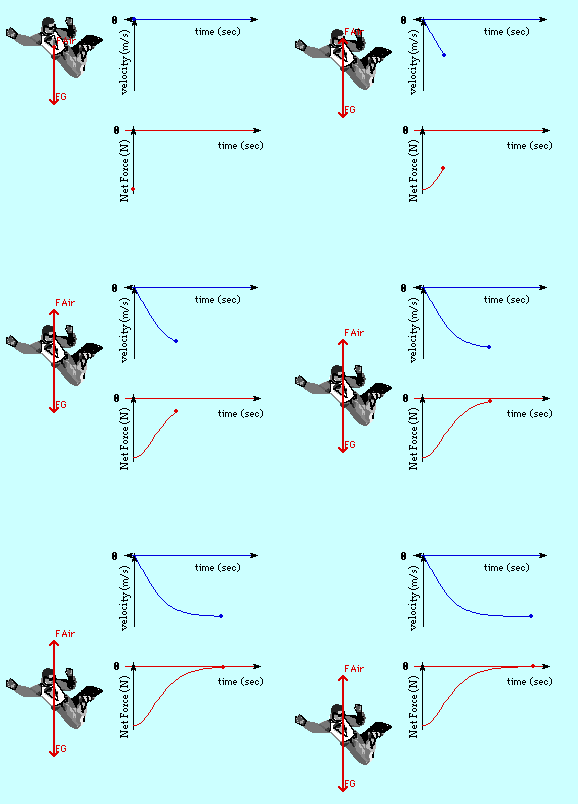
An airboarder is falling and experiencing an increasing air resistance force until terminal velocity is reached. If the 66.4-kg airboarder experiences a downward acceleration of 4.92 m/s/s at a certain point in time, what is the air resistance force (in Newtons) at that instant?
Audio Guided Solution
This problem pertains to the motion of an airboarder and like any problem in physics we like to read it carefully and develop a free body diagram, relate the forces to the acceleration using F net equal MA and solve for the unknown. So what we have when we read this is we have an airboarder that is accelerating downwards. The down force, I could draw a free body diagram and the down force is the force of gravity and the up force would be the force of air resistance and what we wish to know is what is F air. The acceleration A equals 4.92 and the M equals 66.4 kilograms so this appears to be an F net equal MA problem and like any such problem when I go to write F net I am going to take the force in the direction of the acceleration and subtract those that oppose it. So done for this problem I am going to take the M times the G, the force downwards and subtract those that oppose it which is F air. So I am going to go MG minus F air and all that is equal to MA. My M is 66.4, I can substitute it in on both sides of the equation. My G is 9.8, my A is 4.92 and I can solve for F air. Straight forward algebra, I know you can do it.
Solution
324 N
Habits of an Effective Problem Solver
An effective problem solver by habit approaches a physics problem in a manner that reflects a collection of disciplined habits. An effective problem-solver...
- ... read the problem carefully and develop a mental picture of the physical situation. If necessary, sketch a simple diagram of the physical situation to help you visualize it.
- ... identifies the known and unknown quantities in an organized manner, equating given values to the symbols used to represent the corresponding quantity - e.g., m = 1.25 kg, µ = 0.459, vo = 0.0 m/s, Ø = 41.6º, vf = ???.
- ... uses physics formulas and conceptual reasoning to plot a strategy for solving for the unknown quantity.
- ... identifies the appropriate formula(s) to use.
- ... performs substitutions and algebraic manipulations in order to solve for the unknown quantity.
Read About It!
Get more information on the topic of Newton's Laws of Motion at The Physics Classroom Tutorial.