Newton's Laws Audio Guided Solution NL20Q1
Problem Set NL20, Question 1:
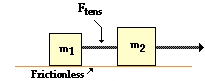 Consider two blocks that are connected by a light string. Their masses are 11.0 kg (m1) and 22.0 kg (m2). A force of 102 N is applied to the 22.0-kg block (m2) to pull the combination across a horizontal, frictionless surface.
 a. Determine the acceleration of the system of two blocks.
b. Determine the tension in the string which connects the two blocks.
Audio Guided Solution
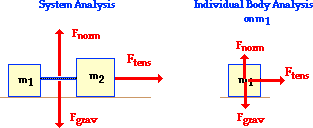
Problems 13 and 14 go together, so we'll use the same audio help file for each one of these. Now, the problem is a two-body problem. A force is applied to a system. We should actually say it's applied to M2, which is part of a system, to pull M1 and M2 horizontally across a frictionless surface. In problem 13, you wish to find the acceleration of the system, which would be the acceleration of either one of the objects. And in problem 14, you wish to find the tension in the string, which connects the two blocks. So, if I am to approach this problem, I have two approaches, and one is to do a system analysis and treat the two objects together as though they were a single object, in which case the light string that connects them becomes part of the object, or the system. And then I can perform an individual body analysis on either object 1 or object 2, it would matter not. And when I do such an individual body analysis, that light string that connects the object is now outside of the objects, and is not part of the system, it's not part of the object we're analyzing. So, you'll notice I've drawn free-body diagrams for the system, in which case that string that has connected them is not exerting a force on the system. And instead, what you have is the force is exerted to the front part of the system, that is object 2, and the force of gravity, and the normal force. And then I've also done an individual body analysis on object 1. In problems such as these, you typically do the system analysis to find the acceleration, and the individual body analysis to find the force that is within the system itself. And so, I'll proceed here by first noticing that the normal force and the gravity force are going to balance each other when treated as both a system or an individual body analysis, because there's no vertical acceleration. When I look at the system, what I notice is that there's one unbalanced force, and that's the force of the 102 newtons that's been applied to the front part of the system, to mass 2. So, F-net is 102 newtons, and I can set that equal to m times a, and the m is the mass of the system now, which is m1 plus m2, or 33 grams. So, straightforward mathematics from here to find the acceleration, it's just 102 divided by 33 is equal to the acceleration. Once I find it, I take a deep breath, and I prepare to answer problem 14, in which I have to determine the tension in the string. I do that through an individual body analysis. You could analyze m1 or m2, it wouldn't matter. I've chosen m1. It's actually the simpler mass to analyze, because there's only one tension force on m1. If you analyzed m2, there would be that forward force of 102 newtons, and then the force of m1 pulling back on m2 by means of that light string that connects them. That gives m2 four forces, two of which are horizontal. So, I've chosen m1. And I've drawn the forward force as the force in that light string that connects the object, and I've called it F-tension. And then there's the up and the down, which are balanced. So, now F-net for this object 1 is simply F-tension, and I can say it's equal to ma. F-tension equals ma, where the m is the mass of my object I'm analyzing, 11 kilograms, for object 1. And a is simply what you found when you answered problem 13. So, you know the whole right side of the equation. You can find F-tension as 11 times the answer to 13. Be certain you're not rounding the answer to 13 before you carry out the computation for 14. Good luck.
Solution
a = 3.09 m/s/s
Tension = 34 N
Habits of an Effective Problem Solver
An effective problem solver by habit approaches a physics problem in a manner that reflects a collection of disciplined habits. An effective problem-solver...
- ... read the problem carefully and develop a mental picture of the physical situation. If necessary, sketch a simple diagram of the physical situation to help you visualize it.
- ... identifies the known and unknown quantities in an organized manner, equating given values to the symbols used to represent the corresponding quantity - e.g., m = 1.25 kg, µ = 0.459, vo = 0.0 m/s, Ø = 41.6º, vf = ???.
- ... uses physics formulas and conceptual reasoning to plot a strategy for solving for the unknown quantity.
- ... identifies the appropriate formula(s) to use.
- ... performs substitutions and algebraic manipulations in order to solve for the unknown quantity.
Read About It!
Get more information on the topic of Newton's Laws at The Physics Classroom Tutorial.
- Mass and Weight
- Drawing Free Body Diagrams
- Newton's Second Law
- Determining Acceleration From Force
- Determining Individual Force Values
- Two Body Problems
Watch It!
Try our YouTube video on the topic of ...