Newton's Laws Audio Guided Solution NL20Q7
Problem Set NL20, Question 7:
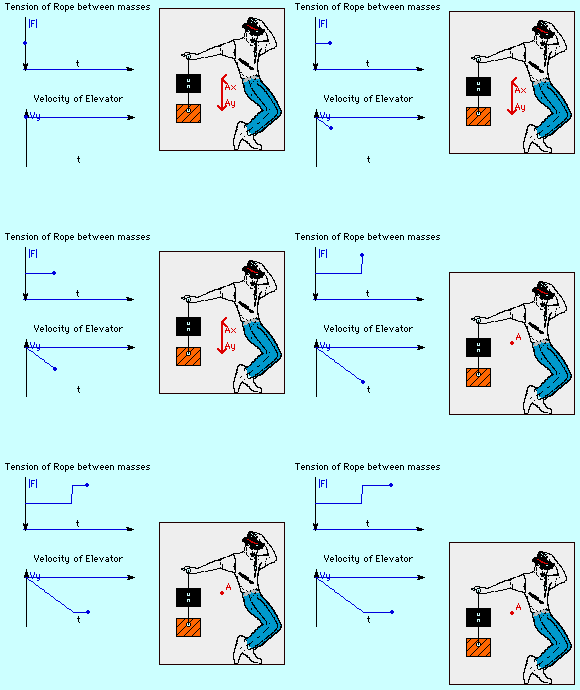
A person walks into an elevator holding two masses hanging on ropes, one below the other. The top mass is 5.20 kg and the lower mass is 3.40 kg. The elevator begins to move downward with an acceleration of 5.05 m/s/s before reaching a constant velocity. How much tension (in Newtons) is in the rope between the masses during the acceleration?
Audio Guided Solution
This problem could be classified as a two-body problem in which there's two masses accelerating together in the same direction, the direction in this case being down. There are also two ropes in this in this problem and so I'm going to refer to the ropes as top rope and bottom rope and what we wish to find in the problem is the tension in the bottom rope. Now as we approach problems like these typically what we do is we perform a system analysis to relate the forces upon the system to the acceleration of the system and then we perform an individual body analysis in which we relate the forces upon either one of our objects to the acceleration of the object. Now in this particular problem we already know the acceleration of the object and it's 5.05 meters per second squared which would mean we would probably be able to skip the part of the problem where we do the system analysis and what we wish to do is find the tension in the rope between the masses and so since that rope is the only rope attached to the bottom mass I'm just going to focus on the bottom mass at 3.4 kilogram mass and do an individual body analysis on the 3.4 kilogram mass. So if I draw the forces upon it there's just two, there's gravity down and then there's tension up and it's the tension that I wish to find in this problem. So I think this is going to be quite easy for us. We can say for the lower mass or bottom mass since it's accelerating downwards I'll take the force downwards minus the force upwards that's the force in the direction of acceleration minus the one that opposes it so I'll go 3.4 times 9.8 minus F tension equal 3.4 times 5.05 equal ma and you solve for F tension and it isn't that easy. Good luck to you.
Solution
16.2 N
(rounded from 16.15 N)
Habits of an Effective Problem Solver
An effective problem solver by habit approaches a physics problem in a manner that reflects a collection of disciplined habits. An effective problem-solver...
- ... read the problem carefully and develop a mental picture of the physical situation. If necessary, sketch a simple diagram of the physical situation to help you visualize it.
- ... identifies the known and unknown quantities in an organized manner, equating given values to the symbols used to represent the corresponding quantity - e.g., m = 1.25 kg, µ = 0.459, vo = 0.0 m/s, Ø = 41.6º, vf = ???.
- ... uses physics formulas and conceptual reasoning to plot a strategy for solving for the unknown quantity.
- ... identifies the appropriate formula(s) to use.
- ... performs substitutions and algebraic manipulations in order to solve for the unknown quantity.
Read About It!
Get more information on the topic of Newton's Laws at The Physics Classroom Tutorial.
- Mass and Weight
- Drawing Free Body Diagrams
- Newton's Second Law
- Determining Acceleration From Force
- Determining Individual Force Values
- Two Body Problems
Watch It!
Try our YouTube video on the topic of ...