Getting your Trinity Audio player ready...

Hold down the T key for 3 seconds to activate the audio accessibility mode, at which point you can click the K key to pause and resume audio. Useful for the Check Your Understanding and See Answers.

pH and pOH - helpApprentice

A pH scale is used as an indicator of the hydronium ion (H3O+) concentration in an aqueous solution. And a pOH scale is used as an indicator of the hydroxide ion (OH-) concentration in an aqueous solution.

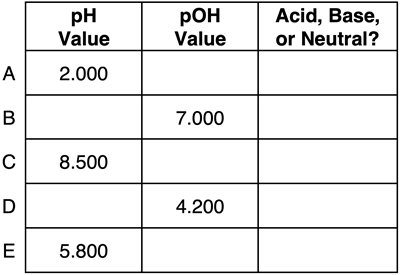
There are four tables for this difficulty level. Each table has the same basic structure with simply different numerical values. Here is one of the versions:
 

Version 1:

Express your understanding of pH, pOH, and the identity of a solution as being acidic, basic, or neutral by completing the table.
 

Help for Apprentice Difficulty Level

Water has a weak tendency to dissociate into ions - the hydronium ion (H3O+) and the hydroxide ion (OH-). The tendency of water to form these ions is so weak that the concentrations of ions in solution is very small. A pH scale is used as an indicator of the hydronium ion concentration. It is a logarithmic scale that is commonly used in science and math to express the magnitude of very large and very small numbers. Because the pH scale is a logarithmic scale, a low pH value is an indicator of a higher hydronium ion concentration.

A pOH scale is also used to indicate the concentration of the other ion - the hydroxide ion (OH-). At a temperature of 25°C, the product of these two ion concentrations is approximately 1.0 x 10⁻¹⁴. This fact is the basis of the pH-pOH relationship, at least for temperatures of 25°C. The pH value and the pOH value add up to 14.
pH + pOH = 14 (at 25°C)

A neutral solution has the same pH value as its pOH value. So a pH of 7 corresponds to a neutral solution. Any pH value less than 7 corresponds to an acidic solution and any pH value greater than 7 corresponds to a basic solution.