Skip to Content Skip to Header Navigation
Getting your Trinity Audio player ready...

Hold down the T key for 3 seconds to activate the audio accessibility mode, at which point you can click the K key to pause and resume audio. Useful for the Check Your Understanding and See Answers.

Case Studies: Electric Power - help15

The power rating of a light bulb indicates the rate at which that bulb emits light energy. It is sometimes referred to as the wattage of the bulb. A bulb with a greater power rating will be a brighter bulb. The power rating depends upon the bulb's resistance. But it also depends upon the voltage of the battery. These two variables - battery voltage and bulb resistance - influence the current that is in the bulb. So to summarize, the power rating of a bulb or bulb brightness can be related to the battery voltage, the bulb's resistance, and the current in the bulb.

There are two similar versions of this question. This is one of those versions.

Version 1:
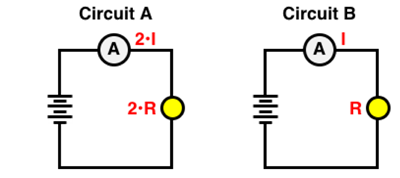
The current in Circuit A is two times the current in Circuit B. The light bulb in Circuit A has two times the resistance of the light bulb in Circuit B. Which circuit has the greatest power? ... and by what factor?
 

What Affects Power?
The power rating of a light bulb in this simple circuit depends upon the battery voltage (not mentioned in the question) and the bulb resistance (R). The current (I) in the bulb depends on the battery voltage; and the current is mentioned in the question. To determine which circuit has the most power and the factor by which it is greatest, you need to understand and apply the math relationship between power (brightness), current, and resistance.


The Relationship and Its Application
The relationship between power (P), current (I) and resistance (R) is given by the equation ...

P = I2•R

As should be obvious from the equation, a larger current results in a larger power. And a larger resistance also results in a larger power. Furthermore, a doubling of the current contributes to a quadrupling of the power (because of the power of 2 on I). And a doubling of the resistance causes a doubling of the power.

In this question, the circuit that has the larger current also has the larger resistance. Both factors contribute to this circuit having the greater power. As mentioned in the previous paragraph, the doubling of current contributes to a quadrupling of the power and having double the resistance results in a doubling of the power. Put these two effects together to determine the overall factor by which the power is greatest.

Try these links to The Physics Classroom Tutorial for more help with understanding power and the factors that affect it:

Power: Putting the Charges to Work

Electric Power Revisited

Return to Screen Reader Navigation