Atoms are composed of protons, neutrons and electrons. The protons and neutrons occupy the nucleus of an atom and give it its mass. The number of protons identifies the type of atom that it is - referred to as an element. Electrons are located outside of the nucleus and have the opposite type of charge as the protons. If the numbers of protons and electrons are equal, then the atom is neutral.
Getting your Trinity Audio player ready...
Hold down the T key for 3 seconds to activate the audio accessibility mode, at which point you can click the K key to pause and resume audio. Useful for the Check Your Understanding and See Answers.
Subatomic Particles - helpApprentice
The Apprentice Difficulty Level involves the completion of a table. There are four different versions of the table. Here is one of the versions.
Version 1:
Complete the following table.
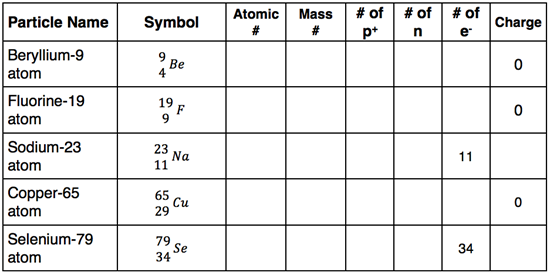
You have to complete a table of data for five different particles. Begin by examining the column headings of the table. Ask yourself What do I know about these terms?
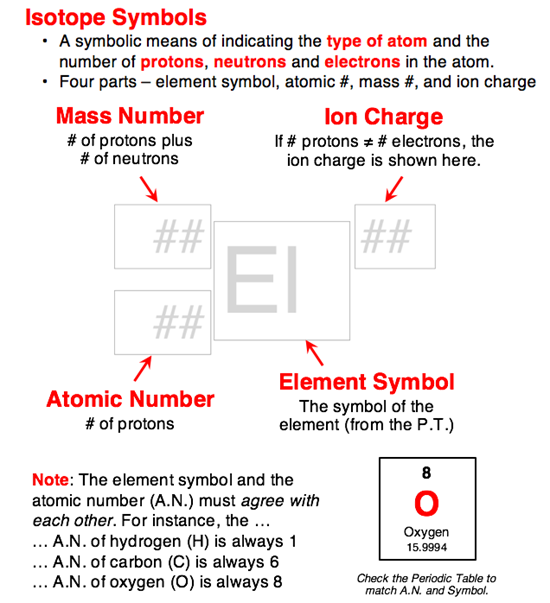
The particles are represented by a name and by a symbol. The symbols have two important numbers. The subscripted number is the atomic number. The atomic number represents the number of protons. The superscripted number is the mass number. The mass number represents the number of protons plus neutrons. Thus, simple subtraction of these two numbers provides the number of neutrons.
The particles in this table are all atoms (that is, they are not ions). That is, they are neutral particles and do not have an overall charge. Charges are the result of protons and electrons - the two charged subatomic particles. Protons and electrons have the opposite type of charge. So if a particle is neutral, the number of protons and electrons must be identical and the overall charge is zero.
The graphic below summarizes these ideas.
The particles in this table are all atoms (that is, they are not ions). That is, they are neutral particles and do not have an overall charge. Charges are the result of protons and electrons - the two charged subatomic particles. Protons and electrons have the opposite type of charge. So if a particle is neutral, the number of protons and electrons must be identical and the overall charge is zero.
The graphic below summarizes these ideas.