An open-end manometer is a device used to measure the gas pressure of a sample of gas. Its operation is built on the idea that gases push. And they can push with enough force to move a column of mercury along a U-tube. An open-end manometer is one in which one end of the U-tube is open to the surrounding atmosphere, allowing the atmospheric gases to push on one side of the mercury column while the gas sample pushes on the opposite end.
Getting your Trinity Audio player ready...
Hold down the T key for 3 seconds to activate the audio accessibility mode, at which point you can click the K key to pause and resume audio. Useful for the Check Your Understanding and See Answers.
Pressure Concepts - help11
There are three similar versions of this question. Here is one of those versions:
Version 1:
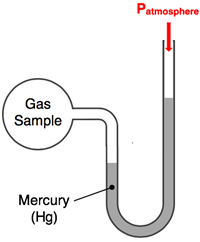 The diagram shows an open-end manometer being used to measure the pressure of a gas sample. The atmospheric pressure is 745 mm Hg. There is a height difference of 215 mm on the opposite sides of the U-tube, with the level being higher on the open-end side (i.e., the atmosphere's side).
Use this information to determine the pressure (in mm Hg) of the gas sample.