By definition, primary colors of light are light colors which produce white light when mixed together in equal intensities. The three primary colors of light are red light, green light and blue light. Mixing two primary colors of light in equal intensities results in secondary colors of light. There are three of those - cyan, magneta, and yellow.
Getting your Trinity Audio player ready...
Hold down the T key for 3 seconds to activate the audio accessibility mode, at which point you can click the K key to pause and resume audio. Useful for the Check Your Understanding and See Answers.
Color Addition and Subtraction - help1
There are two similar versions of this question. Here is one of those versions:
Version 1:
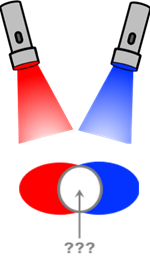 A room is darkened. Then two colored spotlights - one RED and one BLUE - shine onto a white screen. What color will the screen appear at the location where the two spotlights overlap?
The FundamentalsThis Concept Builder will demand that you understand both color addition and color subtraction. The graphic at the right is a great starting point. It shows the three primary colors of light - red, green, and blue. It also shows the three secondary colors of light - cyan, magenta, and yellow. It is important that you understand that a secondary color of light can be thought of as being equivalent to a mixture of two primary light colors. In other words ...
- Magenta light = Red light + Blue light
- Yellow light = Red light + Green light
- Cyan light = Blue light + Green light
This is called color addition.
Try this link to The Physics Classroom Tutorial for more help with the rules of color addition.
Color Addition