Getting your Trinity Audio player ready...

Hold down the T key for 3 seconds to activate the audio accessibility mode, at which point you can click the K key to pause and resume audio. Useful for the Check Your Understanding and See Answers.

Density Ranking Tasks - help11

Density is a physical property of every object that describes the mass per volume ratio. Using information about the mass (amount of stuff) and the volume (the amount of space) for two or more objects, one can make comparisions of their relatice densities.

There are three versions of this question. Here is one of the versions.
 

Version 1:

Four different liquids are used to prepare different density columns. Then three samples of household objects are shredded and dropped into each column. The diagrams show where the shredded materials settle. Rank the samples according to their density.
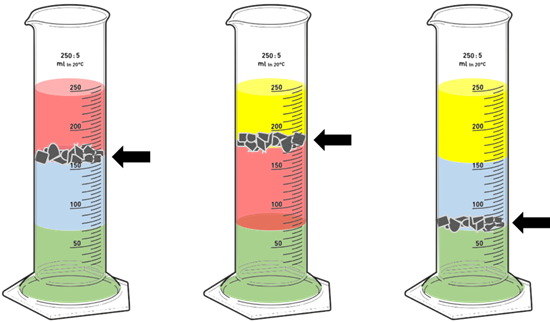
 

Whether a solid object floats on or sinks in a liquid depends upon whether the solid's density is less than or greater than the density of the liquid. If a solid is more dense than a liquid, then it will sink in that liquid. On the other hand, if a solid is less dense than the liquid, it will float on top of the liquid's surface. This is the fundamental principle that governs How to Think About This Situation.

The diagram in this question depicts three different density columns - a column of three immiscible (non-mixing) liquids that are layered on top of each other. For reasons just discussed, the bottom-most layer of each column is the most dense of the three liquids. The top-most layer is the least dense of the three liquids. A different solid material is added to the open end of the density column. The material will subsequently sink until it finally reaches a liquid having a greater density. As such, it is the density of the material relative to the density of the liquids that determines how far it will sink through the column. Analyzing each column allows you to determine which liquid(s) the solid is more dense than and which liquid(s) the solid is less dense than. By putting together the three observations, you will be able to draw conclusions about the relative density of the three samples of material.