Getting your Trinity Audio player ready...

Hold down the T key for 3 seconds to activate the audio accessibility mode, at which point you can click the K key to pause and resume audio. Useful for the Check Your Understanding and See Answers.

Linear and Angular Velocity - help6

The angular velocity refers rate at which an point rotates about the axis of rotation. It is typically expressed in radians/second, revolutions/minute (rpm), or degrees/second. The angular velocity can be related to the linear velocity and the distance the point is from the axis of rotation. See How to Think About This Situation for more details.

There are four similar versions of this question. Here is one of the versions:

Version 1:
In the World Peace Lab, a bucket filled with peas is whirled in a horizontal circle with varying radii and linear velocities. The circle radius (R) and linear velocity (v) for Case A and Case B are shown. How does the angular velocity of the two buckets compare to one another?
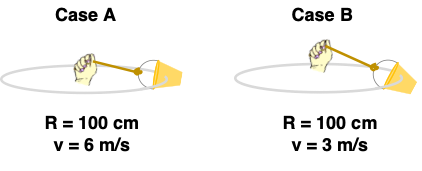
 
The angular velocity in Case A is ______ the angular velocity in Case B.
the same as
two times greater than
four times greater than
two times less than
four times less than

Angular velocity is the rate at which a point on the turntable rotates about its axis. This rate is measured as a change in the angular position divided by a change in time, Δθ/Δt. The linear velocity refers to a distance traveled per unit of time. It is sometimes referred to as the tangential velocity for an object moving in a circle.

These two velocity quantities are related. The linear velocity (v) for an object rotating in a circle of radius R is related to the angular velocity (ω) and the radius of the circle (R). The equation relating these quantities is

v = ω*R.

Since this question pertains to angular velocity, it is often useful to re-arrange the equation to the form of

ω = v/R.

This form of the equation leads to the claim that the angular velocity is directly proportional to the linear velocity and inversely proportional to the radius. In this question, the radius is the same for each bucket. So the bucket with the greatest linear velocity will have the greatest angular velocity. And since the two quantities ω and v are directly proportional, the bucket with twice the linear velocity will also have twice the angular velocity.

One way to conceptualize this is to think of angular velocity as the rate at which the angular position changes (Δθ/Δt). Each bucket is traveling along a circular path with the same circumference. But one bucket is traveling two times the distance along this circumference in the same amount of time. Because it is traveling along a greater distance along the arc of the circle, it will have a greater change in angular position ... and thus a greater angular velocity.

Try these links to The Physics Classroom Tutorial for more help with understanding the concept of angular position and displacement:

Sorry. We hope to add resources in the future.