Getting your Trinity Audio player ready...

Hold down the T key for 3 seconds to activate the audio accessibility mode, at which point you can click the K key to pause and resume audio. Useful for the Check Your Understanding and See Answers.

Molarity Calculations - help5

Not all solutions are created equal. Some are more concentrated than others. Molarity is one means of expressing how concentrated a solution is with solute. Molarity is defined as the number of moles of solute per liter of solution. Its units are mole/liter, sometimes abbreviated with a capital M. Knowledge of the moles of solute and the liters of solution allows one to calculate molarity by division.

There are three very similar versions of questions in this Question Group. One of the versions is shown below.

Version 1
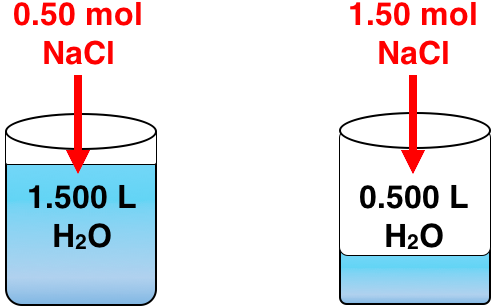
Tap on the fields to accurately complete the statement regarding Solutions A and B.


The solute concentration in Solution _______ is greater than the solute concentration in Solution _______ by a factor of ____________.
The molarity of a solution is equal to the moles of solute per Liter of solution.
 
Molarity = # moles solute / Liters of solution

When comparing the molarity of two solutions, the one with the greatest mole/volume ratio will have the greatest molarity. Increasing the number of moles has the effect of increasing the molarity. In this sense, the molarity is directly proportional to the number of moles. And increasing the volume has the effect of decreasing the molarity. And so the molarity is inversely proportional to the volume of solution.


Thinking Proportionally
In this question, the two solutions have both a different number of moles and a different volume. In the example provided above, Solution B has three times the number of moles, By itself, this would cause Solution B to have three times the molarity. But there is a second factor - the volume of solution. Solution B has one-third the volume. And by itself, this smaller volume would cause solution B to have three times the molarity. In the example provided, the two effects both favor Solution B. And so Solution B has the greater molarity. And
combining the effect of the greater number of moles (leading to three times the molarity) and the effect of the smaller volume (leading to three times the molarity), one would reason that Solution B has nine times the molarity of Solution A.


Alternative Method
The above approach emphasized reasoning in terms of proportionalities. While this is an important skill to develop, one can avoid it altogether by simply calculating two molarity values using the provided formula and then comparing the two calculated results.