Help for Master Difficulty LevelCalorimeters are used to determine the amount of heat exchanged between the system and the surroundings. The system is typically the chemicals under study. They may be undergoing a chemical reaction or a state change. The system might even be a chunk of hot metal undergoing some cooling. In a school chemistry lab, the surroundings is typically water in an insulated cup having a known mass (
m) and initial temperature (
Ti). As heat is exchanged between the system and surroundings, the water undergoes a temperature change to a final temperature of
Tf. The change in temperature (
∆T) is thus
Tf - Ti. If the process occurring in the system is exothermic, then heat is released to the surroundings and
∆T will be a positive value. On the other hand, if the process occurring in the system is endothermic, then heat is absorbed by the system from the surroundings and ∆T will be a negative value. The quantity of heat (
Q) exchanged can be determined using the equation
Q = m•C•∆T
The symbol
C represents the specific heat capacity of the calorimeter. For water calorimeters, the value of C is
4.18 J/(g•°C).
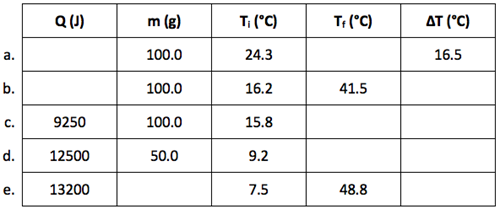
In this question, you are given a five-row table. You must complete each row of the table by providing two numerical values. Take some time to read and re-read the above paragraphs, being certain that you understand the four components of the equation. One of the blank cells is associated with the
∆T = Tf - Ti equation. The other blank is associated with the
Q = m•C•∆T equation.
You may need to do some algebraic arrangement of the equation in order to solve for m or ∆T. For instance, if you need to solve for m, then divide both sides of the equation by C•∆T. After doing so, the equation becomes
m = Q/(C•∆T)
Similar algebraic re-arrangements can be performed to derive a ∆T = ... equation.