The wavelength of a wave is the length of the repeating unit within the wave pattern. Knowledge of the length of the pattern and the number of waves (repeating units) present in the pattern allows one to determine the wavelength.
Getting your Trinity Audio player ready...
Hold down the T key for 3 seconds to activate the audio accessibility mode, at which point you can click the K key to pause and resume audio. Useful for the Check Your Understanding and See Answers.
Wave Basics - help9
There are three similar versions of this question. Here is one of those versions:
Version 1:
The diagram represents a snapshot in time of a wave traveling through a Slinky. Use the background grid to determine the wavelength of the wave. Each square measures 1-cm along its edge.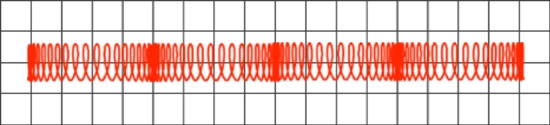
Try this link to The Physics Classroom Tutorial for more help with the concept of wavelength:
The Anatomy of a Wave