Skip to Content Skip to Header Navigation
Getting your Trinity Audio player ready...

Hold down the T key for 3 seconds to activate the audio accessibility mode, at which point you can click the K key to pause and resume audio. Useful for the Check Your Understanding and See Answers.

Wave Basics - helpMaster

When discussing waves, it is often useful to distinguish between the variety of types of waves. While all waves share a set of similar traits, waves that are of a different category possess characteristics that are unique and set it apart from waves of other categories. The unique features of the various categories are discussed in the How to Think About This Situation below.

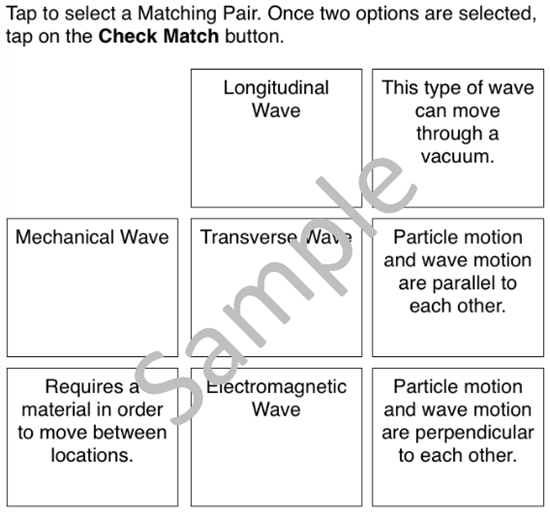
This activity presents learners with 8 different terms that must be matched by meaning. Learners tap on the terms to select them and then tap on the Check Match button. The order of the terms is randomized. A ms-matched pair restarts the gameand re-randomizes the order of the terms. The terms are ...
 

  1. Mechanical Wave
  2. Transverse Wave
  3. Particle motion and wave motion are parallel to each other.
  4. Requires a material in order to move between locations.
  5. This type of wave can move through a vacuum.
  6. Longitudinal Wave
  7. Particle motion and wave motion are perpendicular to each other.
  8. Electromagnetic Wave


Here is a sample screen layout:
 

A wave can either be an electromagnetic wave or a mechanical wave. It cannot be both. An electromagnetic wave is sometimes referred to as a light wave. The source of an electromagnetic wave is the vibration of a charged object. Vibrating objects create an electric and magnetic field that fluctuates in intensity over time and across space. While the vast majority of this Concept Builder is about mechanical waves, the one thing that you should know about electromagnetic waves is that they can travel through empty space. That is, an electromagnetic wave can travel through a region of space that does not contain any material - sometimes referred to as a vacuum. After all, an electromagnetic wave is an electric and magnetic signal that is propagating outward from the source of vibrating charge. Material is not required for that signal to move.

On the other hand, a mechanical wave exists because there is some sort of material object that is vibrating and forcing adjacent material into vibrating. Mechanical waves depend upon the vibration of physical material in order to exist. They cannot travel through a region of empty space; they cannot travel through a vacuum.

Mechanical waves are associated with the vibration of particles of the material (or medium) through which the wave moves. The movement of the wave pattern through the material depends upon the vibrations of the individual particles of the material. So a distinction is often made between the wave motion and the particle motion. And the next two categories - transverse waves and longitudinal waves - emerge from this distinction. A transverse wave can be a mechanical wave. A longitudinal wave is a mechanical wave. These can be thought of as sub-categories of mechanical waves. But a transverse wave cannot be a longitudinal wave.

When a transverse wave moves through a medium, the particles of the medium vibrate perpendicular to the medium. As such, the direction of particle motion and the direction of the wave motion are perpendicular to each other. These types of waves are characterized by the presence of crests and troughs.

When a longitudinal wave moves through a medium, the particles of the medium vibrate parallel to the medium. As such, the direction of particle motion and the direction of the wave motion are parallel to each other. You won't find crests and troughs on a longitudinal wave. Instead, there will be regions in which the particles are compressed together - called compressions. And there will be regions in wihch the particles are spread apart - known as rarefactions.

Try this link to The Physics Classroom Tutorial for more help with the different categories of waves:

Categories of Waves

Return to Screen Reader Navigation