Forces in 2D Audio Guided Solution F2D7Q5
Problem Set F2D7, Question 5:
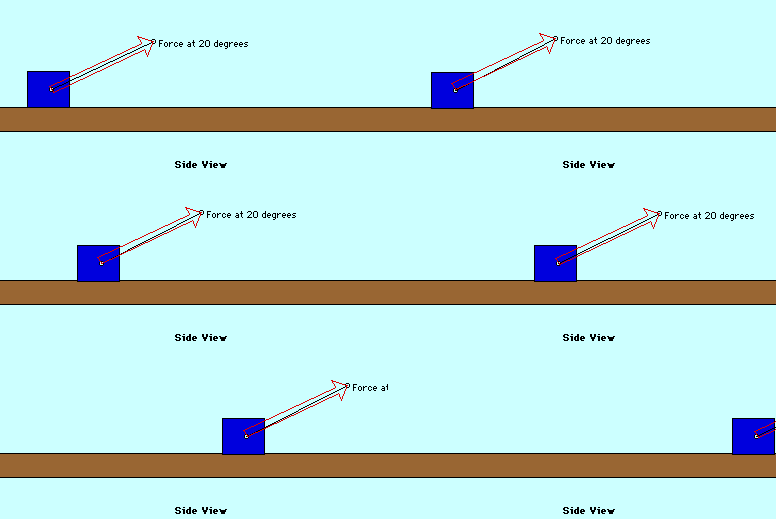
A 12.8 kg box rests on a frictionless surface. The box is pulled at an angle of 20 degrees with a force of 43.2 Newtons. If the force acts over a distance of 44.0 meters, what is the box's final velocity (in m/s)?
Audio Guided Solution
This problem involves a force exerted at an angle to the horizontal to accelerate a box across a horizontal surface. What complicates the problem is the fact that the force that's being applied is not applied in the direction of the acceleration, yet it has a component of force in the direction of the acceleration. So like any problem of this nature, you'd read it carefully, you'd visualize the situation, draw a free body diagram, plot out a strategy as to how to go from knowns to unknowns. So first I say M equals 12.8 kilograms. Then I say F applied equals 43.2 newtons and theta equals 20 degrees. And then in another column I should probably list the following. I should say V original is zero and D equals 44 meters and VF equals question mark. I wish to find the final velocity of a box if it's accelerated from rest for 44 meters of distance. So this is one of those problems where you're going to blend the kinematics in the Newton's laws analysis in order to find the final answer. So let's talk about the end part of the problem first. How do you find the final velocity? If you think about kinematics, you know that you have four equations, the big four, and each one has four quantities in it. So the whole idea is if you can find three, you can calculate a fourth. The fourth that we'd like to calculate is VF. And so what are the three that we know? Well, we know D equals 44, V original equals zero, and that's all we know. But since it's an F net equal MA problem, we should be able to calculate an acceleration from the force information. That would be the third piece of known information capable of calculating VF. That's what you'll do at the end of the problem. At the beginning of the problem, you're going to calculate A. And that's all about drawing a free body diagram on your box. So draw the forces up on the box. Of course, there's gravity down, there's normal up, and there's F applied, which is up at an angle of 20 degrees above the horizontal. So given that, what we could do is take the FF at 20 degrees and break it up into force components that are horizontal and vertical, an Fx and an Fy. The one of importance would be Fx because that's what's accelerating this box. So I'll just kind of take my free body diagram and break it up into an x and a y, and I want to find Fx, which is simply 43.2 times the cosine at 20 degrees. That gives me my Fx, and that is the net force since there's no friction here. Divide it by mass, and you've got the acceleration. Then go do the kinematics part of the problem. End the problems that easy. Good luck to you.
Solution
16.7 m/s
Habits of an Effective Problem Solver
An effective problem solver by habit approaches a physics problem in a manner that reflects a collection of disciplined habits. An effective problem-solver...
- ... read the problem carefully and develop a mental picture of the physical situation. If necessary, sketch a simple diagram of the physical situation to help you visualize it.
- ... identifies the known and unknown quantities in an organized manner, equating given values to the symbols used to represent the corresponding quantity - e.g., m = 1.25 kg, µ = 0.459, vo = 0.0 m/s, Ø = 41.6º, vf = ???.
- ... uses physics formulas and conceptual reasoning to plot a strategy for solving for the unknown quantity.
- ... identifies the appropriate formula(s) to use.
- ... performs substitutions and algebraic manipulations in order to solve for the unknown quantity.
Read About It!
Get more information on the topic of Vectors and Forces in Two-Dimensions at The Physics Classroom Tutorial.
Watch It!
Try our YouTube video on the topic of ...