Newton's Laws Audio Guided Solution NL20Q4
Problem Set NL20, Question 4:
Jed is using his Ford F-250 to pull some large logs along the gravel road at a constant speed back to the shed at the ranch. The logs are fastened to one another by a chain. They each weigh 1680 N. The pickup exerts a force of 1611 N on the front log. The force of friction on the front log is 882 N.
a. Determine the tension in the chain that connects the two logs.
b. Determine the force of friction on the back log.
Audio Guided Solution
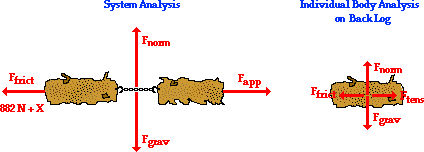
Problems 19 and 20 go together, so we'll use the same audio help file for each of these. The problem is what would be classified as a two-body problem, in which a force is applied to a system of two objects to move it across a horizontal surface. Now, what's unique about this two-body problem is that the velocity is constant, which means the objects are going to move with zero acceleration. The net force on each individual object is zero newtons, and the net force on the system of two objects is zero newtons. Typically, the way we approach problems as these is we approach them by conducting a system analysis, which ignores the force that connects the two objects. It ignores the chain connecting log-1 and log-2. And then we conduct individual body analysis, in which we focus on an individual object. I've done that here, and I've put in a graphic the free-body diagrams for the system and the free-body diagram for that back log. Now, what also complicates the situation is logs are not uniform things. It states the friction on the front log is 882 newtons, and since the back log and the front log have the same weight, you might presume that it's the same friction on the back log. In fact, it's not a great assumption because logs simply are not uniform. And even though their weights are the same, the mu-f norm is not necessarily the same because mu may be different depending on the nature of how the log touches the ground and so forth. So, as I approach this system analysis, what I've done is I've drawn the four forces on my system, the system being defined as the two logs plus the chain between them. And the applied force forward is simply the force of a tractor pulling on these logs, and that's 1611 newtons. And if the force is balanced, then the back force must also be 1611 newtons, which is the combined force of friction on the two logs, which would be the 882 newtons of friction on the front log plus the additional friction on the back log. And I've expressed that in the diagram as 882 newtons plus x, where x is the friction on the back log. If 1611 newtons forward is equal to 882 plus x backwards, then you should be able to solve for x, and when you do, you get, as an answer, 729 newtons. That would be the answer to problem 20, the force of friction on the back log. Now, if you wish to find the tension of the chain, you have to get out of the system and start to focus on an individual object, and either one will do, but I've chosen the back log because there's less forces on the back log. There's only two horizontal forces. One of them is the one we just determined, and that's the 729 newtons of backwards friction force on it. Now, if this log travels with a constant velocity, then that means the forward force must balance the backwards force, so the force transmitted on the back log by the chain is also 729 newtons, and that's your answer to problem 19. Now, I want to finish up with a little additional note here. You'll notice that I focused on the back log. I could have focused on the front log in doing the individual body analysis, and if I had, the way my free body diagram would have looked is I would have had the forward force of the tractor of 1611 newtons, and then I would have had two backward forces. One of them would have been the force of friction on this front log, and the other would be the tension force on this front log, which pulls backwards because the back log is transmitting that force to the front log, pulling backwards to resist the motion of the front log. So, as such, I would have had to say the forward force is equal to the sum of the two backwards forces. That would have been 1611 newtons equal to 882 newtons for friction, plus the tension force. When you do your math there, you'll note you get the same tension value of 729 newtons. The point being here is it matters not which object you analyze when you do your individual body analysis. Good luck.
Solution
a. Tension = 729 N
b. Friction on Back Log = 729 N
Habits of an Effective Problem Solver
An effective problem solver by habit approaches a physics problem in a manner that reflects a collection of disciplined habits. An effective problem-solver...
- ... read the problem carefully and develop a mental picture of the physical situation. If necessary, sketch a simple diagram of the physical situation to help you visualize it.
- ... identifies the known and unknown quantities in an organized manner, equating given values to the symbols used to represent the corresponding quantity - e.g., m = 1.25 kg, µ = 0.459, vo = 0.0 m/s, Ø = 41.6º, vf = ???.
- ... uses physics formulas and conceptual reasoning to plot a strategy for solving for the unknown quantity.
- ... identifies the appropriate formula(s) to use.
- ... performs substitutions and algebraic manipulations in order to solve for the unknown quantity.
Read About It!
Get more information on the topic of Newton's Laws at The Physics Classroom Tutorial.
- Mass and Weight
- Drawing Free Body Diagrams
- Newton's Second Law
- Determining Acceleration From Force
- Determining Individual Force Values
- Two Body Problems
Watch It!
Try our YouTube video on the topic of ...