Hold down the T key for 3 seconds to activate the audio accessibility mode, at which point you can click the K key to pause and resume audio. Useful for the Check Your Understanding and See Answers.
 In these first two lessons of the Circuits unit of The Physics Classroom, an effort has been made to present a model of how and why electric charge flows within an electric circuit. Terms have been defined and rules and principles presented and discussed. The goal has been to help students of physics to construct an accurate mental model of the world of current electricity. This goal is often impeded by the presence of preconceived ideas regarding the nature of charge flow and the role of a battery in a circuit. In many instances, these preconceived notions about charge flow and batteries are incorrect ideas and are completely inconsistent with the model presented here. Like all misconceptions in physics, they must be directly confronted in order to successfully build
  an accurate mental model of the physical world.
What Do You Believe?
To begin the exploration of these misconceptions, take a moment to respond the following five true-false statements. Then click the Check Answers button to view the correct answers.
Batteries Are Not Rechargeable
Batteries are not rechargeable. This statement ought to get some people's attention. The belief that an electrochemical cell is rechargeable may be the starting point of a logically developed collection of misconceptions that are completely inconsistent with the model of circuits presented in this unit. Let's suppose for a moment that an electrochemical cell is rechargeable; and let's suppose that when we say they are rechargeable, we mean that we can place the cell in a small machine and replace or replenish the charge that it has lost through use in a circuit. If an electrochemical cell is rechargeable and this is what we mean by rechargeable, then what logical consequences would this have on our understanding of circuits?
First, if an electrochemical cell is rechargeable, then it must be the source of charge within an electric circuit.  Obviously, if a cell must have its charge replenished or resupplied, then it must do so because its role is to supply the charge needed to operate an electric circuit. It would be reasonable to believe that the charge that flows through a circuit to operate a flashlight bulb must originate in the flashlight battery compartment. And perhaps it would be reasonable to believe that the charge that flows out of the cells and into the bulb becomes consumed or used up in such a manner that it does not flow out of the bulb in as much quantity as it flows into the bulb. The amount of charge exiting the bulb is less than that that enters the bulb. After all, one may think, electricity is used up by a circuit; perhaps what is being used up is the charge that is supplied by the electrochemical cells. And when the flashlight bulb no longer works, the cells inside must have lost all its charge and must be placed in this little recharging machine and be recharged.
The above paragraph represents a perfectly logical extension (though entirely inaccurate) of the belief that batteries are rechargeable. If you really do believe that an electrochemical cell is rechargeable, then you likely answered True to the first three statements of the True-False quiz at the opening of this  page. But the collection of misconceptions usually does not end with the above paragraph. The reasoning continues. If one believes that an electrochemical cell is the source of charge in a flashlight circuit, then one should also believe that charge must move through the wires of a circuit at a very fast speed. After all, one can clearly observe that the bulb lights immediately after the switch on the flashlight is turned to ON. There is no noticeable time delay between when the switch is flipped and when the light bulb lights. Thus, it is reasonable to believe that if charge is being supplied by the cells in the battery compartment, then it must travel through the 2 cm of wire from the battery to the light bulb in less than a millisecond. Whatever time it does take, it cannot be much since a time delay is never observed. The reasoning may continue as follows: a home is not powered by a battery, but rather by an electrical utility company. Instead of using electrochemical cells as the source of charge in a home, the electricity is supplied by the utility company. One could then easily imagine that the utility company must supply a countless number of electrons to homes each day in order to operate all the appliances that are used. These electrons travel at nearly the speed of light from the fuse box or electrical panel to the appliance when an appliance is turned on. This reasoning would explain why a light bulb lights immediately after the light switch is flipped to the ON position.
Getting the Right Mental Model
Again, the above two paragraphs represent a logical extension of the belief that an electrochemical cell is the source of charge in a circuit and that they must have their charged resupplied or replenished when they no longer work. This logic would lead a student of physics to answer True to all five statements of the True-False quiz at the beginning of this page. The problem with the reasoning above is that it leads to completely wrong conclusions. While the reasoning may be logical, the conclusions that it leads to are completely false due to its entirely incorrect initial premise - that batteries are rechargeable. It is important to realize that the mental model developed by such reasoning patterns is completely inconsistent with the model presented in Lessons 1 and 2 of this unit. Consider the following highlights discussed already in this unit and compare them to the conclusions drawn in the above paragraphs.
 An electrochemical cell supplies the energy needed to move a charge from a low potential location to a high potential location. See Lesson 1, Part c.
- The charge that flows through a circuit originates in the wires of the circuit. The charge carriers in wires are simply the electrons possessed by the atoms that make up the wires. See Lesson 2, Part c.
- Charge moves abnormally slowly - on average, about 1 meter in an hour - through a circuit. Yet as soon as a switched is turned to ON, charge located everywhere within the circuit begins to move. See Lesson 2, Part c.
- The rate at which charge flows is everywhere the same within an electric circuit. The rate at which charge flows into a light bulb is the same as the rate at which charge flows out of a light bulb. See Lesson 2, Part c.
- An electrical appliance such as a light bulb transforms the electrical energy of moving charge into other forms of energy such as light energy and thermal energy. Thus, the amount of electrical energy possessed by a charge as it exits an appliance is less than it possessed when it entered the appliance. See Lesson 1, Part c.
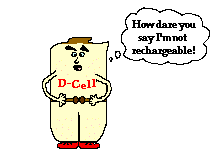
If an electrochemical cell is not rechargeable, then why do stores sell rechargeable cells for a higher cost? What kind of rip-off is that? The fact is that electrochemical cells that are referred to as rechargeable can be bought in stores. And these batteries can be placed in small machines that are called rechargers. And the process of doing so can extend the life of the battery. So as far as the consumer is concerned, it really isn't a rip-off at all. But as far as the physics teacher and physics student is concerned, it is a major offense because batteries should never be referred to as rechargeable.
Electric circuits are all about energy, not charge. When a battery no longer works, it is out of 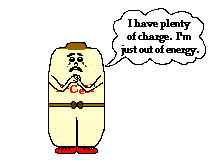 energy. A battery (or single cell) operates by packing a collection of reactive chemicals inside. These chemicals undergo an oxidation-reduction reaction that produces energy. This energy-producing reaction is capable of pumping the charge through the battery from low energy terminal to high energy terminal and establishing the electric potential difference across the external circuit. And when a battery no longer works, it is because the chemicals have been consumed to the point that the ability of the battery to move the charge between terminals has been severely diminished. When a battery no longer works, it is because the conversion of reactants to products have occurred to the extent that the energy-producing reaction is no longer able to do its job of pumping charge.
Some batteries are said to be rechargeable because this problem of the consumption of chemical reactants can be easily fixed. Such so-called rechargeable batteries rely upon a reversible reaction. The reaction can be run in the reverse direction, turning the chemical products back into chemical  reactants within the cell. Since the usual reaction which powers the circuit is an exothermic reaction (a fancy chemistry name for energy-producing), the reverse reaction is an endothermic reaction which requires energy in order to work. By placing the cell into a so-called recharger, the energy of a household electrical circuit can be used to drive the reaction in the reverse direction and transform the chemical products back into chemical reactants. This reverse process requires energy; it is the recharger which supplies the energy. With reactants replenished, the cell can now be used again to power the electric circuit. A true understanding of this process would lead one to refer to such cells as reversible or re-energizable; and the machines that are used to reverse the reaction would be properly referred to as re-energizers.
Electric circuits are all about energy, not charge. The charge is simply the medium which moves the energy from location to location. The batteries or other energy source does work upon the charge to supply it with energy and place it at a high electric potential. Charge at high electric potential will spontaneously begin its very slow migration towards the low potential terminal of the cell. Charge everywhere within the circuit moves together, like soldiers marching in step. As an individual charge moves through circuit elements such as light bulbs, its electrical energy is transformed into other forms of energy such as light energy and thermal energy. With many, many charges moving through the light bulb at the same time, there is a significant transformation of electrical energy to light energy to cause the light bulb filament to noticeably glow. Upon passage through a light bulb filament, an individual charge is less energized and at a lower electric potential. The charge completes its slow migration back to the low potential terminal where the electrochemical cell does work upon the charge again to move it back up to high electric potential. Once at high potential, the charge can begin its loop again through the external circuit.
As a student of physics, grasping the conceptual meaning of ideas is not always easy. It certainly is not a mere matter of memorizing information for future retrieval. Grasping the meaning of ideas demands the exertion of mental exercising. A student of physics must do some processing work. When it comes to understanding the model of charge flow through circuits, a student should take the time to ask:
- What do I believe?
 Is what I believe sensible and logical or simply a set of ideas which I acquired without a lot of thinking about it?
- Does what I believe explain the world which I observe?
- Are there any inconsistencies in my thought processes? Does belief A logically contradict belief B?
- Are there sensible and logical alternative beliefs that better explain the world which I observe?
Taking the time to think about these questions is one of the keys to dispelling incorrect misconceptions of the physical world and arriving with more accurate mental models.
In the next Lesson of this unit of The Physics Classroom, we will explore the cause for why energy is lost within the wires of the external circuit.