Hold down the T key for 3 seconds to activate the audio accessibility mode, at which point you can click the K key to pause and resume audio. Useful for the Check Your Understanding and See Answers.
In the quiet waters of the Orient, there is an unusual fish known as the Archer fish. The Archer fish is unlike any other fish in that the Archer fish finds its prey living outside the water. An insect, butterfly, spider or similar creature is the target of the Archer fish's powerful spray of water. The Archer fish will search for prey that are resting upon a branch or twig above the water. With pinpoint accuracy, the fish knocks the prey off the branch using a powerful jet of water. The prey falls to the water as the Archer fish simultaneously swims directly to the location on the surface where the prey strikes the water, wasting no time to retrieve its meal.
The feat of shooting a stream of water to knock the prey off a branch is remarkable. The fact that the Archer fish can do this time and again with pinpoint accuracy is even more remarkable. The fact that the fish can determine the exact location of incidence at which the prey will subsequently strike the water is incredibly remarkable. But most remarkable of all is that the Archer fish can accomplish this trick despite the fact that light from the prey to its eye undergoes refraction at the air-water boundary. Such refraction would cause a visual distortion, making the prey appear to be in a location where it isn't. Yet the Archer fish is hardly ever fooled. What is the secret of the Archer fish? How is it able to overcome the visual distortion caused by refraction in order to accomplish these remarkable hunting tasks? Biologists are not quite sure, though as of this writing it is a topic that is under considerable experimental investigation.
Now we will entertain the question: What if I was an Archer fish? What could I do to perform such a remarkable aquatic magic trick? Unlike a fish, I don't live in schools; nonetheless, there is a principle taught in schools that might assist me in such a trick. That principle is usually taught in a Physics classroom.
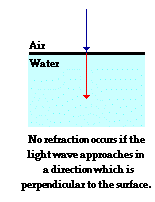
Passing Across a Boundary Without Bending
There is only one condition in which light can pass from one medium to another, change its speed, and still not refract. If the light is traveling in a direction that is perpendicular to the boundary, no refraction occurs. As the light wave crosses over the boundary, its speed and wavelength still change. Yet, since the light wave is approaching the boundary in a perpendicular direction, each point on the wavefront will reach the boundary at the same time. For this reason, there is no refraction of the light. Such a ray of light is said to be approaching the boundary while traveling along the normal. (The normal is a line drawn perpendicular to the surface.)
The only means by which I could remotely match the marvels of the Archer fish would be to line up my sight with the prey from a position directly underneath the prey. From this vantage point, light from the prey travels directly to my eye without undergoing a change in direction. Since the light is traveling along the normal to the surface, it does not refract. The light passes straight through the water to my eyes. Normally, when light from an object changes medium on the way to the eye, there is a visual distortion of the image. But if I sight along the normal, there is no refraction and no visual distortion of the image. From this ideal line of sight, I would be able to hit my prey time after time (assuming I could master the task of spraying a jet of water in the desired direction). Using my physics understanding of the refraction of light, I could pretend to mimic the Archer fish.
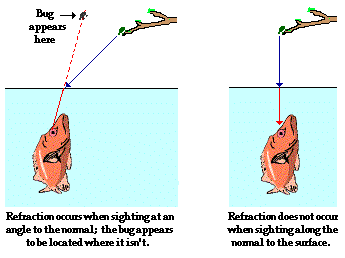
And now for the rest of the story. From this discussion, one might conclude that the secret of the Archer fish is to aim at its prey from directly below. Refraction is less when sighting along the normal. However, the Archer fish's accomplishments are more remarkable than that. It has been found that Archer fish are able to strike their prey when sighting upwards at angles of 40 degrees with the normal. In fact, it has been found that hit probabilities do not show significant variance with the angle of sighting, meaning that an Archer fish is just as likely to strike its prey whether the amount of refraction is great or minimal. Now that's remarkable!