The Big Idea
In this lesson, you will apply your knowledge of reaction types - synthesis, decomposition, combustion, single replacement, and double replacement - to identify the kind of reaction, predict the products, and write balanced chemical equations. Real-world examples and structured patterns will guide you through confidently forecasting reaction outcomes.
 Reaction Types
We have discussed five different reaction types in Lesson 2 with an interest in equipping a Chemistry student to predict the products of simple reactions. Synthesis and decomposition reactions were discussed in Lesson 2a. Combustion reactions were discussed in Lesson 2b. Single replacement reactions were discussed in Lesson 2c. And double replacement reactions were discussed in Lesson 2d.
Numerous examples of how to predict products and write balanced chemical equations were provided on each of these pages. Each reaction type was isolated to its own page. As such, it was relatively easy to predict products since the reaction type was obviously that which was being discussed on the particular page. Now we will see all of the reaction types mixed together on the same page. The goal is to be able to first identify the type, and then to use information about that type to predict the product. We will also write the balanced chemical equation for the reaction.
How to Use the Basic Structure of an Equation to Identify the Reaction Type
Let's begin with a quick review of the five reaction types. Additional details, explanations, and examples for a specific reaction type can be found by following the Learn more about … links below.
Synthesis: The reaction of two elements, an element and a compound, or two compounds to produce a single larger compound is known as a synthesis reaction. This reaction type is unique in that there is a single product. Both reactants are not necessarily free elements; but it is the only reaction type that could have two elements reacting together. The generic form for a synthesis equation is:
A + B → AB
Learn more about Synthesis Reactions.
Decomposition: In a decomposition reaction, a single compound breaks down and forms two or more smaller elements or compounds. This reaction type is unique in that there is only one reactant. The products are often (but not always) free elements. The generic form for a decomposition equation is:
AB → A + B
Learn more about Decomposition Reactions.
Combustion: In a combustion reaction, an element or a compound reacts with oxygen gas. This is sometimes referred to as burning. The products are oxides of the element(s) of the reactant. This reaction type is unique in that there are two reactants and one of them is oxygen. The generic form for a combustion equation is:
A + O2(g) → AxOy
(an element undergoes combustion)
AB + O2(g) → AwOx + ByOz
(a compound undergoes combustion)
Learn more about Combustion Reactions.
Single Replacement: In a single replacement reaction, one element replaces another element in a compound. This reaction type is unique in that there are two reactants; one is an element and the other is a compound. There are also two products – an element and a compound. The ionic compound is usually in the aqueous state. The generic form for a single replacement equation is:
AB + C → A + CB
Learn more about Single Replacement Reactions.
Double Replacement: There are two reactants in a double replacement reaction. They are both ionic compounds in the aqueous state. The cation from one compound switches places with the cation in the other compound. This reaction type is unique in that there are two reactants and they are both ionic compounds in the (aq) state. One of the products is a solid precipitate. The generic form for a double replacement equation is:
AB + CD → AD + CB
Learn more about Double Replacement Reactions.
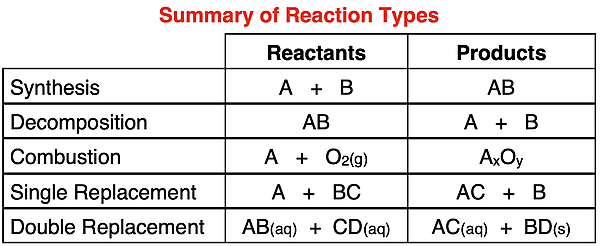
Summary of Reaction Types
The graphic below summarizes the information about these five reaction types:
Other Prerequisite Knowledge
The skill that we are attempting to develop is: if given the reactant names or formulae, predict the product formula(e) and write a balanced chemical equation.
To accomplish this skill, there are three pieces of prior knowledge and skill you must be able to practice. Each of these prior knowledge/skill areas have been addressed on other pages of our Chemistry Tutorial. We have provided links to the relevant pages below.
- Diatomic Elements:
There are seven elements on the periodic table that exist as diatomic elements when present in their free, natural state. Those elements can be remembered by the mnemonic HONClBrIF.
Learn more about Diatomic Elements.
- Formula Writing:
A formula includes elemental symbols and subscripts. There are specific rules for writing a formula. The rules vary depending on whether the compound is ionic or molecular. Some compounds contain polyatomic ions; a list of such ions is helpful.
Learn more about Formula Writing: Ionic Compounds || Molecular Compounds
- Balancing Equations:
Chemical equations are balanced by identifying all reactant and product formulae, writing the skeleton equation, and then inserting coefficients to balance the number of atoms of each element for both sides of the equation.
Learn more about Balancing Equations.
Predicting Products and Writing Balanced Chemical Equations
For the following examples, predict the likely product(s). Then write the balanced chemical equation. Tap the
View Answer button for an answer and explanation.
Example 1 - Predicting Products and Writing a Balanced Chemical Equation
Al(s) + CuCl
2(aq)
→ ???
Check Answer
Products: Cu(s) and AlCl3(aq)
This is definitely a single replacement reaction. The metal Al will replace the metal Cu in the compound. So, Cu gets replaced and becomes an isolated element. Like most metals (except Hg), it is a solid. The Al becomes part of the ionic compound with chloride ions. Al is a 3+ ion and so it forms AlCl3 with chloride (Cl-) ions.
Once the formulae are determined, the skeleton equation can be written. The skeleton equation includes formulae and state symbols without coefficients. Here is the skeleton equation:
Skeleton Equation: Al(s) + CuCl2(aq) → Cu(s) + AlCl3(aq)
Once the skeleton equation is written, coefficients can be inserted in front of formulae to balance the number of atoms of each element on both sides of the yields symbol.
Balanced Equation: 2 Al(s) + 3 CuCl2(aq) → 3 Cu(s) + 2 AlCl3(aq)
Example 2 - Predicting Products and Writing a Balanced Chemical Equation
NH
3(g)
→ ???
Check Answer
Products:
N2(g) and H2(g) This is definitely a decomposition reaction since there is only one reactant. Since the reactant contains two elements, there are two products – the elements nitrogen and hydrogen. These are both diatomic. And as most
periodic tables will indicate, they are both gases.
Once the formulae are determined, the skeleton equation can be written. The skeleton equation includes formulae and state symbols without coefficients. Here is the skeleton equation:
Skeleton Equation: NH
3(g)
→ N
2(g) + H
2(g)
Once the skeleton equation is written, coefficients can be inserted in front of formulae to balance the number of atoms of each element on both sides of the yields symbol.
Balanced Equation:
2 NH3(g) → N2(g) + 3 H2(g) Example 3 - Predicting Products and Writing a Balanced Chemical Equation
Mg(s) + O
2(g)
→ ???
Check Answer
Product:
MgO(s) This can be classified as either a combustion reaction (one reactant is O
2) or a synthesis reaction (two simple elements combining). Either way, the product is the oxide of magnesium. Magnesium oxide is an ionic compound. Writing the formula involves determining the charges of each ion from their location on the periodic table (Group 2 and Group 16), determining the
ion ratio, and then writing the formula.
Once the formulae are determined, the skeleton equation can be written. The skeleton equation includes formulae and state symbols without coefficients. Here is the skeleton equation:
Skeleton Equation: Mg(s) + O
2(g)
→ MgO(s)
Once the skeleton equation is written, coefficients can be inserted in front of formulae to balance the number of atoms of each element on both sides of the yields symbol.
Balanced Equation:
2 Mg(s) + O2(g) → 2 MgO(s) Example 4 - Predicting Products and Writing a Balanced Chemical Equation
CuCl
2(aq) + Na
3PO
4(aq)
→ ???
Check Answer
Products:
NaCl(aq) and Cu3(PO4)2(s) This is definitely a double replacement reaction since there are two reactants and they are both ionic compounds in aqueous solution. So, the products are the result of Cu and Na switching places – sodium chloride and copper(II) phosphate. Copper is a transition metal so there is more than one charge possibility. Here, copper is a 2+ ion; you know this because it forms CuCl
2 with the Cl
- ion. To write the formulae of the ionic compounds sodium chloride and copper(II) phosphate, you will need to determine the charges of each ion (phosphate is polyatomic; look it up
here), determine the ion ratio, and then write the formula. From a list of
solubility rules, you know NaCl is soluble and in the aqueous state. But phosphates like Cu
3(PO
4)
2 (Rule 8) are insoluble and would exist as a solid precipitate.
Once the formulae are determined, the skeleton equation can be written. The skeleton equation includes formulae and state symbols without coefficients. Here is the skeleton equation:
Skeleton Equation: CuCl
2(aq) + Na
3PO
4(aq)
→ NaCl(aq) + Cu
3(PO
4)
2(s)
Once the skeleton equation is written, coefficients can be inserted in front of formulae to balance the number of atoms of each element on both sides of the yields symbol.
Balanced Equation:
3 CuCl2(aq) + 2 Na3PO4(aq) → 6 NaCl(aq) + Cu3(PO4)2(s) Example 5 - Predicting Products and Writing a Balanced Chemical Equation
CH
4(g) + O
2(g)
→ ???
Check Answer
Product: CO2(g) and H2O(g)
This is definitely a combustion reaction because of the presence of oxygen gas as a reactant. The products are oxides of carbon and hydrogen. The most common of these are CO2 and H2O. In fact, this is a hydrocarbon combustion reaction. The products of hydrocarbon combustion are carbon dioxide gas and water vapor.
Once the formulae are determined, the skeleton equation can be written. The skeleton equation includes formulae and state symbols without coefficients. Here is the skeleton equation:
Skeleton Equation: CH4(g) + O2(g) → CO2(g) + H2O(g)
Once the skeleton equation is written, coefficients can be inserted in front of formulae to balance the number of atoms of each element on both sides of the yields symbol.
Balanced Equation: CH4(g) + 2 O2(g) → CO2(g) + 2 H2O(g)
Example 6 - Predicting Products and Writing a Balanced Chemical Equation
Mg(s) + S(s)
→ ???
Check Answer
Product:
MgS(s) This is a synthesis reaction between two elements. The product is the compound formed from these two elements. It would be magnesium sulfide. It is an ionic compound since Mg is a metal and S is a nonmetal. Writing the formula involves determining the charges of each ion from their location in the periodic table (Group 2 and Group 16), determining the
ion ratio, and then writing the formula.
Once the formulae are determined, the skeleton equation can be written. The skeleton equation includes formulae and state symbols without coefficients. Here is the skeleton equation:
Skeleton Equation: Mg(s) + S(s)
→ MgS(s)
Once the skeleton equation is written, coefficients can be inserted in front of formulae to balance the number of atoms of each element on both sides of the yields symbol.
Balanced Equation:
Mg(s) + S(s) → MgS(s) (Balanced as is.)
Before You Leave - Practice and Reinforcement
Now that you've done the reading, take some time to strengthen your understanding and to put the ideas into practice. Here's some suggestions.
- We highly recommend our Writing Balanced Chemical Equations Concept Builder. You will get plenty of interactive practice with immediate feedback and opportunities to make corrections as you predict products and balance equations.
- The Check Your Understanding section below includes questions with answers and explanations. It provides a great chance to self-assess your understanding.
Check Your Understanding of Predicting Products
Use the following questions to practice the skill of predicting products and writing balanced chemical equations. Tap the
Check Answer buttons when ready.
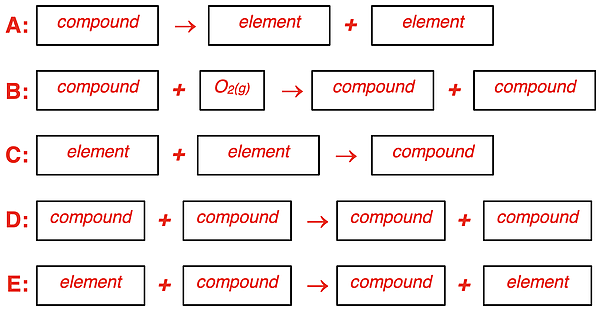
1. Each of the following diagrams represents a reaction type. Identify each reaction type.
Check Answer
Answers:
A: Decomposition
B: Combustion
C: Synthesis
D: Double Replacement
E: Single Replacement
2. For each of the following reactions:
Classify the following reaction according to its type, predict the products, write a skeleton equation, and then write the balanced chemical equation.
- F2(aq) + CuI2(aq) →
Check Answer
This is a single replacement reaction. Fluorine is a more reactive nonmetal than iodide and will replace iodide in the compound. And so the two products are I2(s) and CuF2(aq). The skeleton equation is
F2(g) + CuI2(aq) → I2(s) + CuF2(aq)
The above equation is balanced as is and no coefficients are required to balance it.
- NH4Br(aq) + Pb(NO3)2(aq) →
Check Answer
This is a double replacement reaction of two ionic compounds. The cation of one replaces the cation of the other. Put another way, the cations exchange anion partners. And so the products become
PbBr2(s) and NH4NO3(aq). A check of the
Solubility Rules (particularly the Rule 3 exceptions) reveals that lead bromide is insoluble and will precicpitate as a solid. Ammonium nitrate is soluble and in the aqueous state. The skeleton equation is:
Skeleton Equation: NH
4Br(aq) + Pb(NO
3)
2(aq)
→ PbBr
2(s) + NH
4NO
3(aq)
Coefficients can be inserted in front of the formulae to balance the elements. The balanced chemical equation is:
Balanced Equation:
2 NH4Br(aq) + Pb(NO3)2(aq) → PbBr2(s) + 2 NH4NO3(aq)
- H2O(l) →
Check Answer
This is definitely a decomposition reaction since there is only one reactant. Under the influence of electricity (usually), water will decompose into its elements. So the products are H2(g) and O2(g). Both products are diatomic and both are gases. The skeleton equation is
Skeleton Equation: H2O(l) → H2(g) + O2(g)
Coefficients can be inserted in front of the formulae to balance the elements in the equation. The balanced checmical equation is
Balanced Chemical Equation: 2 H2O(l) → 2 H2(g) + O2(g)
- C3H8O(s) + O2(g) →
Check Answer
This is a hydrocarbon combustion reaction and so the products are carbon dioxide gas and water vapor - CO2(g) and H2O(g). The skeleton equation can now be written:
Skeleton Equation: C3H8O(l) + O2(g) → CO2(g) + H2O(g)
Inserting whole number coefficients in front of the formulae turns the skeleton equation into a balanced chemical equation:
Balanced Equation: 2 C3H8O(l) + 9 O2(g) → 6 CO2(g) + 8 H2O(g)
- Al(s) + SnCl4(aq) →
Check Answer
This is a single replacement reaction. The aluminum will replace the tin. The products are tin and aluminum chloride - Sn(s) and AlCl3(aq). The skeleton equation can now be written:
Skeleton Equation: Al(s) + SnCl4(aq) → Sn(s) + AlCl3(aq)
Inserting coefficients in front of the formulae to balance the three elements will result in a balanced chemical equation:
Balanced Chemical Equation: 4 Al(s) + 3 SnCl4(aq) → 3 Sn(s) + 4 AlCl3(aq)
- Na2CO3(aq) + Ba(NO3)2(aq) →
Check Answer
This is a double replacement reaction of two ionic compounds. The cation of one replaces the cation of the other. Put another way, the cations exchange anion partners. And so the products become
BaCO3(s) and NaNO3(aq). A check of the
Solubility Rules (particularly Rule 8) reveals that barium carbonate is insoluble and will precicpitate as a solid. Sodium nitrate is soluble and in the aqueous state. The skeleton equation is:
Skeleton Equation: Na
2CO
3(aq) + Ba(NO
3)
2(aq)
→ BaCO
3(s) + NaNO
3(aq)
Coefficients can be inserted in front of the formulae to balance the elements. The balanced chemical equation is:
Balanced Equation:
Na2CO3(aq) + Ba(NO3)2(aq) → BaCO3(s) + 2 NaNO3(aq)
- S(s) + O2(g) →
Check Answer
This is a combustion reaction (but also a synthesis reaction). The two elements combine to form an oxide of sulfur. The most common oxide of sulfur is SO2(g) ... but that would be difficult to know without a Google search so just get some oxide of sulfur there on the product side.
Skeleton Equation: S(s) + O2(g) → SO2(g)
The equation can be balanced by inserting coefficients in front of the formulae. It ends up that if SO2(g) is picked as the oxide product, then the equation is already balanced and coefficients are not needed. If a different sulfur oxide formula - like SO(g) - was picked, then coefficients would be required to balance it.