Solubility Rules
Here is a handy collection of solubility rules for predicting whether or not an ionic compound will or will not dissolve in water. Learn more.
Soluble Compounds: Soluble ionic compounds include those with:
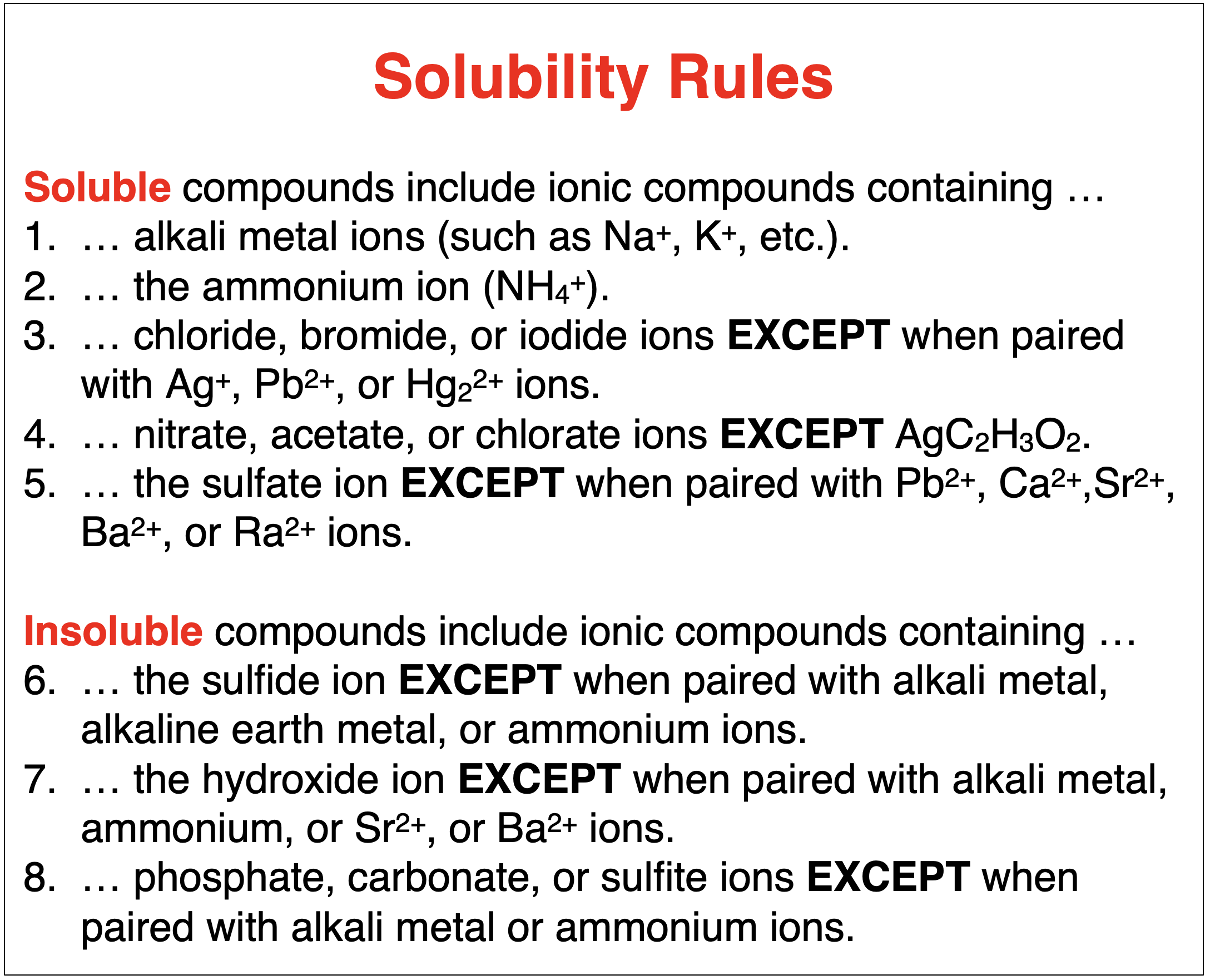
- Alkali metal ions (like \(\eNa^⁺\), \(\eK^⁺\), etc.).
- The ammonium ion (\({\eN\eH_4}^{⁺}\)).
- Chloride, bromide, or iodide ions, EXCEPT when paired with \(\eAg^{+}\), \(\ePb^{2+}\), or \(\eHg_2^{2+}\) ions.
- Nitrate, acetate, or chlorate ions, EXCEPT \(\eAg\eC_2\eH_e\eO_2\).
- The sulfate ion, EXCEPT when paired with \(\ePb^{2+}\), \(\eCa^{2+}\), \(\eSr^{2+}\), \(\eBa^{2+}\), or \(\eRa^{2+}\) ions.
Insoluble Compounds: Insoluble ionic compounds include those with:
- Sulfide ions, EXCEPT when paired with alkali metal, alkaline earth metal, or ammonium ions.
- Hydroxide ions, EXCEPT when paired with alkali metal, ammonium, \(\eSr^{2+}\), or \(\eBa^{2+}\) ions.
- Phosphate, carbonate, or sulfite ions, EXCEPT when paired with alkali metal or ammonium ions.
Download: Solubility Rules