Chapter 4: Compounds, Names, and Formulas - Lesson 2: Molecular Compounds
Names and Formulae
Getting your Trinity Audio player ready...
Hold down the T key for 3 seconds to activate the audio accessibility mode, at which point you can click the K key to pause and resume audio. Useful for the Check Your Understanding and See Answers.
The Big Idea
Binary molecular compounds are formed from two nonmetal elements. This lesson explains how to write formulae and name molecular compounds. The page explains when and how to use Greek prefixes and -ide endings.Binary Molecular Compounds
A binary molecular compound consists of atoms of two nonmetal elements. Examples include H2O, CH4, NH3, CO2, PCl3, etc. When a main group metal and nonmetal form an ionic compound, the formula of that compound is predictable. Calcium and chlorine always form CaCl2 and aluminum and oxygen always form Al2O3. This is not the case for molecular compounds. Carbon and oxygen can form CO or CO2. Sulfur and oxygen can form SO2 or SO3.How to Write Names of Molecular Compounds
The name of a molecular compound must communicate which elements and the number of atoms of each that are in the compound. This communication must be done such that the formula and identify of the compound is clearly known without any ambiguity.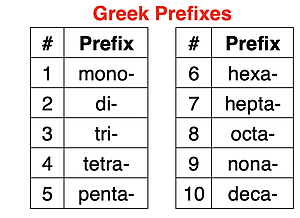 Every binary molecular compound consists of two words. The first word is the name of the first element listed in the formula. The second name is for the element listed in the formula. The ending of the second element is removed and replaced with the -ide suffix. Each name is preceded by Greek prefixes to indicate the number of atoms. See table at right. The prefix mono- is never used in front of the first name; it is however used in front of the second name when appropriate. If you don't see a prefix in front of the first element, then assume there is only one of that atom. If a Greek prefix ending in "a" is followed by an element name starts with "o", then the a is removed. Instead of tetraoxide, the "a" is dropped and tetroxide is used.
Examples of Names of Molecular Compounds
Here are several examples of names being derived from their formulae (plural for formula).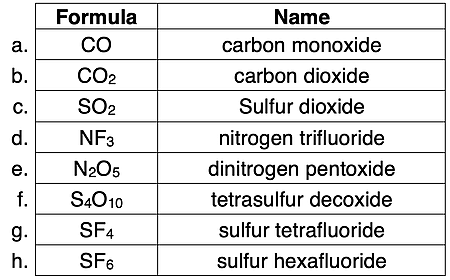
There is additional practice in the Check Your Understanding section.
How to Write a Formula for a Molecular Compound
If you understand how to name a molecular compound, the determination of the formula from the name is a straightforward task. But be aware that subscripts are never reduced to the lowest whole number ratio. Tetrasulfur decoxide is S4O10 and is not reduced to S2O5. The name tetrasulfur decoxide refers to a molecule that contains 4 atoms of sulfur and 10 atoms of oxygen. This is quite different than ionic compounds in which the subscripts are reduced where applicable. As discussed in Lesson 1, ionic compounds are not composed of molecules and the formula states the simplest, whole number ratio of ions in the crystal lattice.Examples of Formulae for Molecular Compounds
Here are several examples of formulae being derived from names.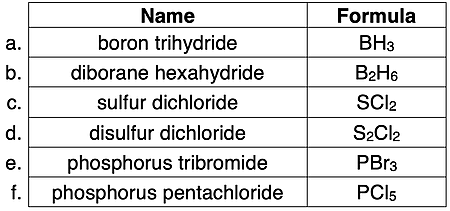
There is additional practice in the Check Your Understanding section.
Before You Leave - Practice and Reinforcement
Now that you've done the reading, take some time to strengthen your understanding and to put the ideas into practice. Here's some suggestions.
- Download our Study Card on Binary Molecular Compounds (Names and Formulae). Save it to a safe location and use it as a review tool.
- Try our Concept Builder titled Names to Formula 2. The first activity (Apprentice Level) would provide great practice with identifying the formulae for binary molecular compounds.
- The Check Your Understanding section below includes questions with answers and explanations. It provides a great chance to self-assess your understanding.
Check Your Understanding of Names and Formulae of Molecular Compounds
Use the following questions to practice your skill at naming and formula writing for molecular compounds. Tap the Check Answer buttons when ready.1. Indicate the name that is consistent with the following molecular formulae.
- SiO2 → Check Answer
- N2O → Check Answer
- NCl3 → Check Answer
- P2O5 → Check Answer
- SCl4 → <Check Answer
- XeF6 → Check Answer
- IF7 → Check Answer
- N2O4 → Check Answer
2. Indicate the formula that is consistent with the following names.
- dihydrogen monoxide → Check Answer
- sulfur tetrachloride → Check Answer
- tetraphosphorus hexafluoride → Check Answer
- xenon tetrafluoride → Check Answer
- dichlorine heptoxide → Check Answer
- carbon tetrachloride → Check Answer