Chapter 3: Elements, Atoms, and Ions - Lesson 1: In Search of the Atom
Subatomic Particles
Hold down the T key for 3 seconds to activate the audio accessibility mode, at which point you can click the K key to pause and resume audio. Useful for the Check Your Understanding and See Answers.
The Big Idea
This lesson describes the world of subatomic particles (from electrons to protons and neutrons), explaining how their charges, masses, and roles affect the structure and behavior of atoms in modern chemistry.
Is the Atom Really Indivisible?
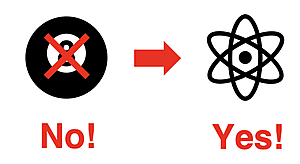 We started Lesson 1 by discussing the effort of natural philosophers like Democritus and scientists like John Dalton to establish a reasonable belief in the atom as the indivisible building block of matter. Dalton was indeed successful in convincing the scientific world of the value and validity of thinking in terms of atoms. But the concept of the atom as indivisible was quickly dispelled by the work of J.J. Thomson (1899) and Ernest Rutherford (1911). The atom is not a solid, miniaturized billiard ball with no internal structure or contents. By 1911, it was well understood that the atom contained electrons and protons. And there was plenty of evidence suggesting that there may be a third particle contained in an atom.
 Discovery of the Neutron
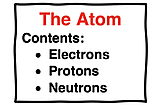
In 1932, English physicist James Chadwick, a student of Ernest Rutherford, conducted studies of the element beryllium. When bombarding beryllium with alpha particles, Chadwick observed the emission of neutral particles. Chadwick confirmed that the particles had no charge and had a mass similar to the mass of a proton. Chadwick named these particles neutrons.
A Comparison of Three Subatomic Particles
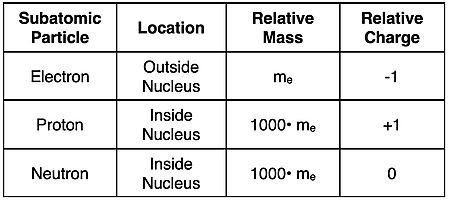
The proton, the neutron, and the electron are the three so-called subatomic particles. The proton and neutron are each approximately 1000 times more massive than the electron. And both are located in the nucleus. This means that nearly all the mass of an atom is located in its very dense center. The positive charge (possessed by protons) is in the nucleus and the negative charge (possessed by electrons) is outside the nucleus. For an electrically neutral atom, the number of electrons must equal the number of protons.
The Empty Space Model
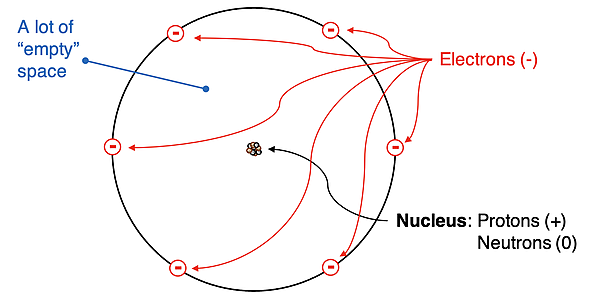
The Rutherford atomic model and the Bohr atomic model are both considered nuclear models. That is, there is a dense, positively charged and massive nucleus at the core of the atom. The electrons are located outside the nucleus. And for both Rutherford and Bohr, those electrons can be thought of as being in orbit. The size of the nucleus is miniscule when compared to the size of the atom. Consider this comparison:
Put another way, the atom is about 100 000 times the size of its nucleus. When given these relative dimensions, one can imagine the atom as being primarily empty space.
The Rest of the Story
The story of the atom's structure will continue in Chapter 5. For now, we need to learn the story of how the elements were organized into the Periodic Table. Continue to the Lesson 2 to learn the story of how a Russian chemist by the name of Dimitri Mendeleev organized the known elements into rows and columns.
Before You Leave - Practice and Reinforcement
Now that you've done the reading, take some time to strengthen your understanding and to put the ideas into practice. Here's some suggestions.
- The Check Your Understanding section below includes questions and problems with answers and explanations and solutions. It provides a great chance to self-assess your understanding.
- Download our Study Card on Subatomic Particles. Save it to a safe location and use it as a review tool.
Check Your Understanding of Subatomic Particles
Use the following questions to assess your understanding of subatomic particles. Tap the Check Answer buttons when ready.1. Identify the following statements as being TRUE or FALSE. If false, correct the statement or explain what is incorrect about it.
- Most of the charge of the atom is located in the nucleus. Check Answer
- The nucleus is mostly empty space. Check Answer
- The proton and the electron have the opposite types of charge. Check Answer
- The mass of a proton or a neutron is approximately 1000 times the mass of an electron. Check Answer
- Most of the mass of the atom is located in the nucleus. Check Answer
- The expanse of an atom consists primarily of empty space. Check Answer
- Most of the volume of the atom is attributed to the size of the nucleus. Check Answer
- Mass is uniformly distributed throughout the mass of the atom. Check Answer
- The proton and the neutron have the opposite type of charge. Check Answer
- The positive charge of an atom is in the nucleus and the negative charge is outside the nucleus. Check Answer
- The neutrons are located in the nucleus. The protons and electrons are located outside the nucleus. Check Answer