Units and Measurements - Lesson 1: Units and Quantitative Science
Units and the Metric System
Hold down the T key for 3 seconds to activate the audio accessibility mode, at which point you can click the K key to pause and resume audio. Useful for the Check Your Understanding and See Answers.
The Big Idea
This lesson will increase your fluency in using the metric system, helping you with base units like meter, liter, and gram and their Greek prefixes (e.g., milli-, centi-, kilo-). The illustrations and strategies will improve your confidence to perform unit conversions in chemistry.
The Three Traits of a Measurement in Chemistry
We learned in Lesson 1 that Chemistry is a lab science. There will be measurements. There will be numbers. But a measurement involves more than a number. There are three types of information included in every measurement. They are the …
- Numerical value
- Unit of measurement
- Degree of precision
The numerical value is obvious. The degree of precision pertains to how many digits (or decimal places) are allowed by the measuring tool. The degree of precision will be thoroughly discussed in Lesson 3. The focus of this page will be on the unit of measurement.
Base Quantities and Base Units
The Metric System (or Systemes International, SI) is a widely adopted system of measurement used in nearly every country. At the heart of the metric system is the acceptance of seven base quantities and seven base units of measurements for those quantities.
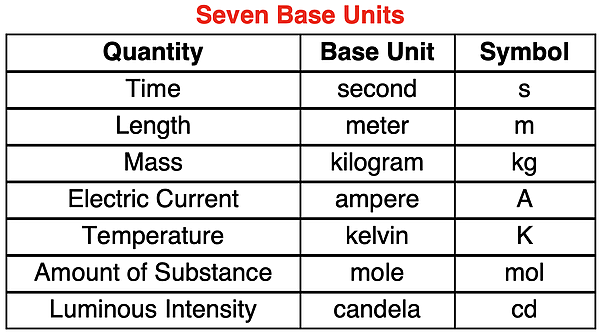
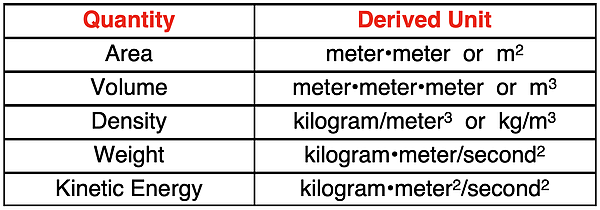
Other quantities beyond these seven are derived quantities formed by combining two or more base quantities. The unit on a derived quantity is determined by the units of the base quantity from which it is formed. Speed is one of many examples of a derived quantity. Speed is a length divided by a time and has units of meter/second. There is an unlimited number of derived quantities and units that can be formed from multiplying or dividing base quantities and units.
Greek Prefixes
The metric system is a decimal-friendly system. The base units can be modified by Greek prefixes that describe a different unit that is some power of ten larger or smaller than the base unit. Because of this power-of-ten foundation, conversion from one unit to another involves the movement of a decimal point a specified number of places. Such decimal point movements are equivalent to multiplying or dividing by some power of 10 (10n).
You are likely familiar with many of the Greek prefixes. The prefix kilo- is used to modify base units gram and meter to form kilogram and kilometer. The prefix centi- is used to modify base unit meter to form centimeter. And the prefix milli- is used to modify the base unit liter to form milliliter. Other Greek prefixes and their meaning are shown in the table below.
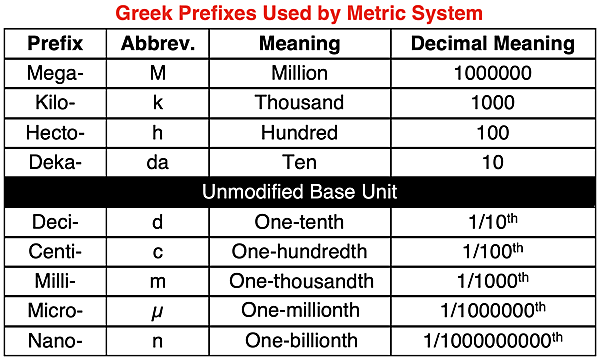
The meaning of the Greek prefixes allows a student to relate a unit to a base unit. Below we relate the base unit liter to other units that utilize a Greek prefix:
Kilo- means 1000. So, 1 kiloliter = 1000 liter.
Centi- means 1/100. So, 1 centiliter = 1/100 of a liter = 0.01 liter.
Milli- means 1/1000. So, 1 milliliter = 1/1000 of a liter = 0.001 liter.
Relating Metric Units
Since the metric system is a decimal system, most conversions involve multiplying or dividing by some power of 10. You can also think of this as the movement of a decimal point to the left or to the right. The virtue of the system is quite obvious when it is contrasted with non-metric alternatives. Consider the following equivalencies for distance units commonly used in the United States:
1 mile = 1760 yards = 5280 feet = 63360 inches
With the metric system, relating one metric unit to another metric unit becomes a matter of moving a decimal point some number of places. For instance,
1 kilometer = 1000 meter = 100000 centimeter = 1000000 millimeter
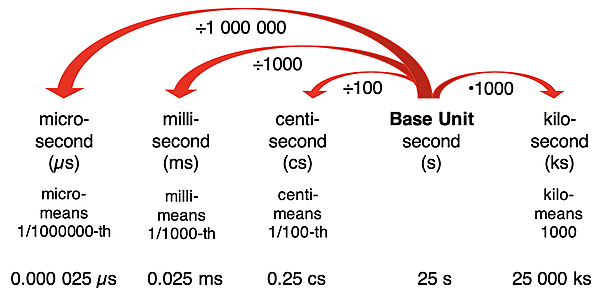
If you must convert 6.2 miles to feet, you will need a calculator. But if you must convert 6.2 kilometers to centimeters, you simply need to count out the proper number of places by which to move the decimal point. The graphic below illustrates how a time of 25 seconds can be converted to other metric units by multiplying or dividing by a power of 10.
Staircase Model of Metric Conversion
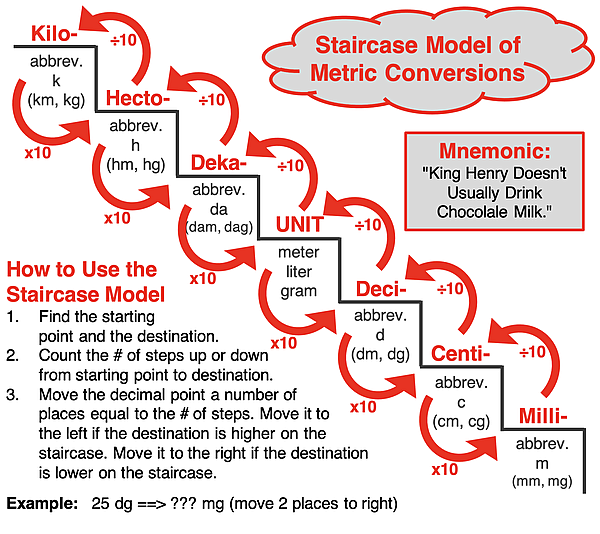
The staircase model is a commonly used approach for converting between metric units. It is illustrated below. The six metric units displayed on the steps of the staircase can be remembered by the mnemonic King Henry Doesn't Usually Drink Chocolate Milk. The first letter of each word represents the abbreviated symbol of a Greek prefix, beginning with the top step – Kilo (k) – and ending with the bottom step – Milli (m). The U of Usually represents the base unit. Each step is one power of 10 different than its neighboring step. So, converting from one unit to another unit three steps away involves moving the decimal place three places. The decimal place should be moved to the left if converting to a unit that is higher on the staircase. The decimal place should be moved to the right if converting to a unit that lower on the staircase.
Thinking Metric
Regrettably, the metric system is not widely used in the United States. The only professionals who use the metric system are science teachers, scientists, and engineers. The result is that most school-age children are metric-ignorant and largely unable to conceive of the meaning of such metric units as liter, meters, or grams. Study the examples below to gain an internalized feel for metric units.
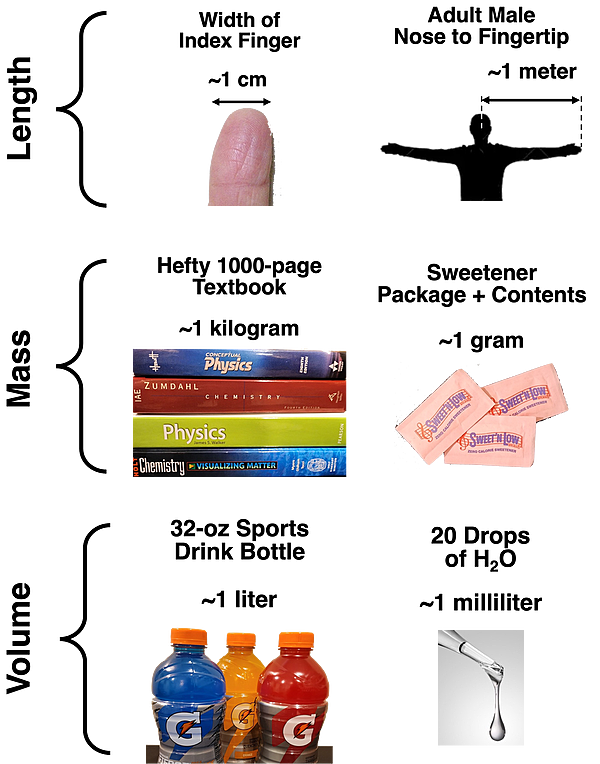
Image Credit: Water Drop (from www.freepick.com)
Before You Leave - Practice and Reinforcement
Now that you've done the reading, take some time to strengthen your understanding and to put the ideas into practice. Here's some suggestions.
- Consider some practice - try one of our Concept Builders:
- Finally, improve your unit conversion skill with our Calculator Pad problem set on Metric Conversion.
- The Check Your Understanding section below includes questions with answers and explanations. It provides a great chance to self-assess your understanding.
- Download our Study Card on Units and the Metric System. Save it to a safe location and use it as a review tool.
- Download our Study Card on Metric Conversions. Save it to a safe location and use it as a review tool.
Check Your Understanding of the Metric System
Use the following questions to assess your understanding of metric units and conversions. Tap the Check Answer buttons when ready.
1. Classify each of the following as being base units or derived units:
a. candela
b. meters/second
c. kilogram
d. g/cm3
e. kilogram•meter/second
2. For each case below, which given quantity describes the more massive amount?
a. 5.0 kilogram or 5.0 gram
b. 1000 gram or 10 milligram
c. 0.1 kg or 100 cg
d. 0.01 g or 100 mg
e. 1 Mg or 1 mg
3. Demonstrate your understanding of the prefixes used in the SI system (metric system) by filling in the blanks below.
a. 415 cm = ______ m
b. 225 mL = ______ L
c. 0.050 mm = _______ m
d. 0.0285 g = _______ mg
e. 89.2 kg = ______ mg
4. Angie made the mistake of pulling her phone out during Mrs. Stymone's Chemistry class. Mrs. Stymone took the phone and determined its volume by water displacement to be 45.2 mL. Determine the phone's volume in kiloliters.