Chapter 4: Vectors and Projectiles - Lesson 2: Projectile Motion
Non-Horizontally Launched Projectiles - Problem-Solving
Hold down the T key for 3 seconds to activate the audio accessibility mode, at which point you can click the K key to pause and resume audio. Useful for the Check Your Understanding and See Answers.
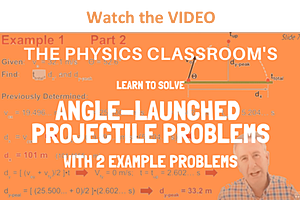 In the previous part of Lesson 2, the use of kinematic equations to solve projectile problems was introduced and demonstrated. These equations were used to solve problems involving the launching of projectiles in a horizontal direction from an elevated position. In this section of Lesson 2, the use of kinematic equations to solve non-horizontally launched projectiles will be demonstrated. A non-horizontally launched projectile is a projectile that begins its motion with an initial velocity that is both horizontal and vertical. To treat such problems, the same principles that were discussed earlier in Lesson 2 will have to be combined with the kinematic equations for projectile motion. You may recall from earlier that there are two sets of kinematic equations - a set of equations for the horizontal components of motion and a similar set for the vertical components of motion. For the horizontal components of motion, the equations are
x = vix•t + 0.5*ax*t2
vfx = vix + ax•t
vfx2 = vix2 + 2*ax•x
| where | x = horiz. displacement | ax = horiz. acceleration | t = time |
| vfx = final horiz. velocity | vix = initial horiz. velocity |
Of these three equations, the top equation is the most commonly used. The other two equations are seldom (if ever) used. An application of projectile concepts to each of these equations would also lead one to conclude that any term with ax in it would cancel out of the equation since ax = 0 m/s/s.
For the vertical components of motion, the three equations are
y = viy•t + 0.5*ay*t2
vfy = viy + ay•t
vfy2 = viy2 + 2*ay•y
| where | y = vert. displacement | ay = vert. acceleration | t = time |
| vfy = final vert. velocity | viy = initial vert. velocity |
In each of the above equations, the vertical acceleration of a projectile is known to be -9.8 m/s/s (the acceleration of gravity).
As discussed earlier in Lesson 2, the vix and viy values in each of the above sets of kinematic equations can be determined by the use of trigonometric functions. The initial x-velocity (vix) can be found using the equation vix = vi•cosine(Theta) where Theta is the angle that the velocity vector makes with the horizontal. The initial y-velocity (viy) can be found using the equation viy = vi•sine(Theta) where Theta is the angle that the velocity vector makes with the horizontal. The topic of components of the velocity vector was discussed earlier in Lesson 2.
To illustrate the usefulness of the above equations in making predictions about the motion of a projectile, consider their use in the solution of the following problem.
ExampleA football is kicked with an initial velocity of 25 m/s at an angle of 45-degrees with the horizontal. Determine the time of flight, the horizontal displacement, and the peak height of the football. |
The solution of any non-horizontally launched projectile problem (in which vi and Theta are given) should begin by first resolving the initial velocity into horizontal and vertical components using the trigonometric functions discussed above. Thus,
Horizontal Component | Vertical Component |
|---|---|
Horizontal Component vix = vi•cos(Theta) vix = 25 m/s•cos(45 deg) vix = 17.7 m/s | Vertical Component viy = vi•sin(Theta) viy = 25 m/s•sin(45 deg) viy = 17.7 m/s |
In this case, it happens that the vix and the viy values are the same as will always be the case when the angle is 45-degrees.
The solution continues by declaring the values of the known information in terms of the symbols of the kinematic equations - x, y, vix, viy, ax, ay, and t. In this case, the following information is either explicitly given or implied in the problem statement:
Horizontal Information | Vertical Information |
|---|---|
Horizontal Information x = ??? vix = 17.7 m/s vfx = 17.7 m/s ax = 0 m/s/s | Vertical Information y = ??? viy = 17.7 m/s vfy = -17.7 m/s ay = -9.8 m/s/s |
As indicated in the table, the final x-velocity (vfx) is the same as the initial x-velocity (vix). This is due to the fact that the horizontal velocity of a projectile is constant; there is no horizontal acceleration. The table also indicates that the final y-velocity (vfy) has the same magnitude and the opposite direction as the initial y-velocity (viy). This is due to the symmetrical nature of a projectile's trajectory.
The unknown quantities are the horizontal displacement, the time of flight, and the height of the football at its peak. The solution of the problem now requires the selection of an appropriate strategy for using the kinematic equations and the known information to solve for the unknown quantities. There are a variety of possible strategies for solving the problem. An organized listing of known quantities in two columns of a table provides clues for the selection of a useful strategy.
From the vertical information in the table above and the second equation listed among the vertical kinematic equations (vfy = viy + ay*t), it becomes obvious that the time of flight of the projectile can be determined. By substitution of known values, the equation takes the form of
The physics problem now takes the form of an algebra problem. By subtracting 17.7 m/s from each side of the equation, the equation becomes
If both sides of the equation are divided by -9.8 m/s/s, the equation becomes
(rounded from 3.6077 s)
The total time of flight of the football is 3.61 seconds.
With the time determined, information in the table and the horizontal kinematic equations can be used to determine the horizontal displacement (x) of the projectile. The first equation (x = vix•t + 0.5•ax•t2) listed among the horizontal kinematic equations is suitable for determining x. With the equation selected, the physics problem once more becomes transformed into an algebra problem. By substitution of known values, the equation takes the form of
Since the second term on the right side of the equation reduces to 0, the equation can then be simplified to
Thus,
The horizontal displacement of the projectile is 63.8 m.
Finally, the problem statement asks for the height of the projectile at is peak. This is the same as asking, "what is the vertical displacement (y) of the projectile when it is halfway through its trajectory?" In other words, find y when t = 1.80 seconds (one-half of the total time). To determine the peak height of the projectile (y with t = 1.80 sec), the first equation (y = viy•t +0.5•ay•t2) listed among the vertical kinematic equations can be used. By substitution of known values into this equation, it takes the form of
Using a calculator, this equation can be simplified to
And thus,
The solution to the problem statement yields the following answers: the time of flight of the football is 3.61 s, the horizontal displacement of the football is 63.8 m, and the peak height of the football 15.9 m.
(Note that in all calculations performed above, unrounded numbers were used. The numbers reported in the preliminary steps and in the final answer were the rounded form of the actual unrounded values.)
A Typical Problem-Solving Approach
The following procedure summarizes the above problem-solving approach.
- Use the given values of the initial velocity (the magnitude and the angle) to determine the horizontal and vertical components of the velocity (vix and viy).
- Carefully read the problem and list known and unknown information in terms of the symbols of the kinematic equations. For convenience sake, make a table with horizontal information on one side and vertical information on the other side.
- Identify the unknown quantity that the problem requests you to solve for.
- Select either a horizontal or vertical equation to solve for the time of flight of the projectile. For non-horizontally launched projectiles, the second equation listed among the vertical equations (vfy = viy + ay*t) is usually the most useful equation.
- With the time determined, use a horizontal equation (usually x = vix*t + 0.5*ax*t2 ) to determine the horizontal displacement of the projectile.
- Finally, the peak height of the projectile can be found using a time value that is one-half the total time of flight. The most useful equation for this is usually y = viy*t +0.5*ay*t2 .
One caution is in order: the sole reliance upon 4- and 5-step procedures to solve physics problems is always a dangerous approach. Physics problems are usually just that - problems! And problems can often be simplified by the use of short procedures as the one above. However, not all problems can be solved with the above procedure. While steps 1, 2 and 3 above are critical to your success in solving non-horizontally launched projectile problems, there will always be a problem that doesn't "fit the mold." Problem solving is not like cooking; it is not a mere matter of following a recipe. Rather, problem solving requires careful reading, a firm grasp of conceptual physics, critical thought and analysis, and lots of disciplined practice. Never divorce conceptual understanding and critical thinking from your approach to solving problems.
A long jumper leaves the ground with an initial velocity of 12 m/s at an angle of 28-degrees above the horizontal. Determine the time of flight, the horizontal distance, and the peak height of the long-jumper.

We Would Like to Suggest ...
 Sometimes it isn't enough to just read about it. You have to interact with it! And that's exactly what you do when you use one of The Physics Classroom's Interactives. We would like to suggest that you combine the reading of this page with the use of either Turd the Target 2 Interactive or our Projectile Motion Simulator. You can find them both in the Physics Interactives section of our website. In the Turd the Target 2 Interactive, learners attempt to prevent Birdman from soling the school's football field by accurately solving a angle-launched projectile problem. The Projectile Motion Simulator allows a learner to explore projectile motion concepts in an interactive manner. Change a height, change an angle, change a speed, and launch the projectile.