Chapter 16: Vibrations and Waves - Lesson 5: Standing Waves
Mathematics of Standing Waves
Hold down the T key for 3 seconds to activate the audio accessibility mode, at which point you can click the K key to pause and resume audio. Useful for the Check Your Understanding and See Answers.
 As discussed in Lesson 4, standing wave patterns are wave patterns produced in a medium when two waves of identical frequencies interfere in such a manner to produce points along the medium that always appear to be standing still. Such standing wave patterns are produced within the medium when it is vibrated at certain frequencies. Each frequency is associated with a different standing wave pattern. These frequencies and their associated wave patterns are referred to as harmonics. A careful study of the standing wave patterns reveal a clear mathematical relationship between the wavelength of the wave that produces the pattern and the length of the medium in which the pattern is displayed. Furthermore, there is a predictability about this mathematical relationship that allows one to generalize and deduce a statement concerning this relationship. To illustrate, consider the first harmonic standing wave pattern for a vibrating rope as shown below.

Analyzing the First Harmonic Pattern
The pattern for the first harmonic reveals a single antinode in the middle of the rope. This antinode position along the rope vibrates up and down from a maximum upward displacement from rest to a maximum downward displacement as shown. The vibration of the rope in this manner creates the appearance of a loop within the string. A complete wave in a pattern could be described as starting at the rest position, rising upward to a peak displacement, returning back down to a rest position, then descending to a peak downward displacement and finally returning back to the rest position. The animation below depicts this familiar pattern. As shown in the animation, one complete wave in a standing wave pattern consists of two loops. Thus, one loop is equivalent to one-half of a wavelength.
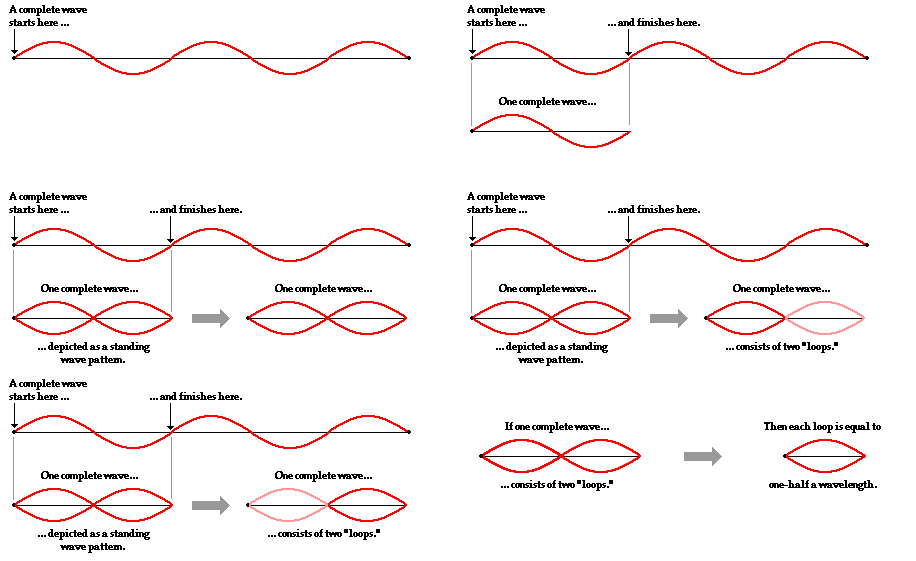
In comparing the standing wave pattern for the first harmonic with its single loop to the diagram of a complete wave, it is evident that there is only one-half of a wave stretching across the length of the string. That is, the length of the string is equal to one-half the length of a wave. Put in the form of an equation:

Analyzing the Second Harmonic Pattern
Now consider the string being vibrated with a frequency that establishes the standing wave pattern for the second harmonic.
The second harmonic pattern consists of two anti-nodes. Thus, there are two loops within the length of the string. Since each loop is equivalent to one-half a wavelength, the length of the string is equal to two-halves of a wavelength. Put in the form of an equation:

The same reasoning pattern can be applied to the case of the string being vibrated with a frequency that establishes the standing wave pattern for the third harmonic.

Analyzing the Third Harmonic Pattern
The third harmonic pattern consists of three anti-nodes. Thus, there are three loops within the length of the string. Since each loop is equivalent to one-half a wavelength, the length of the string is equal to three-halves of a wavelength. Put in the form of an equation:
When inspecting the standing wave patterns and the length-wavelength relationships for the first three harmonics, a clear pattern emerges. The number of antinodes in the pattern is equal to the harmonic number of that pattern. The first harmonic has one antinode; the second harmonic has two antinodes; and the third harmonic has three antinodes. Thus, it can be generalized that the nth harmonic has n antinodes where n is an integer representing the harmonic number. Furthermore, one notices that there are n halves wavelengths present within the length of the string. Put in the form of an equation:

Summarizing the Mathematical Relationships
This information is summarized in the table below.
Harmonic | Pattern | # of Loops | Length-Wavelength Relationship |
|---|---|---|---|
Harmonic 1st | Pattern | # of Loops 1 | Length-WavelengthRelationship L = 1 / 2 • λ |
Harmonic 2nd | Pattern | # of Loops 2 | Length-WavelengthRelationship L = 2 / 2 • λ |
Harmonic 3rd | Pattern | # of Loops 3 | Length-WavelengthRelationship L = 3 / 2 • λ |
Harmonic 4th | Pattern  | # of Loops 4 | Length-WavelengthRelationship L = 4 / 2 • λ |
Harmonic 5th | Pattern  | # of Loops 5 | Length-WavelengthRelationship L = 5 / 2 • λ |
Harmonic 6th | Pattern  | # of Loops 6 | Length-WavelengthRelationship L = 6 / 2 • λ |
Harmonic nth | Pattern -- | # of Loops n | Length-WavelengthRelationship L = n / 2 • λ |
For standing wave patterns, there is a clear mathematical relationship between the length of a string and the wavelength of the wave that creates the pattern. The mathematical relationship simply emerges from the inspection of the pattern and the understanding that each loop in the pattern is equivalent to one-half of a wavelength. The general equation that describes this length-wavelength relationship for any harmonic is:
Test your understanding of this relationship by answering the questions in the Check Your Understanding section.
We Would Like to Suggest ...
 Why just read about it and when you could be interacting with it? Interact - that's exactly what you do when you use one of The Physics Classroom's Interactives. We would like to suggest that you combine the reading of this page with the use of our Standing Wave Patterns Interactive. You can find it in the Physics Interactives section of our website. The Standing Wave Patterns Interactive provides the learner an environment for exploring the formation of standing waves, standing wave patterns, and mathematical relationships for standing wave patterns.
1. Suppose that a string is 1.2 meters long and vibrates in the first, second and third harmonic standing wave patterns. Determine the wavelength of the waves for each of the three patterns.

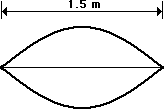 2. The string at the right is 1.5 meters long and is vibrating as the first harmonic. The string vibrates up and down with 33 complete vibrational cycles in 10 seconds. Determine the frequency, period, wavelength and speed for this wave.
 3. The string at the right is 6.0 meters long and is vibrating as the third harmonic. The string vibrates up and down with 45 complete vibrational cycles in 10 seconds. Determine the frequency, period, wavelength and speed for this wave.
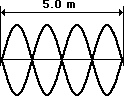 4. The string at the right is 5.0 meters long and is vibrating as the fourth harmonic. The string vibrates up and down with 48 complete vibrational cycles in 20 seconds. Determine the frequency, period, wavelength and speed for this wave.
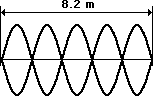 5. The string at the right is 8.2 meters long and is vibrating as the fifth harmonic. The string vibrates up and down with 21 complete vibrational cycles in 5 seconds. Determine the frequency, period, wavelength and speed for this wave.