Hold down the T key for 3 seconds to activate the audio accessibility mode, at which point you can click the K key to pause and resume audio. Useful for the Check Your Understanding and See Answers.
 The previous lesson focused on the principles of color addition. These principles govern the perceived color resulting from the mixing of different colors of light. Principles of color addition have important applications to color television, color computer monitors and on-stage lighting at the theaters. Each of these applications involves the mixing or addition of colors of light to produce a desired appearance. Our understanding of color perception would not be complete without an understanding of the principles of color subtraction. In this part of Lesson 2, we will learn how materials that have been permeated by specific pigments will selectively absorb specific frequencies of light in order to produce a desired appearance.
We have already learned that materials contain atoms that are capable of selectively absorbing one or more frequencies of light. Consider a shirt made of a material that is capable of absorbing blue light. Such a material will absorb blue light (if blue light shines upon it) and reflect the other frequencies of the visible spectrum. What appearance will such a shirt have if illuminated with white light and how can we account for its appearance? To answer this question (and any other similar question), we will rely on our understanding of the three primary colors of light (red, green and blue) and the three secondary colors of light (magenta, yellow and cyan).
 The Process of Color Subtraction
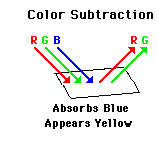
To begin, consider white light to consist of the three primary colors of light - red, green and blue. If white light is shining on a shirt, then red, green and blue light is shining on the shirt. If the shirt absorbs blue light, then only red and green light will be reflected from the shirt. So while red, green and blue light shine upon the shirt, only red and green light will reflect from it. Red and green light striking your eye always gives the appearance of yellow; for this reason, the shirt will appear yellow. This discussion illustrates the process of color subtraction. In this process, the ultimate color appearance of an object is determined by beginning with a single color or mixture of colors and identifying which color or colors of light are subtracted from the original set. The process is depicted visually by diagram at the right. Furthermore, the process is depicted in terms of an equation in the space below.
W - B = (R + G + B) - B = R + G = Y
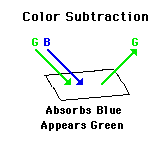 Now suppose that cyan light is shining on the same shirt - a shirt made of a material that is capable of absorbing blue light. What appearance will such a shirt have if illuminated with cyan light and how can we account for its appearance? To answer this question, the process of color subtraction will be applied once more. In this situation, we begin with only blue and green primary colors of light (recall that cyan light consists of blue and green light). From this mixture, we must subtract blue light. After the subtractive process, only green light remains. Thus, the shirt will appear green in the presence of cyan light. Observe the representation of this by the diagram at the right and the equation below.
C - B = (G + B) - B = G
From these two examples, we can conclude that a shirt that looks yellow when white light shines upon it will look green when cyan light shines upon it. This confuses many 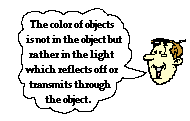 students of physics, especially those who still believe that the color of a shirt is in the shirt itself. This is the misconception that was targeted earlier in Lesson 2 as we discussed how visible light interacts with matter to produce color. In that part of Lesson 2, it was emphasized that the color of an object does not reside in the object itself. Rather, the color is in the light that shines upon the object and that ultimately becomes reflected or transmitted to our eyes. Extending this conception of color to the above two scenarios, we would reason that the shirt appears yellow if there is some red and green light shining upon it. Yellow light is a combination of red and green light. A shirt appears yellow if it reflects red and green light to our eyes. In order to reflect red and green light, these two primary colors of light must be present in the incident light.
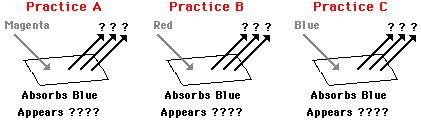
 Test your understanding of these principles of color subtraction by determining the color appearance of the same shirts if illuminated with other colors of light. Be sure to begin by determining the primary color(s) of light that are incident upon the object and then subtracting the absorbed color from the incident color(s).
Complementary Colors and Color Subtraction
In the above examples, the paper absorbed blue light. Paper that absorbs blue light is permeated by a pigment known as a yellow pigment. While most pigments absorb more than a single frequency (and are known as compound pigments), it becomes convenient for our discussion to keep it simple by assuming that a yellow pigment absorbs a single frequency. A pigment that absorbs a single frequency is known as a pure pigment. The following rule will assist in understanding what colors of light are absorbed by which pigments.
|
Pigments absorb light. Pure pigments absorb a single frequency or color of light. The color of light absorbed by a pigment is merely the complementary color of that pigment.
|
Thus, pure blue pigments absorb yellow light (which can be thought of as a combination of red and green light). Pure yellow pigments absorb blue light. Pure green pigments absorb magenta light (which can be thought of as a combination of red and blue light). Pure magenta pigments absorb green light. Pure red pigments absorb cyan light (which can be thought of as a combination of blue and green light). And finally, pure cyan pigments absorb red light.
Now lets combine the process of color subtraction with an understanding of complementary colors to determine the color appearance of various sheets of paper when illuminated by various lights. We will investigate three examples.
Example 1
Magenta light shines on a sheet of paper containing a yellow pigment. Determine the appearance of the paper.
|
Magenta light can be thought of as consisting of red light and blue light. A yellow pigment is capable of absorbing blue light. Thus, blue is subtracted from the light that shines on the paper. This leaves red light. If the paper reflects the red light, then the paper will look red.
M - B = (R + B) - B = R
Example 2
Yellow light shines on a sheet of paper containing a red pigment. Determine the appearance of the paper.
|
Yellow light can be thought of as consisting of red light and green light. A red pigment is capable of absorbing cyan light. That is, red paper can absorb both green and blue primary colors of light (recall that cyan light is a mixture of green and blue light). So red and green light shine on the paper; and green light is subtracted. (There is no need to subtract blue light since blue light is not shining on the paper.) This leaves red light to be reflected. If the paper reflects the red light, then the paper will look red.
Y - G = (R + G) - G = R
Example 3
Yellow light shines on a sheet of paper containing a blue pigment. Determine the appearance of the paper.
|
Yellow light can be thought of as consisting of red light and green light. A blue pigment is capable of absorbing yellow light. That is, blue paper can absorb both red and green primary colors of light (recall that yellow light is a mixture of red and green light). So red and green light shine on the paper; and both the red and the green light are subtracted. There is no color left to be reflected to the eye. Subsequently, the paper appears black.
Y - Y = (R + G) - (R + G) = No reflected light = Black
Flickr Physics Photo
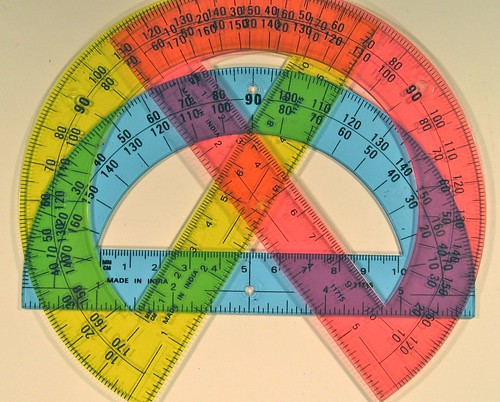
Three transparent protractors are overlaid on top of each other. The protractors are colored cyan, magenta, and yellow. The three protractors are illuminated with white light, sometimes referred to as RGB light. Each protractor absorbs a single primary color of light. The cyan protractor absorbs red light. The magenta protractor absorbs green light. The yellow protractor absorbs blue light. Where two protractors overlap, a single primary color of light shows through. For example, where the cyan and the yellow protractor overlap, the red and blue light are absorbed and the green light is seem shining through. And where the cyan and the magenta protractor overlap, the red and green light are absorbed and the blue light is seem shining through. Finally, where the magenta and the yellow protractor overlap, the green and blue light are absorbed and the red light is seem shining through. This photo illustrates the principles of color subtraction.
Filters and Color Subtraction
 The above discussion applies to the appearance of opaque materials. The distinction between opaque and transparent materials was made earlier in this lesson. Opaque materials selectively absorb one or more frequencies of light and reflect what is not absorbed. In contrast to opaque materials, transparent materials selectively absorb one or more frequencies of light and transmit what is not absorbed. Like opaque materials, transparent materials are permeated by pigments that contain atoms that are capable of absorbing light with a single frequency or even a range of frequencies. Knowing the color(s) of the incident light and the color of light absorbed by the pigment or filter, the process of color subtraction can be applied to determine the color appearance of a transparent material. We will consider three examples in the space below; the examples are visually depicted in the diagrams below.
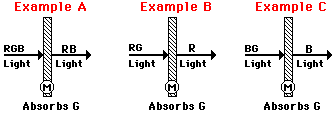
In Example A, white light (i.e., a mixture of red, green and blue) shines upon a magenta filter. Magenta absorbs its complementary color - green. Thus, green is subtracted from white light. That leaves red and blue light to be transmitted by the filter. For this reason, the filter will appear magenta (recall that magenta light is a mixture of red and blue light) when illuminated with white light. This process of color subtraction can be represented by the following equation.
W - G = (R + G + B) - G = R + B = M
In Example B, yellow light (i.e., a mixture of red and green) shines upon the same magenta filter. Magenta absorbs its complementary color - green. Thus, green is subtracted from yellow light. That leaves red light to be transmitted by the filter. For this reason, the filter will appear red when illuminated with yellow light. This process of color subtraction can be represented by the following equation.
Y - G = (R + G) - G = R
In Example C, cyan light (i.e., a mixture of blue and green) shines upon the same magenta filter. Magenta absorbs its complementary color - green. Thus, green is subtracted from cyan light. That leaves blue light to be transmitted by the filter. For this reason, the filter will appear blue when illuminated with cyan light. This process of color subtraction can be represented by the following equation.
C - G = (B + G) - G = B
The reasoning modeled in the above three examples can be used in any situation, regardless of the color of the incident light and the color of the filter. As you approach such problems, whether they involve transparent or opaque materials, be sure to think in terms of primary colors of light and to use the logical reasoning steps. Avoid memorizing and avoid shortcuts. If a filter is capable of absorbing a color of light that is not present in the mixture of incident light, then merely disregard that color. Since that color of light is not incident upon the object, it cannot contribute to the color appearance of the object.
We Would Like to Suggest ...

Sometimes it isn't enough to just read about it. You have to interact with it! And that's exactly what you do when you use one of The Physics Classroom's Interactives. We would like to suggest that you combine the reading of this page with the use of our
Colored Filters Interactive. The Interactive is found in the Physics Interactives section of our website and allows a learner to explore the affect of filters of varying color upon white light and its individual R, G, and B components.
 Primary Colors of Paint
A trip to the local newspaper or film developing company will reveal these same principles of color subtraction at work. The three primary colors of paint used by an artist, color printer or film developer are cyan (C), magenta (M), and yellow (Y). Artists, printers, and film developers do not deal directly with light; rather, they must apply paints or dyes to a white sheet of paper. These paints and dyes must be capable of absorbing the appropriate components of white light in order to produce the desired affect. Most artists start with a white canvas and apply paints. These paints have to subtract colors so that you might see the desired image. An artist can create any color by using varying amounts of these three primary colors of paint.
Each primary color of paint absorbs one primary color of light. The color absorbed by a primary color of paint is the complementary color of that paint. The three colors that are primary to an artist (magenta, cyan, and yellow) subtract red, green, and blue individually from an otherwise white sheet of paper. Thus,
Magenta paints absorb green light.
Cyan paints absorb red light.
Yellow paints absorb blue light.
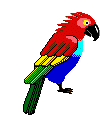 Let's suppose that an artist wishes to use the three primary colors of paint in order to produce a picture of the colorful bird shown at the right. The bird will be painted onto white paper and viewed under white light. It is hoped that the bird will have green tail feathers, a blue lower body, a cyan upper body, a red head, a magenta eye patch, a yellow eye and middle feathers, and a black beak. How can the three primary colors of paint be used to produce such a likeness? And how can we explain the answers in terms of color subtraction?
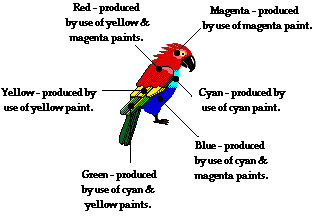
To produce a green tail, paints must be applied to the tail region in order to absorb red and blue light and leave green to be reflected. Thus, the green tail must be painted using yellow paint (to absorb the blue) and cyan paint (to absorb the red).
To produce a blue lower body, paints must be applied to the lower body region in order to absorb red and green light, leaving blue light to be reflected. Thus, the blue lower body must be painted using magenta paint (to absorb the green) and cyan paint (to absorb the red).
To produce a red head, paints must be applied to the head region in order to absorb blue and green light, leaving red light to be reflected. Thus, the red head must be painted using magenta paint (to absorb the green) and yellow paint (to absorb the blue).
To produce a cyan upper body, paints must be applied to the upper body region in order to absorb red, leaving green and blue light to be reflected. If green and blue light are reflected from the upper body region, it will appear cyan (recall that blue and green light combine to form cyan light). Thus, the cyan upper body must be painted using merely cyan paint (to absorb the red).
To produce a magenta eye patch, paints must be applied to the eye patch region in order to absorb green, leaving red and blue light to be reflected. If red and blue light is reflected from the eye patch region, it will appear magenta (recall that blue and red light combine to form magenta light). Thus, the magenta eye patch must be painted using merely magenta paint (to absorb the green).
To produce a yellow eye and middle feathers, paints must be applied to the eye and middle feather regions in order to absorb blue, leaving red and green light to be reflected. If red and green light is reflected from the eye and middle feather regions, it will appear yellow (recall that red and green light combine to form yellow light). Thus, the yellow eye and middle feathers must be painted using merely yellow paint (to absorb the blue).
This information is summarized in the graphic below.
The process of color subtraction is a useful means of predicting the ultimate color appearance of an object if the color of the incident light and the pigments are known. By using the complementary color scheme, the colors of light that will be absorbed by a given material can be determined. These colors are subtracted from the incident light colors (if present) and the colors of reflected light (or transmitted light) can be determined. Then the color appearance of the object can be predicted.
We Would Like to Suggest ...
Sometimes it isn't enough to just read about it. You have to interact with it! And that's exactly what you do when you use one of The Physics Classroom's Interactives. We would like to suggest that you combine the reading of this page with the use of our
Painting With CMY Interactive. The Interactive is found in the Physics Interactives section of our website and allows a learner to explore the affect of varying colors of primary pigments.
Investigate!
It's probably been a long time since you had a chance to play with those old Crayola crayons. It's time to get that box out now! What color do you get when you mix two crayons from the Crayola box? Use the Phun With Crayola Crayons widget to find out. Enter the names of two crayons from the box. (Examples: tan, forest green, yellow, mauve, brown, crimson, periwinkle, and more. Then click the Mix 'Em button to find out the result.
Flickr Physics Photo
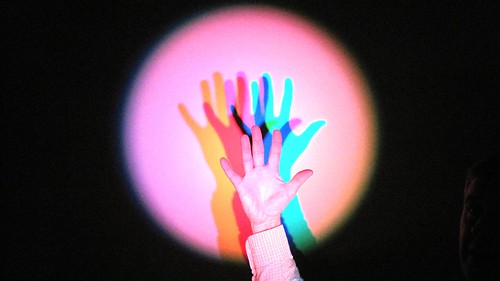
Three colored spotlights - red, green and blue - illuminate a white screen. A hand is placed between the screen and the lights, thus casting overlapping shadows on the screen. From left to right, you will observe a yellow, magenta and cyan shadow. The yellow shadow is produced by the blocking of the blue light; the red and green lights converge to produce yellow. The magenta shadow is produced by the blocking of the green light; red and blue lights converge to produce magenta. And finally, the cyan shadow is produced by the blocking of the red light; blue and green light converge to produce the cyan. The colors red and blue are produced where the shadows overlap. The photo demonstrates principles of color subtraction and color addition.
We Would Like to Suggest ...
Sometimes it isn't enough to just read about it. You have to interact with it! And that's exactly what you do when you use one of The Physics Classroom's Interactives. We would like to suggest that you combine the reading of this page with the use of our
Colored Shadows Interactive. The Interactive is found in the Physics Interactives section of our website and allows a learner to explore the arrangment of overlapping shadows produced when various combinations of red, green and blue spotlights are projected onto a person.
Check Your Understanding
1. Blue jeans appear blue because the jeans are permeated by a chemical dye. Explain the role of the dye. That is, what does the dye do (absorb or reflect) to the various frequencies of white light?
2. A red shirt looks red when visible light ("ROYGBIV") shines upon it. Use your physics understanding to explain this phenomenon.
3. Express your understanding of complementary colors and the rule of color subtraction by completing the following three diagrams. White light (red-green-blue) is shown incident on a sheet of paper that is painted with a pigment that absorbs one of the primary colors of light. For each diagram, determine the color of the two reflected rays and determine the color that the paper appears.
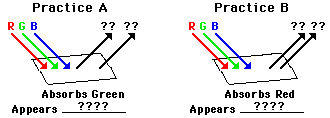
4. In the diagrams below, several sheets of paper are illuminated by different primary colors of light (R for red, B for blue, and G for green). Indicate what primary colors of light will be reflected and the appearance of the sheet of paper. (Note the similarity between this problem and the above problem.)
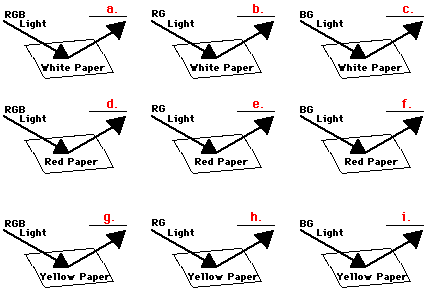
5. Different colored light sources shine on different colored sheets of paper. The indicated paper color represents the appearance of the paper when viewed in white light. Fill in the table below to show the color of light that reflects from the paper (i.e., the color observed).
6. The following diagrams depict various primary colors of light (R for red, B for blue, and G for green) incident upon a colored filter (C for cyan, M for magenta, and Y for yellow). Determine which primary colors of light will pass through the filters.
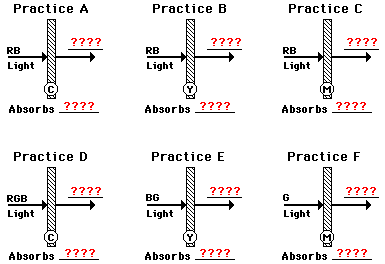
7. Suppose an object is permeated by a mixture of two or more paints and illuminated with white light. Fill in the table below to indicate the color appearance of the object.
|
Paint
One
|
Paint
Two
|
Color Observed
|
|
Cyan
|
Magenta
|

|
|
Magenta
|
Yellow
|
|
|
Cyan
|
Yellow
|
|
|
Cyan, Magenta &
|
Yellow
|
|
8. What primary paint colors (CMY) or combination of paint colors would you use to paint the boy below? He has pink (magenta) skin, blue jeans, a yellow sweater, a black baseball cap, red sneakers and aqua-colored socks. Indicate the primary colors of paint to be used on the diagram below.
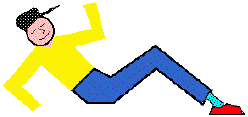
|
Skin: ______________
Jeans: ______________
Sweater: ______________
Cap: ______________
Sneakers: ______________
Socks: ______________
|