 This part of Lesson 3 focuses on net force-acceleration problems in which an applied force is directed at an angle to the horizontal. We have already discussed earlier in Lesson 3 how a force directed an angle can be resolved into two components - a horizontal and a vertical component. We have also discussed in an earlier unit that the acceleration of an object is related to the net force acting upon the object and the mass of the object (Newton's second law). We had used this principle to solve net force-acceleration problems in an earlier unit. Therefore, it is a natural extension of this unit to combine our understanding of Newton's second law with our understanding of force vectors directed at angles.
Simplifying a Difficult Problem
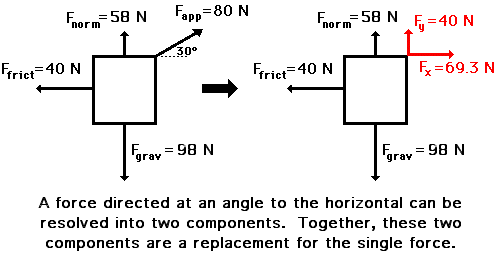
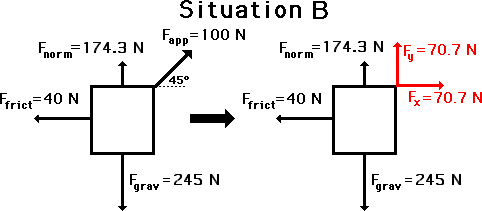
Consider the situation below in which a force is directed at an angle to the horizontal. In such a situation, the applied force could be resolved into two components. These two components can be considered to replace the applied force at an angle. By doing so, the situation simplifies into a familiar situation in which all the forces are directed horizontally and vertically.
Once the situation has been simplified, the problem can be solved like any other problem. The task of determining the acceleration involves first determining the net force by adding up all the forces as vectors and then dividing the net force by the mass to determine the acceleration. In the above situation, the vertical forces are balanced (i.e., Fgrav, Fy, and Fnorm add up to 0 N), and the horizontal forces add up to 29.3 N, right (i.e., 69.3 N, right + 40 N, left = 29.3 N, right). The net force is 29.3 N, right and the mass is 10 kg (m = Fgrav/g); therefore, the acceleration is 2.93 m/s/s, right.
Your Turn to Practice
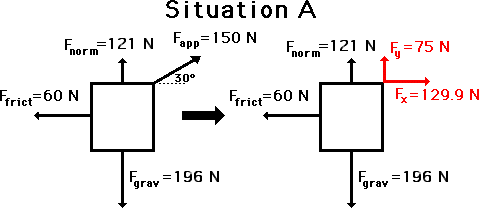
To test your understanding, analyze the two situations below to determine the net force and the acceleration. When finished, click the button to view the answers.
See Answer
The net force is 69.9 N, right and the acceleration is 3.5 m/s/s, right.
Note that the vertical forces balance but the horizontal forces do not. The net force is
Fnet = 129.9 N, right - 60 N, left = 69.9 N, right
The mass is
m = (Fgrav / g) = 20 kg
So the acceleration is
a = (69.9 N) / (20 kg) =3.50 m/s/s.
See Answer
The net force is 30.7 N, right and the acceleration is 1.23 m/s/s, right.
Note that the vertical forces balance but the horizontal forces do not. The net force is
Fnet = 70.7 N, right - 40 N, left = 30.7 N, right
The mass is
m = (Fgrav / g) = 25 kg
So the acceleration is
a = (30.7 N) / (25 kg) =1.23 m/s/s.
What's Up with the Normal Force?
There is one peculiarity about these types of problems that you need to be aware of. The normal force (Fnorm) is not necessarily equal to the gravitational force (Fgrav) as it has been in problems that we have previously seen. The principle is that the vertical forces must balance if there is no vertical acceleration. If an object is being dragged across a horizontal surface, then there is no vertical acceleration. For this reason, the normal force (Fnorm) plus the vertical component (Fy) of the applied force must balance the gravitational force (Fgrav). A quick review of these problems shows that this is the case. If there is an acceleration for an object being pulled across a floor, then it is a horizontal acceleration; and thus the only imbalance of force would be in the horizontal direction.
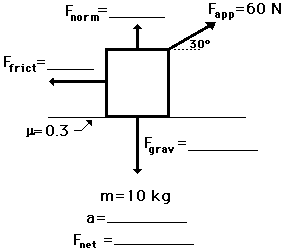
Now consider the following situation in which a force analysis must be conducted to fill in all the blanks and to determine the net force and acceleration. In a case such as this, a thorough understanding of the relationships between the various quantities must be fully understood. Make an effort to solve this problem. When finished, click the button to view the answers. (When you run into difficulties, consult the help from a previous unit.)
See Answer
The Fgrav is
Fgrav = m • g = (10 kg) • (9.8 m/s/s) = 98 N
Using the sine function,
Fy = (60 N) • sine (30 degrees) = 30 N
Since vertical forces are balanced, Fnorm = 68 N.
Now Ffrict can be found
Ffrict = mu • Fnorm = ( 0.3) • (68 N) = 20.4 N
Using the cosine function,
Fx = (60 N) • cosine (30 degrees) = 52.0 N
Now since all the individual force values are known, the Fnet can be found:
Fnet = 52.0 N,right + 20.4 N, left = 31.6 N, right.
The acceleration is
a = F
net / m = (31.6 N) / ( 10 kg)
a = 3.16 m/s/ s, right.
In conclusion, a situation involving a force at an angle can be simplified by using trigonometric relations to resolve that force into two components. Such a situation can be analyzed like any other situation involving individual forces. The net force can be determined by adding all the forces as vectors and the acceleration can be determined as the ratio of Fnet/mass.
The following problems provide plenty of practice with Fnet= m • a problems involving forces at angles. Try each problem and then click the button to view the answers.
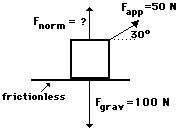 1. A 50-N applied force (30 degrees to the horizontal) accelerates a box across a horizontal sheet of ice (see diagram). Glen Brook, Olive N. Glenveau, and Warren Peace are discussing the problem. Glen suggests that the normal force is 50 N; Olive suggests that the normal force in the diagram is 75 N; and Warren suggests that the normal force is 100 N. While all three answers may seem reasonable, only one is correct. Indicate which two answers are wrong and explain why they are wrong.
See Answer
Glen Brook and Warren Peace are incorrect. Warren Peace perhaps believes that the Fnorm = Fgrav; but this is only the case when there are only two vertical forces and no vertical acceleration; sorry Warren - there is a second vertical force in this problem (Fapp).
Glen Brook perhaps thinks that the Fapp force is 50 N upwards and thus the Fnorm must be 50 N upwards to balance the Fgrav. Sorry Glen - the Fapp is only 25 N upwards (50 N) • sine 30 degrees).
"Datagal Olive!"
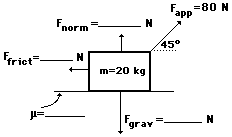
2. A box is pulled at a constant speed of 0.40 m/s across a frictional surface. Perform an extensive analysis of the diagram below to determine the values for the blanks.
See Answer
First use the mass to determine the force of gravity.
Fgrav = m • g = (20 kg) • (9.8 m/s/s) = 196 N
Now find the vertical component of the applied force using a trigonometric function.
Fy = (80 N) • sine (45 degrees) = 56.7 N
Thus, Fnorm =139.3 N in order for the vertical forces to balance.
The horizontal component of the applied force can be found as
Fx = (80 N) • cosine (45 degrees) = 56.7 N
Since the speed is constant, the horizontal forces must also balance; and so Ffrict = 56.7 N.
The value of "mu" can be found using the equation
"mu"= F
frict / F
norm = (56.7 N) / (139.3 N) =
0.406.
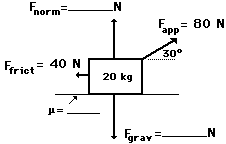
3. Use your understanding of force relationships and vector components to fill in the blanks in the following diagram and to determine the net force and acceleration of the object. (Fnet = m•a; Ffrict = μ•Fnorm; Fgrav = m•g)
See Answer
Answer: "mu" = 0.25
The Fgrav can be calculated from the mass of the object.
Fgrav = m • g = (20 kg) • (9.8 m/s/s) = 196 N
The vertical component of the applied force can be calculated using a trigonometric function:
Fy = (80 N) • sine (30 degrees) = 40 N
In order for the vertical forces to balance, Fnorm + Fy = Fgrav. Thus,
Fnorm = Fgrav - Fy = = 196 N - 40 N = 156 N
The horizontal component of the applied force can be calculated using a trigonometric function:
Fx = (80 N) • cosine (30 degrees) = 69.2 N
The net force is the sum of all the forces when added as vectors. Thus,
Fnet = (69.2 N, right) + (40 N,left) = 29.2 N, right
The acceleration is
a = Fnet / m = (29.2 N, right) / (20 kg) = 1.46 m/s/s, right.
The value of "mu" can be found using the equation "mu" = Ffrict / Fnorm.
"mu" = F
frict / F
norm = (40 N) / (156 N) = 0.256
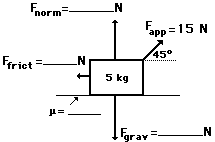
4. The 5-kg mass below is moving with a constant speed of 4 m/s to the right. Use your understanding of force relationships and vector components to fill in the blanks in the following diagram and to determine the net force and acceleration of the object. (Fnet = m•a; Ffrict = μ•Fnorm; Fgrav = m•g)
See Answer
The Fgrav can be calculated from the mass of the object.
Fgrav = m • g = (5 kg) • (9.8 m/s/s) = 49 N
The vertical component of the applied force can be calculated using a trigonometric function.
Fy = (15 N) • sine (45 degrees) =10.6 N
In order for the vertical forces to balance, Fnorm + Fy = Fgrav. Thus,
Fnorm = Fgrav - Fy = = 49 N - 10.6 N = 38.4 N
The horizontal component of the applied force can be calculated using a trigonometric function:
Fx = (15 N) • cosine (45 degrees) = 10.6 N
Since the speed is constant, the horizontal forces must balance. Therefore, Ffrict = 10.6 N.
The value of "mu" can be found using the equation "mu"= Ffrict / Fnorm :
"mu"= F
frict / F
norm = (10.6 N) / (38.4 N)
"mu" = 0.276
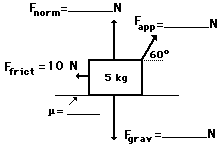
5. The following object is being pulled at a constant speed of 2.5 m/s. Use your understanding of force relationships and vector components to fill in the blanks in the following diagram and to determine the net force and acceleration of the object. (Fnet = m•a; Ffrict = μ•Fnorm; Fgrav = m•g)
See Answer
Since the velocity is constant, the acceleration and the net force are 0 m/s/s and 0 N respectively.
The Fgrav can be calculated from the mass of the object.
Fgrav = m • g = (5 kg) • (9.8 m/s/s) = 49 N
The object moves at constant speed; thus, the horizontal forces must balance. For this reason, Fx = 10 N.
The applied force can now be found using a trigonometric function and the horizontal component:
cosine (60 degrees) = (10 N) / (Fapp)
Proper algebra yields
Fapp = (10 N) / [cosine (60 degrees) ] = 20 N
The vertical component of the applied force can be calculated using a trigonometric function.
Fy = (20 N) • sine (60 degrees) = 17.3 N
In order for the vertical forces to balance, Fnorm + Fy = Fgrav. Thus,
Fnorm = Fgrav - Fy = 49 N - 17.3 N = 31.7 N
The value of "mu" can be found using the equation "mu"= Ffrict / Fnorm :
"mu"= F
frict / F
norm = (10 N) / (31.7 N) = 0.316
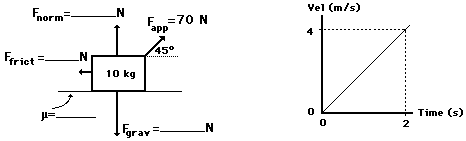
6. Use your understanding of force relationships and vector components to fill in the blanks in the following diagram and to determine the net force and acceleration of the object. (Fnet = m•a; Ffrict = μ•Fnorm; Fgrav = m•g)
See Answer
The Fgrav can be calculated from the mass of the object.
Fgrav = m • g = (10 kg) • (9.8 m/s/s) = 98 N
The slope of a velocity-time graph is the acceleration of the object. In this case, a = +2 m/s/s.
The net force can be calculated as:
Fnet = m • a = (10 kg) • (2 m/s/s) = 20 N, right.
The horizontal component of the applied force can be calculated using a trigonometric function:
Fx = (70 N) • cosine (45 degrees) = 49.5 N
The net force is the vector sum of all the forces. Thus, Fnet = Fx + Ffrict. That is,
20 N, right = 49.5 N, right + Ffrict
Therefore, Ffrict must be 29.5 N, left.
The vertical component of the applied force can be calculated using a trigonometric function.
Fy = (70 N) • sine (45 degrees) = 49.5 N
In order for the vertical forces to balance, Fnorm + Fy = Fgrav. Thus,
Fnorm = Fgrav - Fy = = 98 N - 49.5 N = 48.5 N
The value of "mu" can be found using the equation "mu" = Ffrict / Fnorm :
mu = F
frict / F
norm = (29.5 N) / (48.5 N)
mu = 0.608
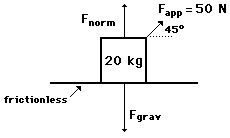
7. Study the diagram below and determine the acceleration of the box and its velocity after being pulled by the applied force for 2.0 seconds.
See Answer
The Fgrav can be calculated from the mass of the object.
Fgrav = m • g = (20 kg) • (9.8 m/s/s) = 196 N
The vertical component of the applied force can be calculated using a trigonometric function.
Fy = (50 N) • sine (45 degrees) = 35.4 N
In order for the vertical forces to balance, Fnorm + Fy = Fgrav. Algebraic rearrangement leads to:
Fnorm = Fgrav - Fy = 196 N - 35.4 N = 160.6 N
The horizontal component of the applied force can be calculated using a trigonometric function:
Fx = (50 N) • cosine (45 degrees) = 35.4 N
The Fnet is 35.4 N, right since the only force which is not balanced is Fx.
The acceleration is:
a = Fnet / m = (35.4 N) / (20 kg) = 1.77 m/s/s
The velocity after 2.0 seconds can be calculated using a kinematic equation:
vf = vi + a • t = 0 m/s + (1.77 m/s/s) • (2.0 s)vf = 3.54 m/s
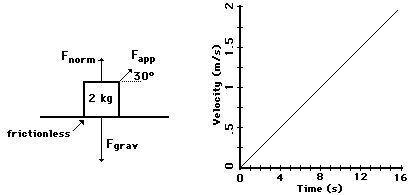
8. A student pulls a 2-kg backpack across the ice (assume friction-free) by pulling at a 30-degree angle to the horizontal. The velocity-time graph for the motion is shown. Perform a careful analysis of the situation and determine the applied force.
See Answer
The slope of a velocity-time graph is the acceleration of the object. In this case, a = +0.125 m/s/s.
The net force can be calculated as:
Fnet = m • a = (2 kg) • (0.125 m/s/s) = 0.250 N, right
Since the acceleration is horizontal, the vertical forces balance each other. The horizontal component of the applied force (Fx) supplies the horizontal force required for the acceleration. Thus, the horizontal component of the applied force is 0.250 N.
Using trigonometry, the applied force (Fapp) can be calculated:
cosine (30 degrees) = ( 0.250 N) / (Fapp)
Algebraic rearrangement of this equation leads to:
F
app = (0.250 N) / [cosine (30 degrees) ]
Fapp = 0.289 N
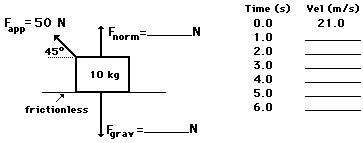
9. The following object is moving to the right and encountering the following forces. Use your understanding of force relationships and vector components to fill in the blanks in the following diagram and to determine the net force and acceleration of the object. (Fnet = m•a; Ffrict = μ•Fnorm; Fgrav = m•g)
See Answer

The Fgrav can be calculated from the mass of the object.
Fgrav = m • g = (10 kg) • (10 m/s/s) = 100 N
The vertical component of the applied force can be calculated using a trigonometric function.
Fy = (50 N) • sine (45 degrees) = 35.4 N
In order for the vertical forces to balance, Fnorm + Fy = Fgrav. Algebraic rearrangement leads to:
Fnorm = Fgrav - Fy = 100 N - 35.4 N = 64.6 N
The horizontal component of the applied force can be calculated using a trigonometric function:
Fx = (50 N) • cosine (45 degrees) = 35.4 N
This x-component of the applied force (Fx) is directed leftward. This horizontal component of force is not counteracted by a rightward force. For this reason, the net force is 35.4 N. Knowing Fnet, allows us to determine the acceleration of the object:
a = Fnet / m = (35.4 N) / (10 kg) = ~3.5 m/s/s
The acceleration of an object is the velocity change per time. For an acceleration of 3.5 m/s/s, the velocity change should be 3.5 m/s for each second of time change. In the velocity-time table, the velocity is decreasing by 3.5 m/s each second. Thus, the values should read 17.5 m/s, 14.0 m/s, 10.5 m/s, 7.0 m/s, 3.5 m/s, 0 m/s.
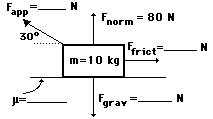
10. The 10-kg object is being pulled to the left at a constant speed of 2.5 m/s. Use your understanding of force relationships and vector components to fill in the blanks in the following diagram. (Fnet = m•a; Ffrict = μ•Fnorm; Fgrav = m•g)
See Answer
The Fgrav can be calculated from the mass of the object.
Fgrav = m • g = (10 kg) • (9.8 m/s/s) = 98 N
In order for the vertical forces to balance, Fnorm + Fy = Fgrav. Algebraic rearrangement leads to:
Fy = Fgrav - Fnorm = 98 N - 80 N = 18 N
The applied force can be determined using a trigonometric function:
sine 30 (degrees) = (18 N) / Fapp
Algebraic rearrangement leads to:
Fapp = (18 N) / [ sine (30 degrees) ] = 36 N
Similar trigonometry allows one to determine the x-component of the applied force:
Fx = (36 N) • cosine(30 degrees) = 31.2 N
Since the speed is constant, the horizontal forces must also balance. Thus the force of friction is equal to the Fx value. Ffrict = 31.2 N
The value of "mu" can be found using the equation "mu" = Ffrict / Fnorm
mu = F
frict / F
norm = (31.2 N) / (80 N) = 0.390
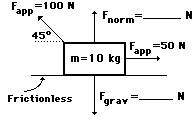
11. Use your understanding of force relationships and vector components to fill in the blanks in the following diagram and to determine the net force and acceleration of the object. (Fnet = m•a; Ffrict = μ•Fnorm; Fgrav = m•g)
See Answer
The Fgrav can be calculated from the mass of the object.
Fgrav = m • g = (10 kg) • (9.8 m/s/s) = 98 N
The vertical component of the applied force can be calculated using a trigonometric function.
Fy = (100 N) • sine (45 degrees) = 70.7 N
In order for the vertical forces to balance, Fnorm + Fy = Fgrav. Algebraic rearrangement leads to:
Fnorm = Fgrav - Fy = 98 N - 70.7 N = 27.3 N
The horizontal component of the applied force can be calculated using a trigonometric function:
Fx = (100 N) • cosine (45 degrees) = 70. N
The net force is the vector sum of all the forces.
Fnet = 50 N, right + 70.7 N, left = 20.7 N, left
The acceleration is can be found from a = Fnet / m :
a = F
net / m = (20.7 N) / (10 kg) = 2.07 m/s/s, left.