Reflection and Mirrors Legacy Problem #3 Guided Solution
Problem*
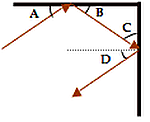
In a physics lab, Ray Zuvlite arranges two mirrors with a right-angle orientation as shown below. Ray then directs a laser line at one of the mirrors. The light reflects off both mirrors as shown. If angle A is 38°, then what is the angle measure of angles B, C, and D and E?
Audio Guided Solution
This question demands that you have a good understanding of the law of reflection and you be able to apply it in the context of a situation in which you also must combine some understanding of geometry. A ray light is approaching a surface at an angle of 38 degrees with respect to the surface. That's angle A. We're asked to find angle B. Angle B is not the angle of reflection, nor is angle A the angle of incidence. Irregardless, these two angles are equal to one another. We would say that the angle of incidence is actually 52 degrees, the complementary angle to angle A, because you measure the angle of incidence with respect to the normal line. And so you would go 90 degrees minus A to get the angle of incidence. The angle of reflection would be the same, but again, that would be with respect to the normal line. And so the angle B is the complementary angle of the angle of reflection. It's 90 minus this 52 degrees. That's angle B. Now to get angle C, I have to recognize that angle B and angle C are both angles within a right triangle. And so what we have is angle B plus angle C plus 90 degrees is equal to 180 degrees. After all, the three angles in a right triangle add up to 180 degrees. And so I can find angle C by going 180 minus this angle B of 38 degrees minus the 90 degree right angle. That gives me 52 degrees for angle C. And that's the angle between the incident rate of the surface and the mirror itself. Now the actual incident angle at the second surface is going to be the complementary angle of angle C. It's actually going to be 38 degrees. That's the angle of incidence for the light ray approaching that surface. If I wish to find the angle of reflection, all I can do is simply apply the law of reflection which states the angle of reflection is equal to the angle of incidence. And for this situation, the angle of reflection would be 38 degrees.
Solution
Angle B = 38°
Angle C = 52°
Angle D = 38°
Habbits of an Effective Problem Solver
- Read the problem carefully and develop a mental picture of the physical situation. If necessary, sketch a simple diagram of the physical situation to help you visualize it.
- Identify the known and unknown quantities in an organized manner. Equate given values to the symbols used to represent the corresponding quantity - e.g., \(\descriptive{d_o}{d_o,distance object} = 24.2\unit{cm}\); \(\descriptive{d_i}{d_i,distance image} = 16.8\unit{cm}\); \(\descriptive{f}{f,focal length} = \colorbox{gray}{Unknown}\).
- Use physics formulas and conceptual reasoning to plot a strategy for solving for the unknown quantity.
- Identify the appropriate formula(s) to use. Perform substitutions and algebraic manipulations in order to solve for the unknown quantity.
Read About It!
Get more information on the topic of Reflection and Mirrors at The Physics Classroom Tutorial.