The L•O•S•T Art of Image Description Lab
Resource Downloads
The Following Information is Provided to the Student
Question: How do the characteristics of images formed by converging lenses compare for various object locations?
Purpose: To describe the relative location, orientation, size and type of the image produced of an object by a converging lens when the object is located at four strategic locations along the principal axis.
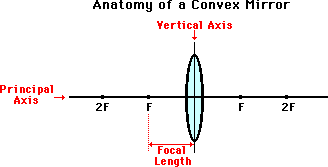
A complete lab write-up includes a Title, a Purpose, a Data section, a Conclusion/Discussion. The Data section should include a table in which you identify the observed (LOST) characteristics of the images for object positions beyond the 2F location, at the 2F location, between the F and 2F locations and inside F. The data table should be accompanied by a diagram depicting the strategic locations. The Conclusion/Discussion should include an organized paragraph in which you respond to the question raised in the Purpose of the lab.
Scoring Ruberic
| RL9. | The L•O•S•T Art of Image Description Lab | Score |
|---|---|---|
| _____ | Included, labeled and organized all parts of the lab report. | _____ / _____ |
| _____ | Data section includes an organized table with column headings which documents observations of the location, orientation, size and type of the images for the four general object locations. Observations are accurate and complete. | |
| _____ | Conclusion/Discussion describes the location, orientation, size and type of the images for the four general object locations. Writing is thorough and clear. Conclusion is correct. |
Lab Details
Materials Required
Small converging lens (focal length of 10 cm-20 cm; diameter of 4 to 6 cm); lens holder; 7-Watt night light bulb; bulb base; large note card; meter stick.
Description of Procedure
The meter stick is placed upon the lab table. The lens and lens holder are positioned at the 50.0-cm mark on the meter stick. The light bulb (affectionately known as "Smiley") is placed at the 100.0-cm mark on the meter stick. The light refracted through the lens is projected onto a note card. The note card is slowly moved away from the lens along the meter stick until a focused image of Smiley is observed on the card. Once found, consideration is given to which way the object must be moved in order for the object and the image to be the same size and the same distance from the mirror. The object position is adjusted, the new image position is found and the process continues until the 2F position has been found. The first row of the Data table (see Auxiliary Materials section) is completed. The object is then moved to the other regions - beyond 2F, between 2F and F, and in front of F; observations are made and recorded in the Data table.
Alternative Materials and Procedure
Some schools may have access to sophisticated optics bench equipment which makes the task of data acquisition quicker and easier.
Safety Concerns
There is always a higher than usual level of risk associated with working in a science lab. Teachers should be aware of this and take the necessary precautions to insure that working environment is as safe as possible. Student horseplay (especially the use of meter sticks as swords) and off-task behaviors should not be tolerated.
Suggestions, Precautions, Notes
- Night light bulbs can be purchased at home stores and department stores. A permanent marker can be used to draw a picture of a smiley face on the part of the bulb facing the lens.
- Some starting point is needed in order to know which section along the principal axis that the object bulb is located in. A great starting point is to identify the 2F point as the location at which the object distance and size is equal to the image distance and size. Students can also be told in advance that projectible images are real and unprojectible images are virtual.
- Introduce the lab by drawing a diagram of a lens, the principal axis and the 2F, F, F' and 2F' points along the axis. An example of such a diagram is found at The Physics Classroom Tutorial: http://www.physicsclassroom.com/Class/refrn/u14l5a4.gif
- Students often confuse the meter stick reading with the object distance or the image distance. The object distance is the distance between the light bulb and the lens; the image distance is the distance between the image and the lens. If the procedure is done as described, then the difference between 50.0 cm and the meter stick reading must be taken to determine the object distance and the image distance.
- If students sight in the lens at the image of Smiley and observe it to be upright, then Smiley is positioned inside of the focal point and the image is virtual.
- Label the lens using a marker, giving each a unique number or letter. Have students record the number or letter of the lens which they used. The same lens can be used in subsequent labs of if measurements need to be redone for this lab.
Links
Connections to The Physics Classroom Tutorial:
The following reading is a suitable accompaniment to this lab:
http://www.physicsclassroom.com/Class/refrn/u14l5da.cfm
http://www.physicsclassroom.com/Class/refrn/u14l5db.cfm
Connections to Minds on Physics Internet Modules:
Sublevel 9 of the Refraction and Lenses module is a suitable accompaniment to this lab:
https://www.physicsclassroom.com/minds-on/refraction-and-lenses