Hold down the T key for 3 seconds to activate the audio accessibility mode, at which point you can click the K key to pause and resume audio. Useful for the Check Your Understanding and See Answers.
Lesson 4: Kinetic Molecular Theory
Part b: Explaining Ideal Gas Behavior
Part a:
Characteristics of the Model
Part b: Explaining Ideal Gas Behavior
Part c:
Get Real
The Big Idea
This Lesson explains how a particle model of gas behavior (Kinetic Molecular Theory) can explain observable gas laws. Logical explanations for the gas laws are given using fundamental assumptions about the motion of particles.
The Particle Model
On the previous page of Lesson 4, we discussed the Kinetic Molecular Theory (KMT). KMT provides a particle-level model for explaining the behavior of an ideal gas. The particles are atoms for gaseous elements like Ne, Ar, Kr, etc. and molecules for compounds like CO2, NO, SO2, and HCl and diatomic elements like O2, N2, and Cl2. In this part of Lesson 4, we will use an understanding of particle behavior to explain several of the gas laws discussed in Lesson 2.
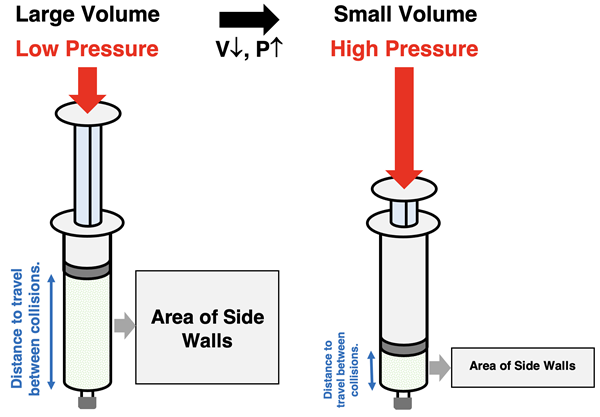
Boyle’s Law Explained by KMT
Boyle’s Law describes the relationship between pressure and volume for a sample of gas held at a constant temperature and number of moles. The law states that the pressure and volume are inversely proportional. As the volume of a sample of gas decreases, the pressure is observed to increase. How is this pattern explained using KMT?

Pressure is the result of particles colliding with the container walls and applying force to the walls. Mathematically, pressure is the ratio of the cummulative amount of force per surface area of the container. Two factors contribute to the increase in pressure as the volume decreases. The first factor is that the surface area of the container decreases. The second factor is that collisions occur more frequently in a smaller container. In a smaller container, the distance from one side of the container to the other is shorter and a particle will travel from one wall to the other wall in less time. This results in a higher collision frequency and more cummulative force on the wall. By decreasing area and increasing force, there will be an increase in pressure.
Gay Lussac’s or Amontons’ Law Explained by KMT
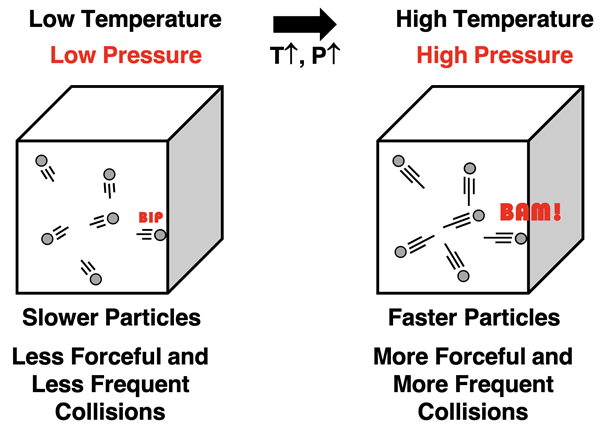
Gay Lussac’s Law (a.k.a., Amontons’ Law) describes the relationship between pressure and Kelvin temperature for a sample of gas held at a constant volume and number of moles. The law states that the pressure and temperature are directly proportional. As the Kelvin temperature of a sample of gas increases, the pressure is observed to increase. How is this pattern explained using KMT?
One of the postulates or assumptions of kinetic molecular theory is that the average kinetic energy of particles is directly proportional to the Kelvin temperature. So if the temperature is increased, particles move with a greater kinetic energy. The kinetic energy is the energy of motion and dependent upon particle speed. So at higher temperatures, particles are moving faster. This impacts the pressure for two reasons. Faster particles will have more forceful collisions with the container walls. And faster particles will have more frequent collisions with container walls since they travel from wall to wall in less time. Both of these factors increase the amount of force upon the container walls. With the volume held constant, there is no change in surface area of the walls. Since pressure is directly related to the force on the wall, an increase in Kelvin temperature causes an increase in pressure.
Charles’ Law Explained by KMT
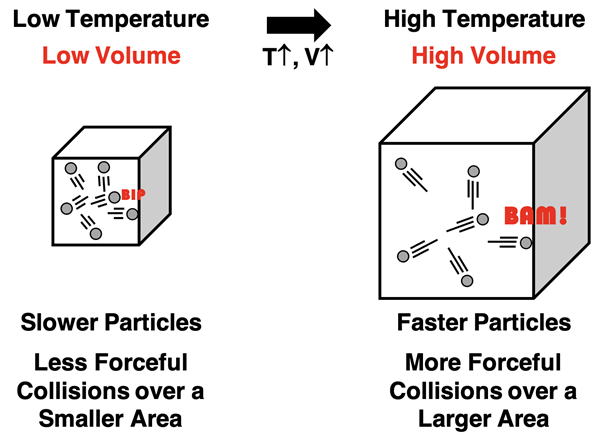
Charles’ Law describes the relationship between volume and Kelvin temperature for a sample of gas held at a constant pressure and number of moles. The law states that the volume and temperature are directly proportional. As the Kelvin temperature of a sample of gas increases, the volume is observed to increase. How is this pattern explained using KMT?
We begin again with the assumption that the average kinetic energy of particles is directly proportional to the Kelvin temperature. So if the temperature is increased, particles move with a greater kinetic energy. That is, they move faster at higher temperatures and have more forceful collisions with the container walls. Based on the Pressure-Force-Area relationship (equation at right), more force would result in more pressure. But Charles’ law is based on constant pressure conditions. The only way for that the pressure could stay constant is if the container expands in volume and its walls be of greater area. With more forceful collisions on walls that have a greater area, the pressure can remain constant. Thus at a constant pressure, an increase in Kelvin temperature leads to an increase in volume.
Avogadro’s Law Explained by KMT
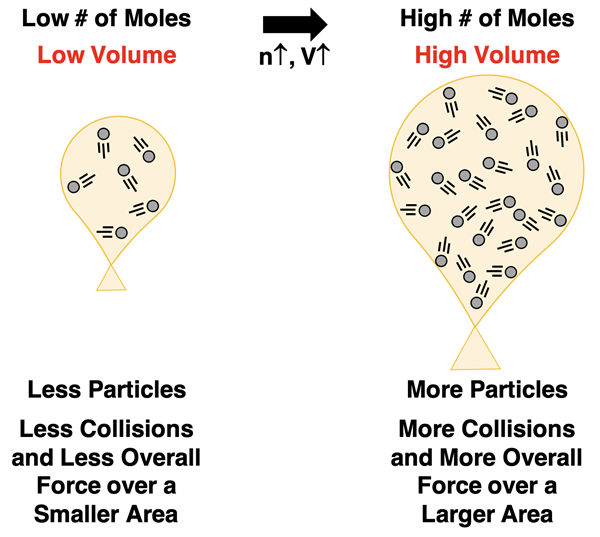
Avogadro’s Law describes the relationship between volume and number of moles for a sample of gas held at a constant pressure and temperature. The law states that the volume and number of moles of gas are directly proportional. As the number of moles of gas particles increases, the volume of the gas is observed to increase. How is this pattern explained using KMT?
We begin with the definition of pressure as the force per area. Each collision that occurs between a gas particle and the container wall contributes to the force on the container walls. With more particles of gas in the container, collisions occur more frequently and resut in a greater amount of force. But Avogadro’s law includes the restriction that the pressure remains constant. The only means by which the pressure can remain constant when the force increases is for the area to increase proportionally. Thus, the container volume increases. This increases the area of the container and maintains a constant pressure.
Conlusion
The Kinetic Molecular Theory (KMT) provides a simple model of gas particles that explains the relationship between state variables for an ideal gas. The foundation of the theory are five postulates or assumptions about particles of an ideal gas. But what if one or more of those assumptions turned out to be quite contrary to reality. For instance, what if particles did exert attractive forces upon one another as they move about the container? Or what if the particles of a gas weren’t points in space but had a finite volume? These questions will be explored on our final page of Lesson 4 as we discuss the limitations of the Kinetic Molecular Theory.
Before You Leave - Practice and Reinforcement
Now that you've done the reading, take some time to strengthen your understanding and to put the ideas into practice. Here's some suggestions.
- Download our Study Card on Kinetic Molecular Theory. Save it to a safe location and use it as a review tool.
- The Check Your Understanding section below includes questions with answers and explanations. It provides a great chance to self-assess your understanding.
Check Your Understanding of Kinetic Molecular Theory
Use the following questions to assess your understanding. Tap the Check Answer buttons when ready.
1. Identify the effect that the following changes would have upon the force of the collision of a single ideal gas particle with a container wall. Choose increase collision force, decrease collision force, or no effect upon the collision force.
- Increasing the temperature (constant V and n)
Check Answer
Answer: Increase Force
Increasing the temperature increaseses the average kinetic energy of particles. They will thus collide more energetically with the container walls and exert more force upon the container.
- Increasing the volume (constant T and n)
Check Answer
Answer: No Effect upon Force
The force of a single collision is not affected by the container volume. It is only affected by the temperature of the container. Temperature affects the average kinetic energy of particles. This in turn affects the average force a particle exerts upon the container wall at the time of the collision.
- Increasing the number of particles (constant V and T)
Check Answer
Answer: No Effect on Force
The force of a single collision is not affected by the number of particles in the container. It is only affected by the temperature of the container. Temperature affects the average kinetic energy of particles. This in turn affects the average force a particle exerts upon the container wall at the time of the collision. Increasing the number of particles does increase the frequency of collisions and thus the overall amount of force ... but not the force of a single collision as worded in this question.
- Changing the gas from CH4 to O2.
Check Answer
Answer: No Effect on Force
The force of a single collision is not affected by the type of particle that is colliding with the wall (at least not on average). The force of a collision is only affected by the temperature of the container. Temperature affects the average kinetic energy of particles. This in turn affects the average force a particle exerts upon the container wall at the time of the collision. Confusing the situation is the fact that two different gas partciles at the same temperature will have the save average kinetic energy while the less massive gas particles have the greater average speed. So the CH4 gas particles would be moving faster than the O2 gas particle. However, since kinetic energy depends on both mass and speed, both gas particles have the same kinetic energy.
2. Identify the effect that the following changes would have upon the frequency of the collisions of ideal gas particles with a container wall. Choose increase collision frequency, decrease collision frequency, or no effect upon the collision frequency.
- Increasing the temperature (constant V and n)
Check Answer
Answer: Increases Collision Frequency
Increasing the temperature causes gas particles to move with a greater average speed. This greater average speed allows them to move from one side of the container to the other side at a higher speed. Since they would reach the other side in less time, there would be a smaller time interval for any single partile between collisions (on average). This means that the collision frequency increases.
- Increasing the volume (constant T and n)
Check Answer
Answer: Decreases Collision Frequency
As the volume is increased, the distance between the container walls at their opposite ends would increase as well. With more distance for the particle to travel between collisions with opposite walls (and adjoining walls), the average time interval between collisions will increase. This in turn causes the collision frequency to decrease.
- Increasing the number of particles (constant V and T)
Check Answer
Answer: Increases Collision Frequency
Collision frequency refers to how often collisions between particles and container walls occur. If more particles are added to the container, then the probablility that one of them would at any moment be undergoing a collision with a container wall increases. Imagine one particle in the container. It would hit one wall, travel to another wall and hit it, and so on. But if there are 100 particles in the container, while one particle is traveling between walls, there's likely another particle or two or three that is in the process of having a collision. More particles means a greater collision frequency.
3. Identify the effect that the following changes would have upon the pressure of an ideal gas. Choose increase pressure, decrease pressure, or no effect upon the pressure.
- Increasing the temperature (constant V and n)
Check Answer
Answer: Increases the Pressure
Increasing the temperature increases the cumulative amount of force of collisions. Collision on average occur with more force on the wall (due to the greater kinetic energy) and collisions occur more frequently since particles travel from wall to wall in less time.
- Increasing the volume (constant T and n)
Check Answer
Answer: Decreases the Pressure
In a larger container, particles collide less frequently because there is (on average) a large distance to travel between collisions. And the area of the container walls increases. Both factors cause the force-to-area ratio to decrease.
- Increasing the number of particles (constant V and T)
Check Answer
Answer: Increases the Pressure
With more particles in the container, the collision frequency increases. This means the total force on the container wall increases and the force-to-area ratio increases.
- Changing the gas from CH4 to O2.
Check Answer
Answer: No Change in Pressure
For an ideal gas, changing the identity of the particle never affects any of the state variables.
4. Identify the effect that the following changes would have upon the average speed at which an ideal gas particle moves about the container. Choose increase speed, decrease speed, or no effect upon the speed.
- Increasing the temperature (constant V and n)
Check Answer
Answer: Increases the Average Speed
The average kinetic energy of particles in a gas sample is directly proportional to the Kelvin temperature. Higher temperatures result in a higher kinetic energy value (on average). The kinetic energy is the energy of motion and depends on particle mass (m) and particle speed (v). A higher temperature means a higher kinetic energy and partciles moving with a higher speed (on average).
- Increasing the volume (constant T and n)
Check Answer
Answer: No Effect on Average Speed
The average speed is related to the average kinetic energy of the particles in a sample. The only way to impact the average kinetic energy is to change the Kelvin temperature. Changing the volume will not have such an effect.
- Increasing the number of particles (constant V and T)
Check Answer
Answer: No Effect on Average Speed
The average speed is related to the average kinetic energy of the particles in a sample. The only way to impact the average kinetic energy is to change the Kelvin temperature. Changing the numer of particles will not have such an effect.
- Changing the gas from CH4 to O2.
Check Answer
Answer: Decreases the Average Speed
Now this one might surprise you. Here's the logic: The average kinetic energy of particles in a gas sample is directly proportional to the Kelvin temperature. Higher temperatures result in a higher kinetic energy value (on average). The kinetic energy is (KE) the energy of motion and depends on particle mass (m) and particle speed (v). The equation is KE = 0.5•m•v2. At the same temperature, two different gas particles would have the same average kinetic energy. But since both mass and speed is involved in the equation, the more massive particle has the lower average speed. O2 has more mass (32.0 g/mol) than CH4 (16 g/mol).